Peromyscus truei
Pinyon Mouse
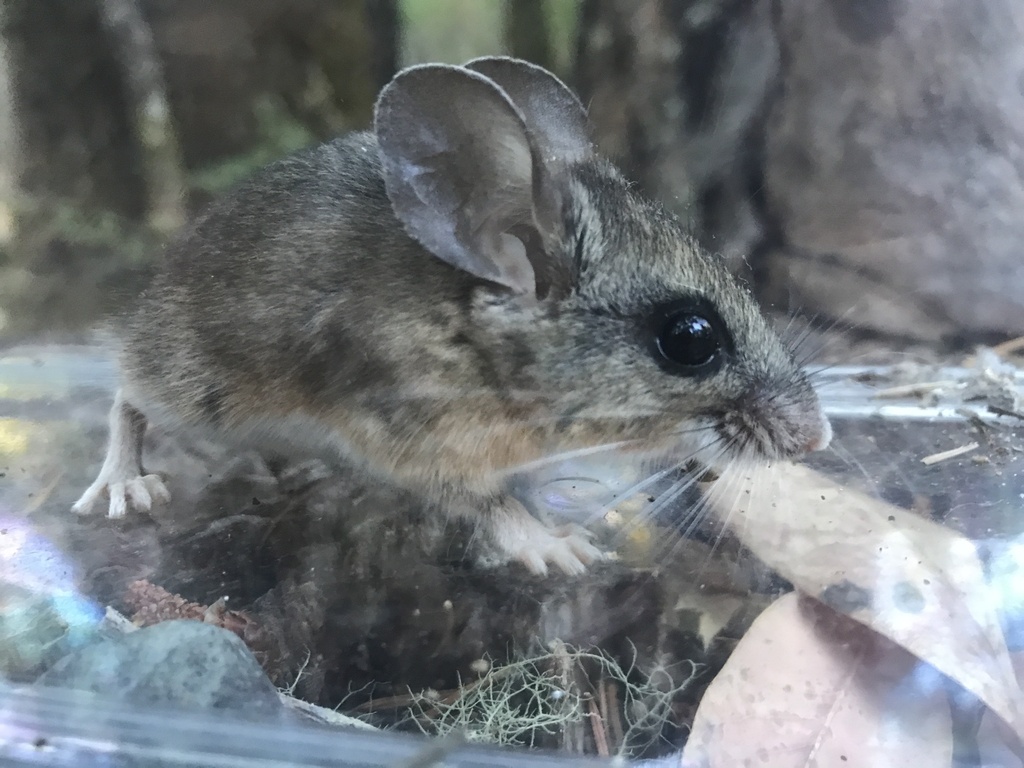
(c) Lee Cain, some rights reserved (CC BY) · licence
Family: Cricetidae · Class: Mammalia · Order: Rodentia
Peromyscus truei (Pinyon Mouse) is a California animal in the Cricetidae family.
The pinyon mouse is a small rodent species endemic to the western United States, with populations extending into California's eastern desert regions. Adults typically measure 160 to 220 millimeters (6.3 to 8.7 inches) in total length, including a tail that comprises roughly half the body length. The dorsal pelage is grayish-brown to buff-colored, while the ventral surface is white or pale gray. The ears are relatively large and prominent, measuring 15 to 22 millimeters (0.6 to 0.9 inches). The tail is distinctly bicolored, dark above and light below, and is well-furred with a prominent tuft at the tip. In California, the pinyon mouse occurs primarily in the eastern Sierra Nevada, White Mountains, and Inyo Mountains of Mono and Inyo counties. The species' range extends eastward through Nevada, Utah, Arizona, and small portions of Colorado and New Mexico. California represents the western edge of the species' distribution, with populations documented at elevations ranging from 1,200 to 3,400 meters (3,900 to 11,200 feet). Pinyon mice inhabit pinyon-juniper woodlands, characterized by scattered Pinus monophylla (single-leaf pinyon pine) and various juniper species. The species also occurs in adjacent sagebrush scrub and mountain mahogany communities. Rocky outcrops, talus slopes, and cliff faces provide essential denning sites, with individuals constructing nests in crevices and caves. The species shows strong preference for areas with complex topography that offer numerous hiding places and vertical escape routes. This primarily nocturnal species exhibits excellent climbing abilities, using its semi-prehensile tail for balance while navigating rocky terrain and vegetation. The diet consists mainly of pinyon pine seeds, which are cached for winter consumption, along with juniper berries, green vegetation, and occasionally insects. Breeding typically occurs from March through September, with females producing one to three litters annually. Litter size ranges from two to six young, with an average of four. The gestation period is approximately 23 to 27 days. Young become independent at four to five weeks of age and reach sexual maturity by three months. Currently, the pinyon mouse holds no federal or state conservation listing status. However, the species faces potential threats from habitat fragmentation due to development, altered fire regimes, and climate change impacts on pinyon-juniper ecosystems. Prolonged drought conditions can affect seed production of pinyon pines, potentially impacting food availability. Additionally, expansion of exotic plant species and livestock grazing may degrade habitat quality in some areas. Population monitoring data for California populations is limited, making it difficult to assess long-term trends. The species' dependence on pinyon-juniper woodlands, which are considered sensitive ecosystems in the Great Basin region, suggests that habitat conservation efforts would benefit pinyon mouse populations throughout their range.
Classification
Class: Mammalia · Order: Rodentia · Family: Cricetidae
Frequently asked questions
How is Peromyscus truei classified?
Peromyscus truei belongs to class Mammalia, order Rodentia, family Cricetidae.
What family does Peromyscus truei belong to?
Peromyscus truei is in the Cricetidae family.
What is Peromyscus truei?
The pinyon mouse is a small rodent species endemic to the western United States, with populations extending into California's eastern desert regions.
Is Peromyscus truei found in California?
Yes. Peromyscus truei is recorded in California in The California Species Project's catalogue.
Related species
Other California species in the same genus, family, or bioregion.
Data from The California Species Project — 14,000+ California species with verified data from CNPS, CDFW, USFWS, and more.