Petrochelidon fulva
Cave Swallow
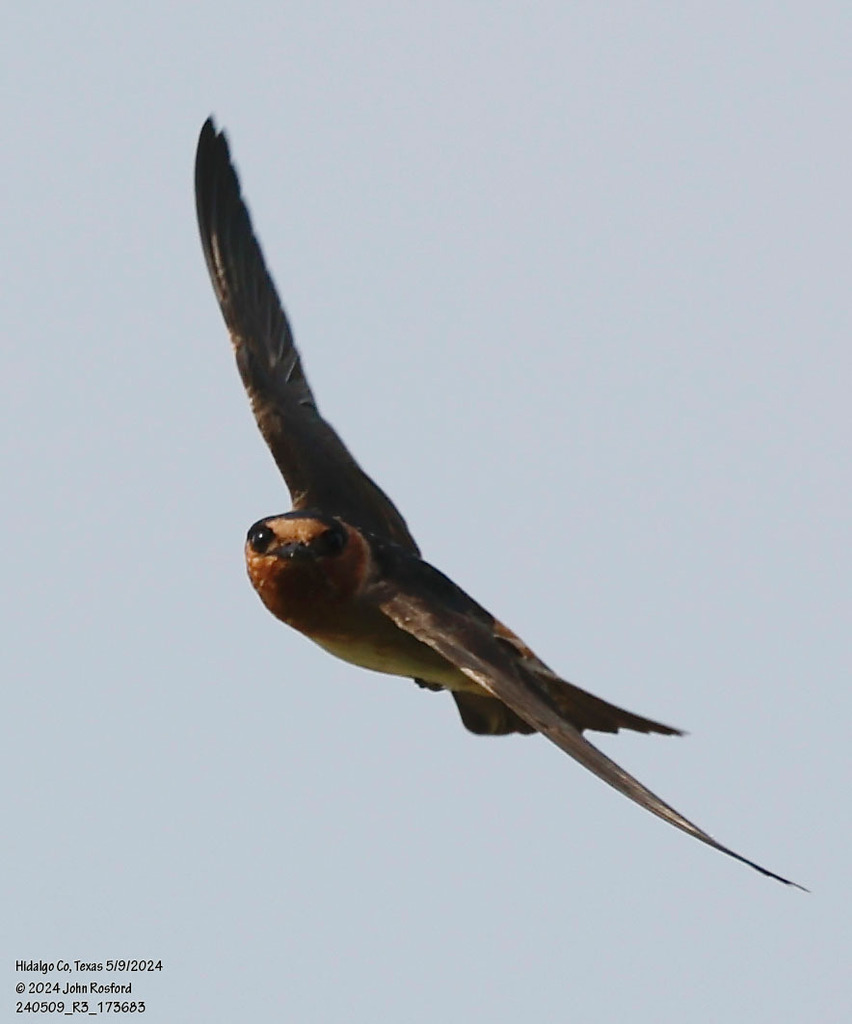
(c) John Rosford, some rights reserved (CC BY) · licence
Family: Hirundinidae · Class: Aves · Order: Passeriformes
Petrochelidon fulva (Cave Swallow) is a California animal in the Hirundinidae family.
The Cave Swallow is a medium-sized aerial insectivore measuring 12 to 14 cm (4.7 to 5.5 inches) in length with a wingspan of 27 to 30 cm (10.6 to 11.8 inches). Adults weigh approximately 19 to 20 grams. The species displays a distinctive rufous or cinnamon-colored rump and forehead, contrasting with a dark blue-black crown, back, and wings. The throat and underparts are pale buff to whitish, with a dark collar across the upper chest. The tail is moderately forked, less deeply than in Barn Swallows, and the wings are relatively broad and pointed for sustained flight. Cave Swallows have expanded their range significantly in recent decades. Originally restricted to caves and sinkholes in Texas, New Mexico, and Mexico, the species has colonized much of the southern United States. In California, Cave Swallows first appeared as vagrants in the 1980s and have since established small breeding populations, primarily in the southern counties including San Diego, Imperial, and Riverside. The species also occurs along the Gulf Coast from Texas to Florida, with isolated populations in the Caribbean and Mexico. The species exhibits flexibility in nesting habitat selection. While historically dependent on natural caves, limestone caverns, and cliff overhangs, Cave Swallows now commonly nest under highway overpasses, bridges, culverts, and building eaves. They construct gourd-shaped mud nests with tubular entrances, typically placed on vertical or overhanging surfaces. Foraging occurs over open areas including agricultural fields, wetlands, and urban environments where aerial insects are abundant. Cave Swallows are highly social, often nesting in colonies ranging from a few pairs to several hundred individuals. They feed exclusively on flying insects captured during aerial foraging, including flies, beetles, flying ants, and termites. The breeding season extends from March through August, with pairs capable of producing multiple broods. Females lay 3 to 5 glossy white eggs with brown spots, incubated for 15 to 16 days. Young fledge after 22 to 24 days but may return to the nest for several days. The species migrates to Central and South America during winter months. Cave Swallows are not federally or state listed in California. The species is considered secure globally with populations appearing stable or increasing in most regions. The North American Breeding Bird Survey indicates population growth of approximately 3.5 percent annually from 1966 to 2019. Primary conservation concerns include potential impacts from bridge and culvert maintenance activities that could destroy nesting colonies, and pesticide use that reduces insect prey availability. Climate change may affect insect abundance and distribution, potentially influencing foraging success and breeding productivity.
Classification
Class: Aves · Order: Passeriformes · Family: Hirundinidae
Frequently asked questions
How is Petrochelidon fulva classified?
Petrochelidon fulva belongs to class Aves, order Passeriformes, family Hirundinidae.
What family does Petrochelidon fulva belong to?
Petrochelidon fulva is in the Hirundinidae family.
What is Petrochelidon fulva?
The Cave Swallow is a medium-sized aerial insectivore measuring 12 to 14 cm (4.7 to 5.5 inches) in length with a wingspan of 27 to 30 cm (10.6 to 11.8 inches).
Is Petrochelidon fulva found in California?
Yes. Petrochelidon fulva is recorded in California in The California Species Project's catalogue.
Related species
Other California species in the same genus, family, or bioregion.
Data from The California Species Project — 14,000+ California species with verified data from CNPS, CDFW, USFWS, and more.