Petrochelidon pyrrhonota
Cliff Swallow
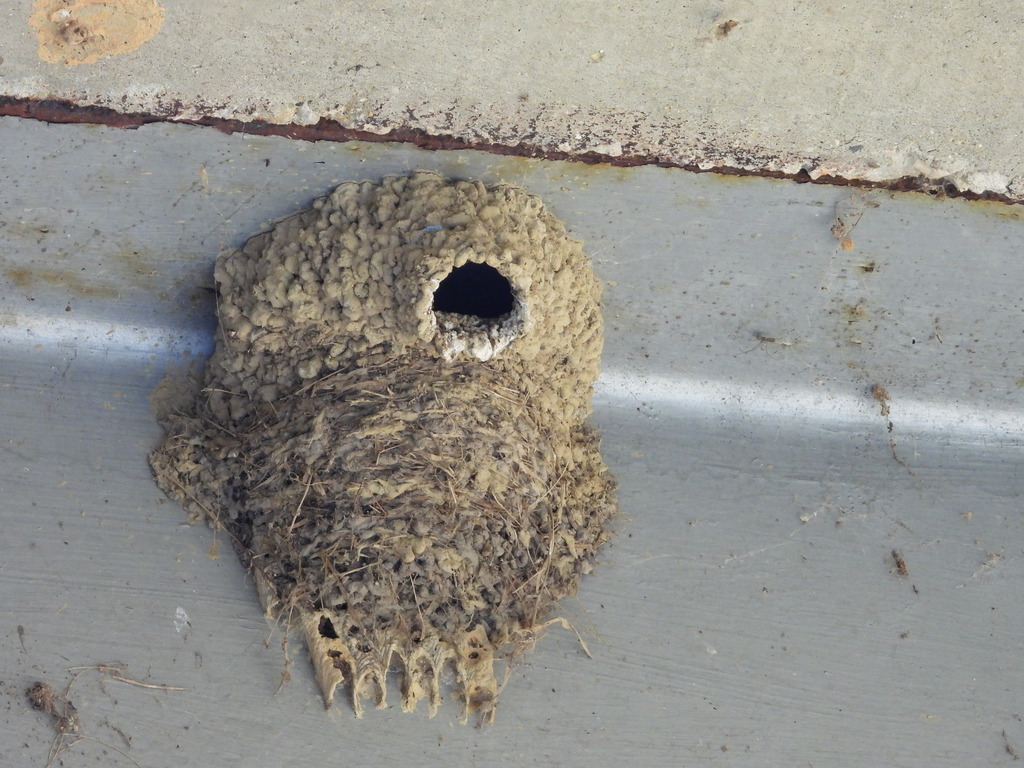
(c) Anna Hess, some rights reserved (CC BY) · licence
Family: Hirundinidae · Class: Aves · Order: Passeriformes
Petrochelidon pyrrhonota (Cliff Swallow) is a California animal in the Hirundinidae family.
The Cliff Swallow is a medium-sized aerial insectivore measuring 13 to 14 cm (5.1 to 5.5 inches) in length with a wingspan of 28 to 30 cm (11 to 12 inches). Adults weigh 18 to 30 grams. The species exhibits distinctive coloration with a dark blue-black back and wings, rusty-orange rump, pale buff forehead, and whitish underparts. The throat displays a dark chestnut patch, and the tail is nearly square with a slight notch. Juveniles show duller plumage with less distinct markings and darker foreheads. Cliff Swallows breed across most of North America from southern Alaska to central Mexico. In California, the species occurs throughout the state during breeding season, from sea level to elevations exceeding 2,700 meters (8,900 feet). Historical breeding colonies were documented in all 58 counties. The species is migratory, wintering primarily in South America from Brazil to Argentina, with migration occurring along Pacific and inland flyways. Breeding habitat consists of areas near vertical cliff faces, rock outcrops, building eaves, bridges, and culverts that provide suitable nesting substrate. Colonies require proximity to mud sources for nest construction and open areas for foraging. Natural sites include canyon walls, coastal bluffs, and rocky gorges. Artificial structures such as highway overpasses, barns, and building overhangs increasingly serve as nesting sites. Foraging occurs over open water, agricultural fields, grasslands, and urban areas. Cliff Swallows are highly social, nesting in colonies ranging from a few pairs to several thousand individuals. They construct gourd-shaped mud nests attached to vertical surfaces, with entrance holes on the side. Breeding occurs from April through August, varying by elevation and latitude. Females lay 3 to 5 white eggs spotted with brown and gray. Incubation lasts 14 to 16 days, and nestlings fledge after 21 to 24 days. The species typically produces one brood per year, occasionally two in favorable conditions. Diet consists entirely of flying insects captured during aerial foraging, including flies, beetles, flying ants, and mosquitoes. The Cliff Swallow is not federally or state listed and maintains stable populations across most of its range. According to the North American Breeding Bird Survey, populations have shown slight increases since 1970, though regional variations exist. Some local declines have been attributed to habitat loss from bridge modifications and building renovations that remove nesting sites. Climate change may affect insect prey availability and alter migration timing. The species benefits from nest site protection under the Migratory Bird Treaty Act, which prohibits destruction of active nests. Conservation efforts focus on maintaining suitable nesting habitat and timing construction activities to avoid breeding seasons.
Classification
Class: Aves · Order: Passeriformes · Family: Hirundinidae
Frequently asked questions
How is Petrochelidon pyrrhonota classified?
Petrochelidon pyrrhonota belongs to class Aves, order Passeriformes, family Hirundinidae.
What family does Petrochelidon pyrrhonota belong to?
Petrochelidon pyrrhonota is in the Hirundinidae family.
What is Petrochelidon pyrrhonota?
The Cliff Swallow is a medium-sized aerial insectivore measuring 13 to 14 cm (5.1 to 5.5 inches) in length with a wingspan of 28 to 30 cm (11 to 12 inches).
Is Petrochelidon pyrrhonota found in California?
Yes. Petrochelidon pyrrhonota is recorded in California in The California Species Project's catalogue.
Related species
Other California species in the same genus, family, or bioregion.
Data from The California Species Project — 14,000+ California species with verified data from CNPS, CDFW, USFWS, and more.