Petrosaurus mearnsi
Banded Rock Lizard
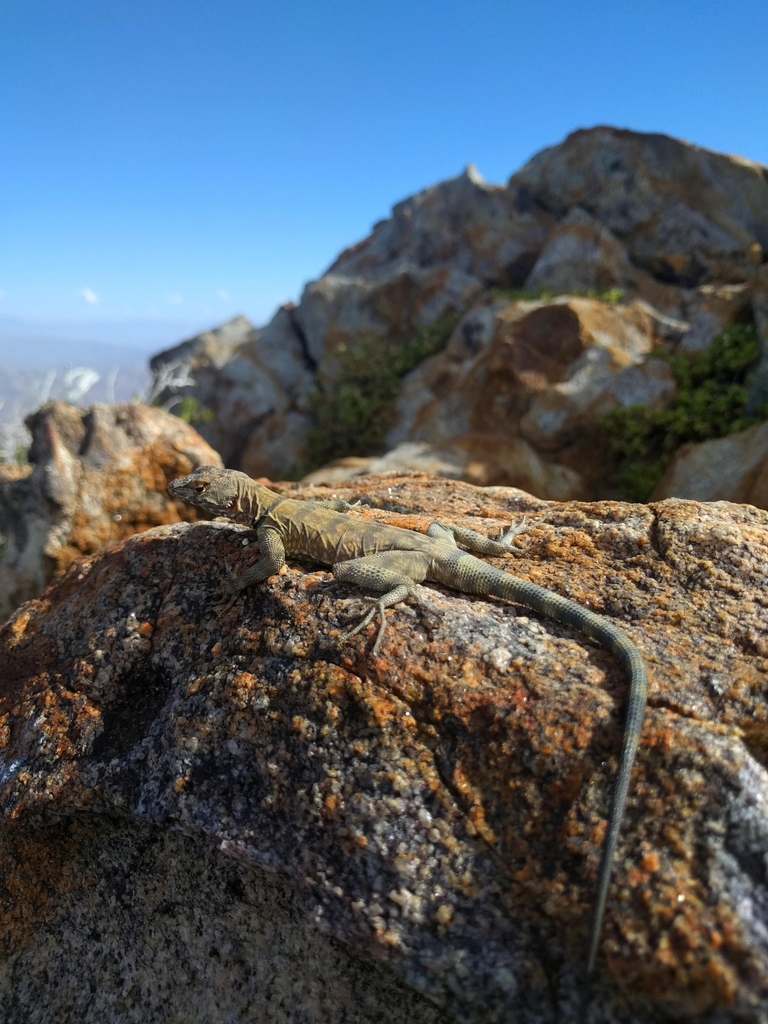
(c) Matthew Zarzeka, some rights reserved (CC BY) · licence
Family: Phrynosomatidae · Class: Reptilia · Order: Squamata
Petrosaurus mearnsi (Banded Rock Lizard) is a California animal in the Phrynosomatidae family.
The banded rock lizard (Petrosaurus mearnsi), also known as Mearns' rock lizard, is a medium-sized lizard species in the family Phrynosomatidae. Adults typically measure 64 to 95 millimeters (2.5 to 3.7 inches) in snout-to-vent length, with a total length including the tail reaching 200 to 250 millimeters (7.9 to 9.8 inches). The species displays distinct sexual dimorphism in coloration. Males exhibit a bright blue throat and belly, often with orange or yellow coloration on the sides of the head and body. Females and juveniles are more subdued, displaying gray to brown dorsal coloration with darker banding patterns across the back and tail. Both sexes possess keeled scales that give the skin a rough texture, and the tail shows pronounced dark banding that gives the species its common name. The banded rock lizard is endemic to southern California and Baja California, Mexico. In California, the species occurs in San Diego and Imperial counties, with populations documented in the Peninsular Ranges including the Laguna Mountains, Cuyamaca Mountains, and areas extending south toward the Mexican border. The species also occurs in the desert regions of eastern San Diego County and western Imperial County. Historical records indicate the species was more widely distributed, but current populations are fragmented across suitable habitat patches. This species inhabits rocky outcrops, boulder fields, and cliff faces in both chaparral and desert environments. Elevations range from approximately 150 meters (492 feet) in desert regions to over 1,500 meters (4,921 feet) in montane areas. The lizards show strong site fidelity to specific rock formations, utilizing crevices and spaces between boulders for shelter and thermoregulation. Preferred habitats include granite boulder piles, metamorphic rock formations, and areas with southern or western exposures that provide optimal thermal conditions. Banded rock lizards are primarily insectivorous, feeding on a variety of arthropods including beetles, ants, spiders, and small moths. They are sit-and-wait predators that position themselves on prominent rocks to scan for prey and potential threats. The species is oviparous, with females depositing clutches of 2 to 5 eggs in soil or sand beneath rocks during late spring and early summer. Eggs incubate for approximately 60 to 70 days, with hatchlings emerging in late summer. Adults are active during daylight hours and exhibit complex thermoregulatory behaviors, moving between sun and shade to maintain optimal body temperatures. During winter months, individuals become inactive and shelter in deep rock crevices. Currently, the banded rock lizard does not hold federal or state listing status, though local populations face pressure from habitat fragmentation and urban development. Primary threats include residential and commercial development in suitable rocky habitat areas, recreational activities that disturb nesting sites, and invasive plant species that alter microhabitat conditions. Climate change may pose additional challenges through altered precipitation patterns and increased temperatures that could affect thermal refugia. Conservation efforts focus on habitat protection through land use planning and monitoring of key population sites to assess long-term population trends.
Classification
Class: Reptilia · Order: Squamata · Family: Phrynosomatidae
Frequently asked questions
How is Petrosaurus mearnsi classified?
Petrosaurus mearnsi belongs to class Reptilia, order Squamata, family Phrynosomatidae.
What family does Petrosaurus mearnsi belong to?
Petrosaurus mearnsi is in the Phrynosomatidae family.
What is Petrosaurus mearnsi?
The banded rock lizard (Petrosaurus mearnsi), also known as Mearns' rock lizard, is a medium-sized lizard species in the family Phrynosomatidae.
Is Petrosaurus mearnsi found in California?
Yes. Petrosaurus mearnsi is recorded in California in The California Species Project's catalogue.
Related species
Other California species in the same genus, family, or bioregion.
Data from The California Species Project — 14,000+ California species with verified data from CNPS, CDFW, USFWS, and more.