Peucaea cassinii
Cassin's Sparrow
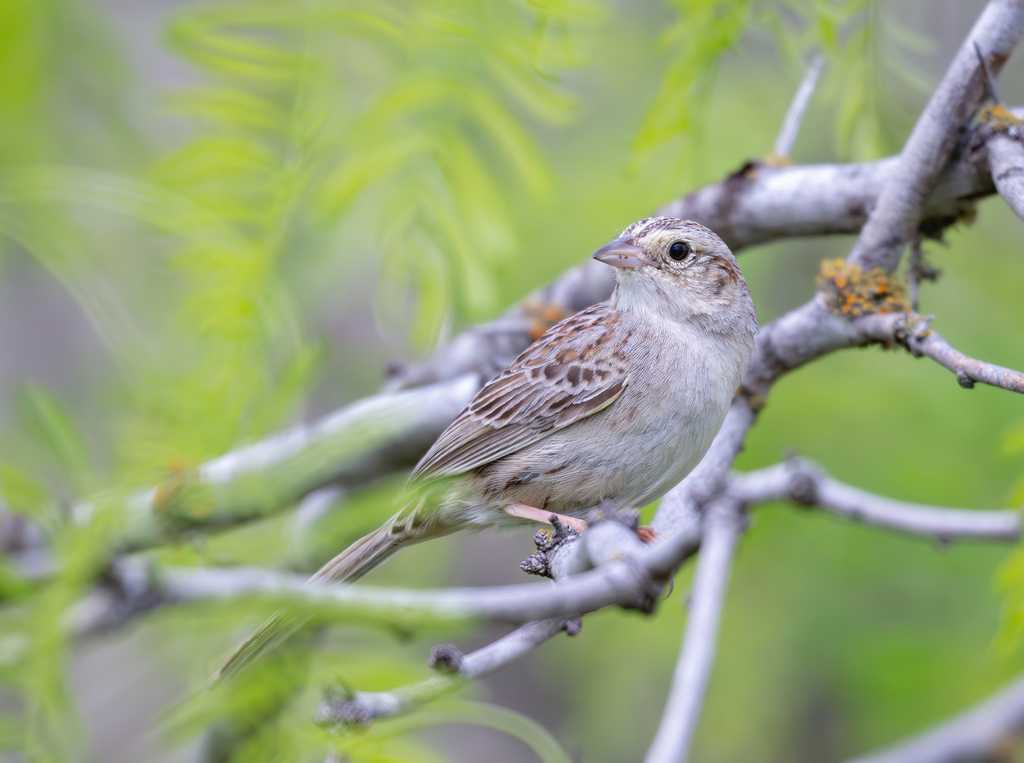
(c) Karen Szafrajda, some rights reserved (CC BY) · licence
Family: Passerellidae · Class: Aves · Order: Passeriformes
Peucaea cassinii (Cassin's Sparrow) is a California animal in the Passerellidae family.
Cassin's Sparrow is a medium-sized passerine measuring 14-15 cm (5.5-5.9 inches) in length with a wingspan of 18-20 cm (7.1-7.9 inches). Adults weigh 17-20 grams. The species exhibits subtle gray-brown plumage with darker streaking on the back and crown. The underparts are pale gray to whitish with minimal markings. A faint whitish eye-ring and pale supercilium provide modest contrast against the brownish-gray head. The bill is pale with a dark culmen, and the legs are pinkish-brown. Juveniles appear more heavily streaked below than adults. Cassin's Sparrow breeds across the south-central Great Plains from southeastern Colorado and southwestern Kansas south through eastern New Mexico, western Texas, and into north-central Mexico. The species is largely absent from California as a breeding bird, with only occasional vagrant records documented in the state's desert regions, primarily in the Mojave Desert and southeastern Imperial County. During winter, populations retreat southward to Texas, New Mexico, and Mexico. The species inhabits arid grasslands, desert grasslands, and shrublands characterized by scattered shrubs and sparse grass cover. Preferred elevations range from 600 to 1,800 meters (1,970 to 5,910 feet). Cassin's Sparrow favors areas with 10-30% shrub cover, particularly where four-wing saltbush, mesquite, and yucca are present. The species requires open areas for foraging combined with shrub perches for singing and nesting. Habitat typically receives 250-400 mm (10-16 inches) of annual precipitation. Cassin's Sparrow feeds primarily on seeds from grasses and forbs, supplemented with insects during the breeding season. Common food items include seeds from grama grass, three-awn grass, and various forbs. Insects consumed include beetles, caterpillars, and grasshoppers, which provide essential protein for nestlings. The species employs a unique courtship flight called 'skylarking,' where males ascend 6-9 meters (20-30 feet) while singing, then flutter down with wings and tail spread. Breeding occurs from April through August, with peak activity in May and June. Females construct cup-shaped nests in shrubs or dense grass clumps, typically 0.3-1.5 meters (1-5 feet) above ground. Clutch size ranges from 3-5 eggs, with an incubation period of 11-12 days. Cassin's Sparrow is not federally or state-listed in California, though it is considered a vagrant species within the state. According to Partners in Flight population estimates, the species has experienced moderate declines across its range since 1970, primarily due to habitat conversion from grassland to agriculture and urban development. Overgrazing has degraded native grassland structure in many areas. Climate change poses additional threats through altered precipitation patterns and increased drought frequency in the species' arid habitat. Fire suppression has allowed woody encroachment in some grassland areas, reducing habitat suitability. The species benefits from rotational grazing practices that maintain appropriate grass height and shrub density.
Classification
Class: Aves · Order: Passeriformes · Family: Passerellidae
Frequently asked questions
How is Peucaea cassinii classified?
Peucaea cassinii belongs to class Aves, order Passeriformes, family Passerellidae.
What family does Peucaea cassinii belong to?
Peucaea cassinii is in the Passerellidae family.
What is Peucaea cassinii?
Cassin's Sparrow is a medium-sized passerine measuring 14-15 cm (5.5-5.9 inches) in length with a wingspan of 18-20 cm (7.1-7.9 inches).
Is Peucaea cassinii found in California?
Yes. Peucaea cassinii is recorded in California in The California Species Project's catalogue.
Related species
Other California species in the same genus, family, or bioregion.
Data from The California Species Project — 14,000+ California species with verified data from CNPS, CDFW, USFWS, and more.