Peucetia longipalpis
Lesser Green Lynx Spider
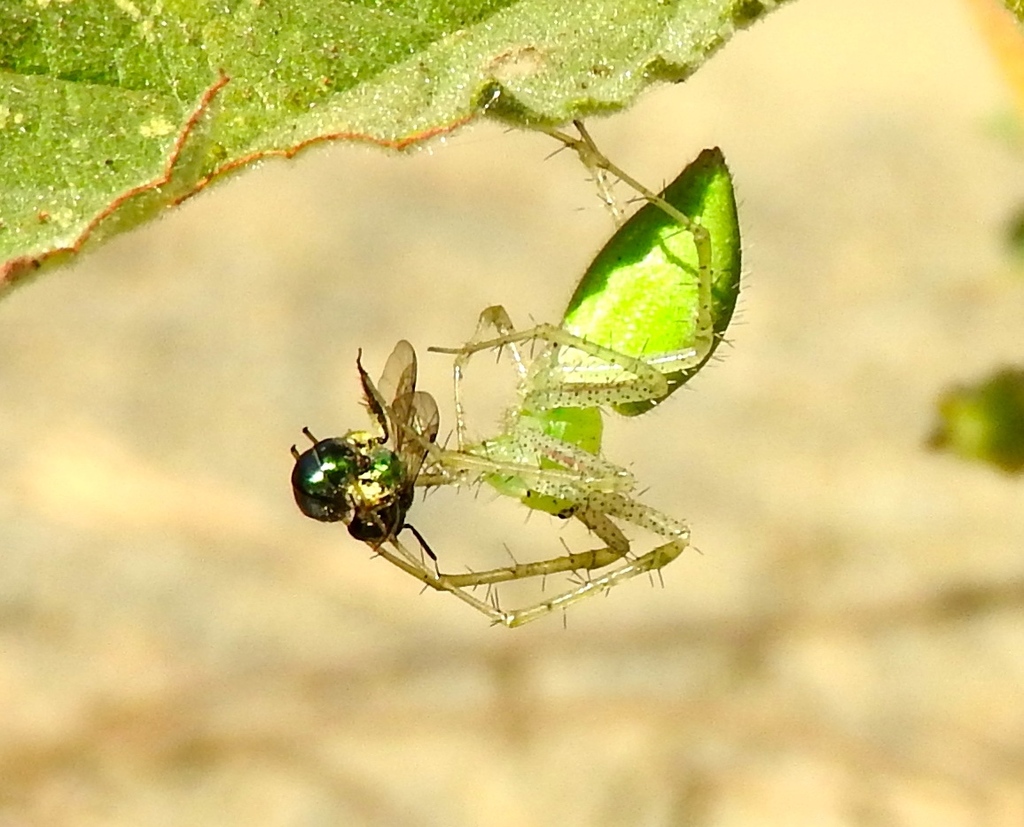
(c) Francisco Farriols Sarabia, some rights reserved (CC BY) · licence
Family: Oxyopidae · Class: Arachnida · Order: Araneae
Peucetia longipalpis (Lesser Green Lynx Spider) is a California animal in the Oxyopidae family.
The Lesser Green Lynx Spider is a medium-sized hunting spider in the family Oxyopidae, distinguished from its larger relative Peucetia viridans by several morphological characteristics. Males of P. longipalpis measure 7 to 12 mm in body length, while females reach 10 to 16 mm, making them notably smaller than P. viridans which can reach 26 mm (Brady 1964). The body is bright green with a narrow, high cephalothorax that broadens posteriorly. Red spots may be present in the eye region and on the body. The legs are proportionally long, pale green to yellow in coloration, and armed with distinctive long black spines and numerous black spots, particularly prominent on the femora. Peucetia longipalpis occurs in the southwestern United States, extending south to British Honduras (Brady 1964). In California, the species has been documented as far north as Fresno and Tuolumne counties, with its range overlapping but generally more restricted than P. viridans. The species inhabits warmer regions where winter temperatures remain moderate, following distribution patterns typical of thermophilic arthropods. This lynx spider occupies diverse plant communities, particularly favoring areas with abundant flowering vegetation. Unlike web-building spiders, P. longipalpis is an active hunter that utilizes its excellent vision and agility to pursue prey across plant surfaces. The species demonstrates exceptional mobility, capable of rapid movement through vegetation and even jumping between branches similar to jumping spiders. These spiders often position themselves near flowers where they ambush visiting insects. As opportunistic predators, Lesser Green Lynx Spiders feed primarily on flying insects including flies, moths, bees, and other small arthropods that visit flowers. Their hunting strategy involves both active pursuit and sit-and-wait ambush tactics. The species exhibits cryptic coloration that provides camouflage among green vegetation. Males can be distinguished from females and from P. viridans by distinctive genitalic characteristics, with the elongated palps referenced in the species name longipalpis being a key diagnostic feature (Brady 1964). Reproductive behavior follows typical lynx spider patterns, with females producing egg sacs that they guard vigilantly. The species appears to have an annual life cycle in most of its range, with adults most commonly observed during warmer months when prey abundance peaks. Currently, P. longipalpis has no formal conservation status at federal or state levels. The species appears to maintain stable populations throughout its range, benefiting from its adaptability to various plant communities and its role as a generalist predator. Climate change may potentially affect distribution patterns, as the species' range appears limited by winter temperature tolerance. Habitat modification and pesticide use in agricultural areas could pose localized threats, though the species' mobility and broad host plant associations likely provide some resilience to environmental changes.
Classification
Class: Arachnida · Order: Araneae · Family: Oxyopidae
Frequently asked questions
How is Peucetia longipalpis classified?
Peucetia longipalpis belongs to class Arachnida, order Araneae, family Oxyopidae.
What family does Peucetia longipalpis belong to?
Peucetia longipalpis is in the Oxyopidae family.
What is Peucetia longipalpis?
The Lesser Green Lynx Spider is a medium-sized hunting spider in the family Oxyopidae, distinguished from its larger relative Peucetia viridans by several morphological characteristics.
Is Peucetia longipalpis found in California?
Yes. Peucetia longipalpis is recorded in California in The California Species Project's catalogue.
Related species
Other California species in the same genus, family, or bioregion.
Data from The California Species Project — 14,000+ California species with verified data from CNPS, CDFW, USFWS, and more.