Peucetia viridans
Green Lynx Spider
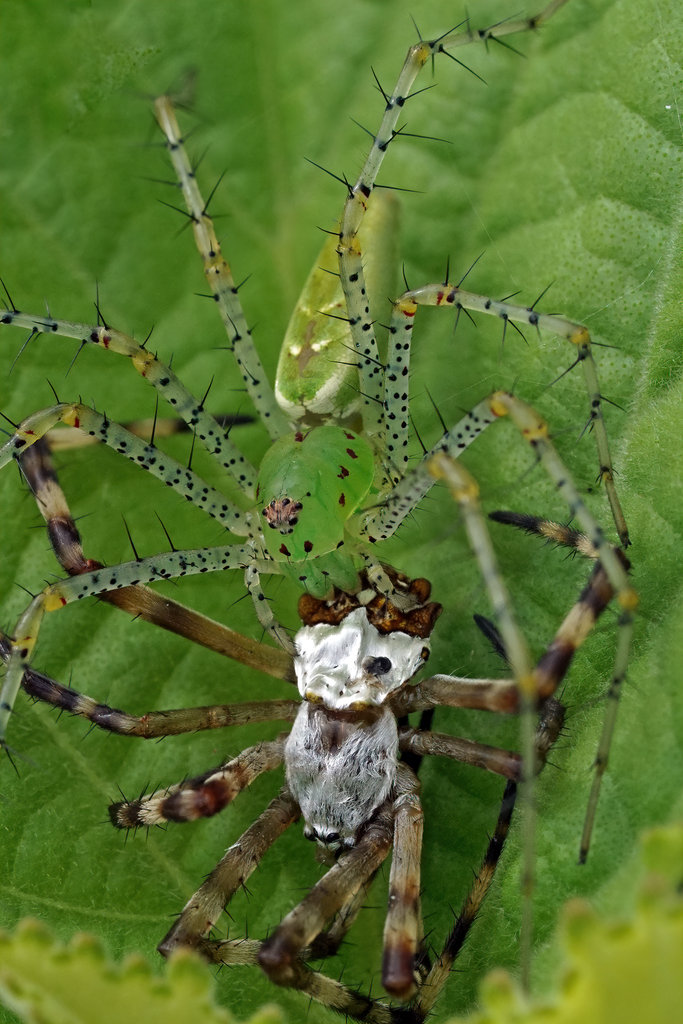
(c) Eridan Xharahi, some rights reserved (CC BY) · licence
Family: Oxyopidae · Class: Arachnida · Order: Araneae
Peucetia viridans (Green Lynx Spider) is a California animal in the Oxyopidae family.
The green lynx spider is a medium-sized hunting spider measuring 12 to 22 millimeters (0.5 to 0.9 inches) in body length, with females typically larger than males. The species displays distinctive bright green coloration with red spots on the abdomen and chevron-shaped markings on the legs. The cephalothorax and abdomen are covered in fine setae, and the legs are notably long and spiny, adapted for grasping prey. Males are generally smaller and may show more pronounced red markings during breeding season. Peucetia viridans occurs throughout much of the southern and western United States, with its California range extending from the Mexican border north to at least Lassen County in the northeastern corner of the state (BugGuide). The species is documented in multiple California counties, with observations recorded year-round but peak activity during summer and fall months. According to BugGuide data, California observations span from February through December, with highest numbers recorded from July through November. Green lynx spiders inhabit a variety of vegetation types, showing preference for flowering plants, shrubs, and low trees. They are commonly found in gardens, agricultural areas, chaparral, and grasslands where they position themselves on flowers and foliage to ambush prey. The species shows particular association with plants that attract flying insects, including various wildflowers and crop plants. Unlike web-building spiders, green lynx spiders are active hunters that rely on their excellent vision and agility. This species is a visual predator that stalks and captures prey using keen eyesight and rapid movements (Xerces Society). Green lynx spiders feed primarily on flying insects including flies, bees, wasps, and moths, making them beneficial predators in agricultural settings. Mating occurs in late summer and fall, with females producing one to three egg sacs containing 25 to 600 eggs each. Females guard their egg sacs and newly hatched spiderlings. The species overwinters as juveniles in warmer climates, reaching maturity the following year. Adults can live for approximately one year. The green lynx spider currently holds no special conservation status and is considered secure throughout its range, with NatureServe ranking it as G5 (Globally Secure). Populations appear stable across California and the broader southwestern United States. The species benefits from its adaptability to human-modified environments and its role as a beneficial predator in agricultural systems. Climate change may affect distribution patterns, particularly at northern range limits, but the species' broad habitat tolerance suggests resilience to environmental changes. Agricultural practices that reduce pesticide use may benefit populations, as green lynx spiders provide natural pest control services in crop systems.
Classification
Class: Arachnida · Order: Araneae · Family: Oxyopidae
Frequently asked questions
How is Peucetia viridans classified?
Peucetia viridans belongs to class Arachnida, order Araneae, family Oxyopidae.
What family does Peucetia viridans belong to?
Peucetia viridans is in the Oxyopidae family.
What is Peucetia viridans?
The green lynx spider is a medium-sized hunting spider measuring 12 to 22 millimeters (0.5 to 0.9 inches) in body length, with females typically larger than males.
Is Peucetia viridans found in California?
Yes. Peucetia viridans is recorded in California in The California Species Project's catalogue.
Related species
Other California species in the same genus, family, or bioregion.
Data from The California Species Project — 14,000+ California species with verified data from CNPS, CDFW, USFWS, and more.