Phacellophora camtschatica
Egg-yolk Jelly
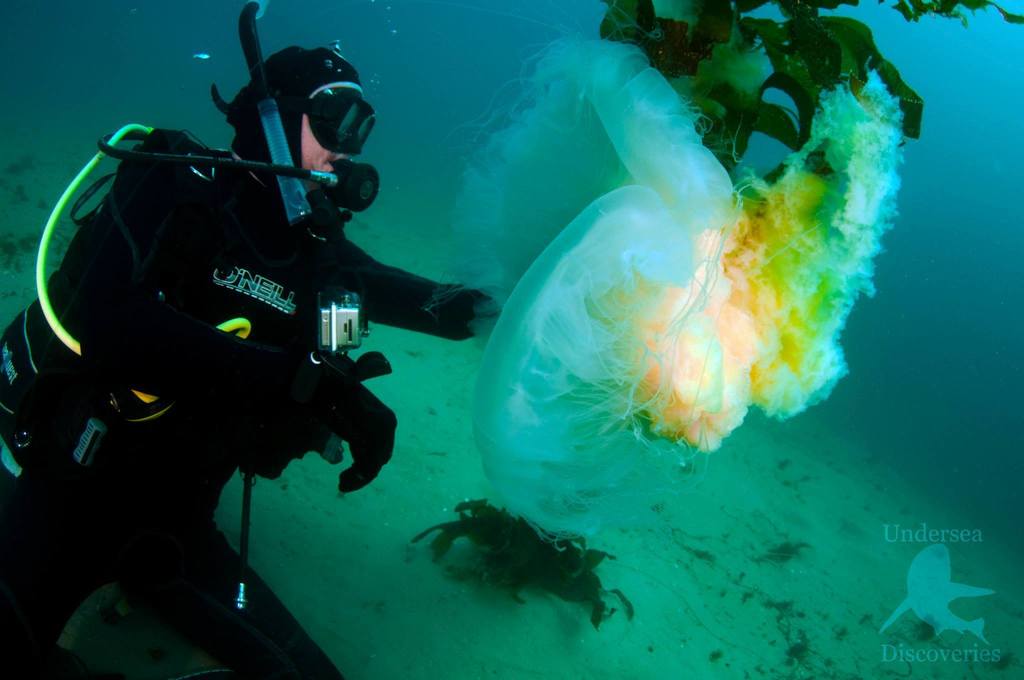
(c) Michael Bear, some rights reserved (CC BY) · licence
Family: Ulmaridae · Class: Scyphozoa · Order: Semaeostomeae
Phacellophora camtschatica (Egg-yolk Jelly) is a California animal in the Ulmaridae family.
Phacellophora camtschatica, commonly known as the egg-yolk jelly or fried egg jellyfish, is a very large scyphozoan jellyfish with a distinctive bell that can reach up to 60 cm (2 feet) in diameter (iNaturalist). The species derives its common name from its appearance, featuring a thick, opaque white bell center surrounded by a translucent yellow-orange margin that resembles a fried egg. The bell is relatively flattened compared to other large jellyfish species, with a smooth, gelatinous texture. Long, streaming tentacles extend from the bell margin and can trail several meters behind the animal. The egg-yolk jelly has a wide distribution in the North Pacific Ocean. The species ranges from the Bering Sea south along the Pacific coast to California waters. In California, it occurs in offshore and nearshore marine environments, particularly in cooler northern and central coastal waters. The species is also found in the eastern Bering Sea, where it has been documented in ecosystem surveys as one of the dominant jellyfish species (NOAA Fisheries 2022, 2023). Phacellophora camtschatica extends its range across the North Pacific to Asian waters, including the Sea of Okhotsk and waters around the Kamchatka Peninsula. This species inhabits open ocean environments and coastal waters, typically occurring in depths ranging from surface waters to several hundred meters. Egg-yolk jellies are pelagic organisms that drift with ocean currents, though they possess some swimming capability through rhythmic contractions of their bell. They are found in both offshore oceanic waters and nearshore environments, including areas near the continental shelf. The species appears to prefer cooler water temperatures characteristic of subarctic and temperate North Pacific regions. Phacellophora camtschatica is a carnivorous predator that feeds primarily on other gelatinous organisms, including smaller jellyfish, comb jellies, and various zooplankton. The species uses its long tentacles, armed with stinging cells called nematocysts, to capture prey. Like other scyphozoans, it exhibits a complex life cycle involving both sexual and asexual reproduction phases. The species alternates between a free-swimming medusa stage (the familiar jellyfish form) and a benthic polyp stage. Reproduction typically involves the release of gametes into the water column, followed by development through planular larvae that settle and develop into polyps. Currently, Phacellophora camtschatica has no special conservation status at federal or state levels. The species appears to maintain stable populations throughout its North Pacific range. In the eastern Bering Sea, it has been consistently recorded in ecosystem surveys as one of the dominant jellyfish species, suggesting healthy population levels in that region (NOAA Fisheries 2022, 2023). However, like many marine species, egg-yolk jellies may face indirect threats from climate change, ocean acidification, and changes in prey availability. The species plays an important ecological role as both predator and prey in North Pacific marine food webs.
Classification
Class: Scyphozoa · Order: Semaeostomeae · Family: Ulmaridae
Frequently asked questions
How is Phacellophora camtschatica classified?
Phacellophora camtschatica belongs to class Scyphozoa, order Semaeostomeae, family Ulmaridae.
What family does Phacellophora camtschatica belong to?
Phacellophora camtschatica is in the Ulmaridae family.
What is Phacellophora camtschatica?
Phacellophora camtschatica, commonly known as the egg-yolk jelly or fried egg jellyfish, is a very large scyphozoan jellyfish with a distinctive bell that can reach up to 60 cm (2 feet) in diameter (iNaturalist).
Is Phacellophora camtschatica found in California?
Yes. Phacellophora camtschatica is recorded in California in The California Species Project's catalogue.
Related species
Other California species in the same genus, family, or bioregion.
Data from The California Species Project — 14,000+ California species with verified data from CNPS, CDFW, USFWS, and more.