Phaethon aethereus
Red-billed Tropicbird
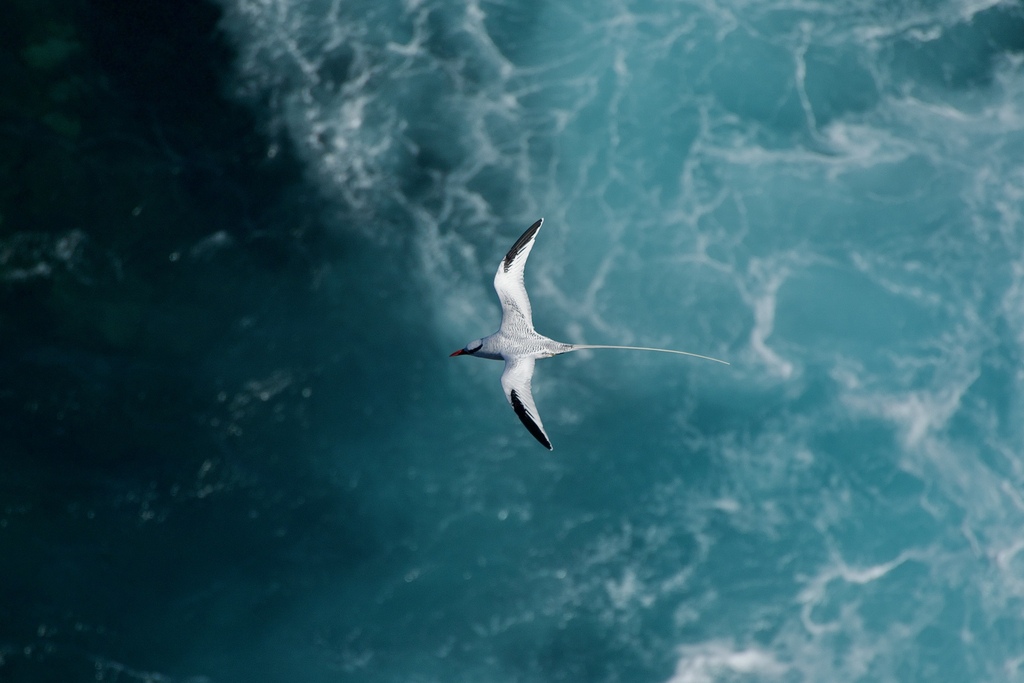
(c) Matteo Bellucci, some rights reserved (CC BY) · licence
Family: Phaethontidae · Class: Aves · Order: Phaethontiformes
Phaethon aethereus (Red-billed Tropicbird) is a California animal in the Phaethontidae family.
The Red-billed Tropicbird is a large seabird with distinctive white plumage and striking red coloration on the bill. Adults measure 90 to 105 cm (35 to 41 inches) in length, including elongated central tail feathers that extend 35 to 56 cm (14 to 22 inches) beyond the body. The wingspan ranges from 99 to 106 cm (39 to 42 inches). The species displays predominantly white plumage with black barring on the back and wings. Adults possess a bright coral-red to orange-red bill, while juveniles have yellow bills that gradually change to red with maturity. A distinctive black eye stripe extends from the base of the bill through the eye to the nape. The Red-billed Tropicbird has a pantropical distribution, occurring across tropical and subtropical waters of the Atlantic, Pacific, and Indian Oceans. In California waters, the species is considered a rare visitor, primarily observed off the southern coast during warmer months. Sightings have been documented from the Channel Islands south to waters off San Diego County. The species breeds on remote oceanic islands including the Galápagos, Caribbean islands, and various Pacific atolls, but does not maintain breeding populations within California. This highly pelagic species inhabits open ocean waters, typically remaining far from shore except when breeding or during dispersal. Red-billed Tropicbirds prefer warm tropical waters with surface temperatures above 24°C (75°F). They are often associated with areas of upwelling or convergence zones where prey concentrations are higher. During breeding season, they nest on rocky cliffs, crevices, or under vegetation on oceanic islands. Red-billed Tropicbirds are specialized plunge-divers, feeding primarily on flying fish, squid, and small pelagic fish. They dive from heights of 3 to 15 meters (10 to 50 feet) above the water surface, often completely submerging to capture prey. The species exhibits strong flight capabilities with distinctive deep wingbeats interspersed with gliding. Breeding occurs year-round in different parts of their range, with pairs typically laying a single spotted egg in cliff crevices or shallow depressions. The incubation period lasts approximately 44 days, with both parents sharing duties. Chicks remain in the nest for 80 to 90 days before fledging. The Red-billed Tropicbird is not federally listed in the United States and is classified as Least Concern by the International Union for Conservation of Nature. Global populations appear stable, though some breeding colonies face threats from habitat degradation, introduced predators, and human disturbance. Climate change poses potential long-term risks through alterations in ocean temperature and prey distribution. In California, the species' status as a rare visitor means it receives protection under the Migratory Bird Treaty Act. Observations off California typically involve single individuals or small groups during post-breeding dispersal periods, primarily from July through October.
Classification
Class: Aves · Order: Phaethontiformes · Family: Phaethontidae
Frequently asked questions
How is Phaethon aethereus classified?
Phaethon aethereus belongs to class Aves, order Phaethontiformes, family Phaethontidae.
What family does Phaethon aethereus belong to?
Phaethon aethereus is in the Phaethontidae family.
What is Phaethon aethereus?
The Red-billed Tropicbird is a large seabird with distinctive white plumage and striking red coloration on the bill.
Is Phaethon aethereus found in California?
Yes. Phaethon aethereus is recorded in California in The California Species Project's catalogue.
Related species
Other California species in the same genus, family, or bioregion.
Data from The California Species Project — 14,000+ California species with verified data from CNPS, CDFW, USFWS, and more.