Phaethon rubricauda
Red-tailed Tropicbird
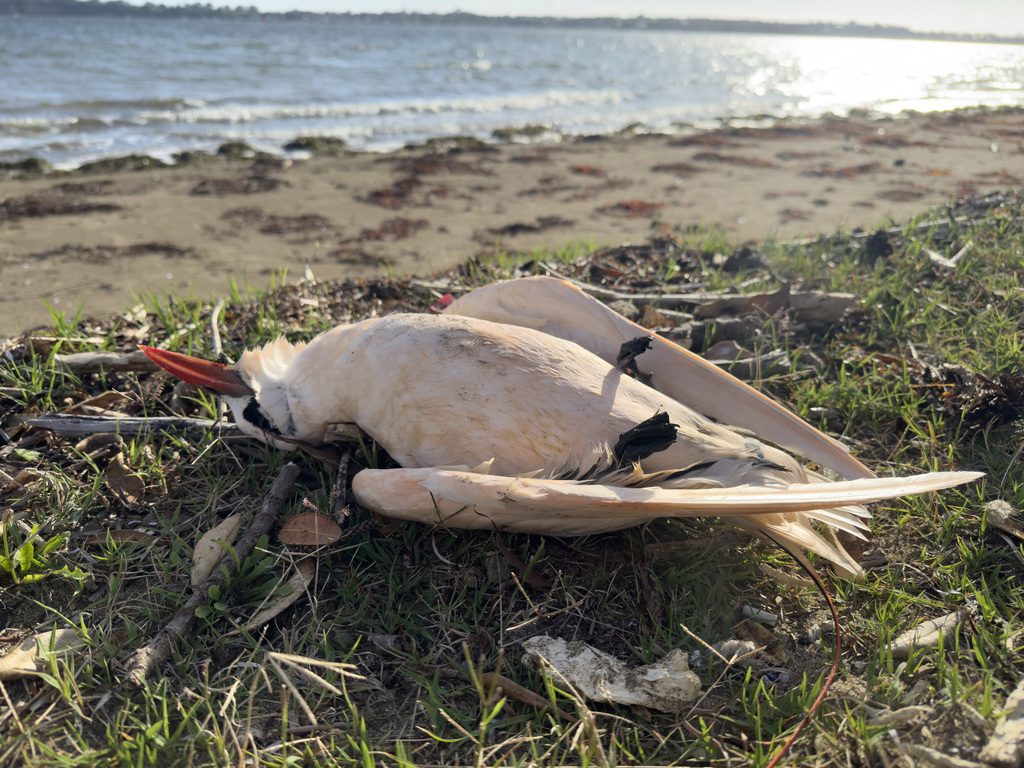
(c) Shaun Lee, some rights reserved (CC BY) · licence
Family: Phaethontidae · Class: Aves · Order: Phaethontiformes
Phaethon rubricauda (Red-tailed Tropicbird) is a California animal in the Phaethontidae family.
The Red-tailed Tropicbird is a large seabird with distinctive long, streaming tail feathers and predominantly white plumage. Adults measure 90 to 105 cm (35 to 41 inches) in total length, including the characteristic red tail streamers that extend 35 to 56 cm (14 to 22 inches) beyond the body. The wingspan ranges from 104 to 119 cm (41 to 47 inches), with body weight typically between 625 to 795 grams (1.4 to 1.8 pounds). The species displays sexual dimorphism, with males having longer, more vibrant red tail streamers than females. Adult plumage is primarily white with black markings on the outer wing feathers and a black eye stripe. The bill is orange-red to coral-colored, thick at the base, and slightly curved downward. Juveniles lack the long tail streamers and show more extensive black barring on the wings and back. The Red-tailed Tropicbird has a pantropical distribution across the Pacific and Indian Oceans. In North America, the species occurs primarily in Hawaiian waters, with occasional vagrant records documented along the California coast. According to eBird records, sightings off California are extremely rare, with most observations occurring during El Niño events when warm water conditions extend northward. The species breeds on remote oceanic islands including Hawaii, the Galápagos, Easter Island, and various Pacific atolls. This pelagic species inhabits tropical and subtropical oceanic waters, typically remaining far from shore except when breeding or during severe weather events. Red-tailed Tropicbirds prefer warm surface waters above 24°C (75°F) and are often associated with areas of upwelling or convergence zones where prey concentrations are higher. During breeding season, they nest on cliff ledges, rocky outcrops, and occasionally in vegetation on remote islands. Red-tailed Tropicbirds are primarily piscivorous, feeding on flying fish, squid, and small pelagic fish species. They employ a distinctive hunting technique, flying 10 to 30 meters above the ocean surface before executing steep plunge dives to capture prey. The species is generally solitary at sea but forms loose aggregations around productive feeding areas. Breeding occurs year-round in different parts of their range, with peak activity varying by location. Females typically lay a single egg in a simple scrape or shallow depression. The incubation period lasts 39 to 51 days, with both parents sharing duties. Chicks fledge after 90 to 120 days but may remain dependent on parents for several additional weeks. The Red-tailed Tropicbird is not federally listed under the Endangered Species Act and maintains stable global populations according to the International Union for Conservation of Nature, which classifies the species as Least Concern. However, local populations face threats from introduced predators on breeding islands, habitat disturbance from human activities, plastic pollution, and climate change impacts on marine ecosystems. In California waters, the species remains an extremely rare visitor, with sightings considered noteworthy ornithological events.
Classification
Class: Aves · Order: Phaethontiformes · Family: Phaethontidae
Frequently asked questions
How is Phaethon rubricauda classified?
Phaethon rubricauda belongs to class Aves, order Phaethontiformes, family Phaethontidae.
What family does Phaethon rubricauda belong to?
Phaethon rubricauda is in the Phaethontidae family.
What is Phaethon rubricauda?
The Red-tailed Tropicbird is a large seabird with distinctive long, streaming tail feathers and predominantly white plumage.
Is Phaethon rubricauda found in California?
Yes. Phaethon rubricauda is recorded in California in The California Species Project's catalogue.
Related species
Other California species in the same genus, family, or bioregion.
Data from The California Species Project — 14,000+ California species with verified data from CNPS, CDFW, USFWS, and more.