Phainopepla nitens
Phainopepla
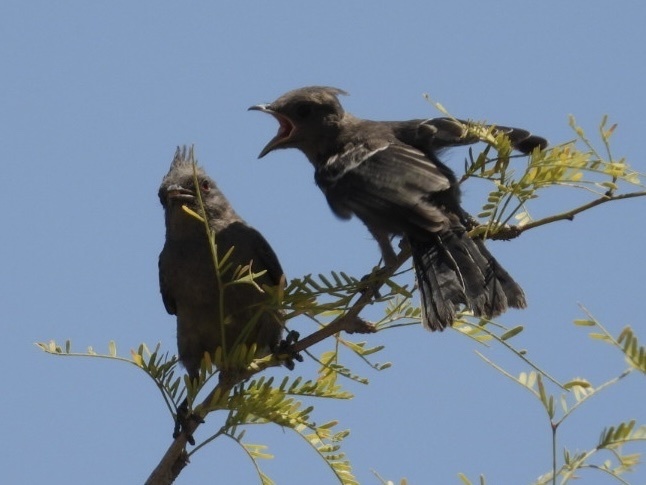
(c) Katrina Smith, some rights reserved (CC BY) · licence
Family: Ptilogonatidae · Class: Aves · Order: Passeriformes
Phainopepla nitens (Phainopepla) is a California animal in the Ptilogonatidae family.
The Phainopepla is a medium-sized songbird measuring 18-20 cm (7.1-7.9 inches) in length with a wingspan of 28 cm (11 inches). Adult males are glossy black with a prominent crest and white wing patches visible in flight. Females and juveniles are gray with lighter underparts and lack the male's distinctive glossy plumage. Both sexes have red eyes and a slender, slightly curved bill adapted for consuming berries. The species exhibits sexual dimorphism, with males being significantly darker and more conspicuous than females. Phainopeplas occur throughout much of California, from sea level to elevations of 2,300 meters (7,500 feet). Their range extends from the southwestern United States through Mexico, with California populations found in desert regions, foothills, and oak woodlands. The species is most abundant in the Sonoran and Mojave deserts, coastal sage scrub, and chaparral habitats. They also inhabit riparian areas and suburban environments with appropriate vegetation. The species occupies diverse habitats characterized by desert scrub, oak woodlands, riparian forests, and areas with abundant mistletoe. Phainopeplas show a strong association with desert mistletoe (Phoradendron californicum) and oak mistletoe (Phoradendron villosum), which serve as primary food sources. They prefer habitats with scattered trees and shrubs that provide nesting sites and foraging opportunities. The species demonstrates notable habitat flexibility, adapting to both arid desert environments and more mesic woodland areas. Phainopeplas are primarily frugivorous, with mistletoe berries comprising up to 90% of their diet during winter months. They also consume insects, particularly during the breeding season when protein requirements increase for reproduction and feeding young. The species exhibits nomadic behavior, moving seasonally between different habitats based on food availability. Breeding occurs from March through July, with pairs constructing cup-shaped nests in tree forks or shrub branches. Females typically lay 2-3 eggs, which are incubated for 14 days. Males are highly territorial during breeding season and perform elaborate flight displays to attract mates and defend territories. The species demonstrates unique breeding strategies, with some populations breeding twice per year in different habitats - first in desert lowlands during spring, then moving to higher elevation oak woodlands for a second breeding attempt. This altitudinal migration pattern is linked to the seasonal availability of mistletoe crops and favorable breeding conditions. Phainopeplas are not federally or state listed as threatened or endangered species. The species appears to maintain stable populations across most of its range, though local populations may fluctuate based on mistletoe crop cycles and habitat availability. Urban development and habitat fragmentation pose potential threats in some areas, particularly where desert scrub and oak woodland habitats are converted for human use. Climate change may affect the distribution and abundance of mistletoe, their primary food source, potentially impacting population dynamics in the future.
Classification
Class: Aves · Order: Passeriformes · Family: Ptilogonatidae
Frequently asked questions
How is Phainopepla nitens classified?
Phainopepla nitens belongs to class Aves, order Passeriformes, family Ptilogonatidae.
What family does Phainopepla nitens belong to?
Phainopepla nitens is in the Ptilogonatidae family.
What is Phainopepla nitens?
The Phainopepla is a medium-sized songbird measuring 18-20 cm (7.1-7.9 inches) in length with a wingspan of 28 cm (11 inches).
Is Phainopepla nitens found in California?
Yes. Phainopepla nitens is recorded in California in The California Species Project's catalogue.
More California species
This species has no close relatives in our California data — here are other species to explore.
Data from The California Species Project — 14,000+ California species with verified data from CNPS, CDFW, USFWS, and more.