Phalaenoptilus nuttallii
Common Poorwill
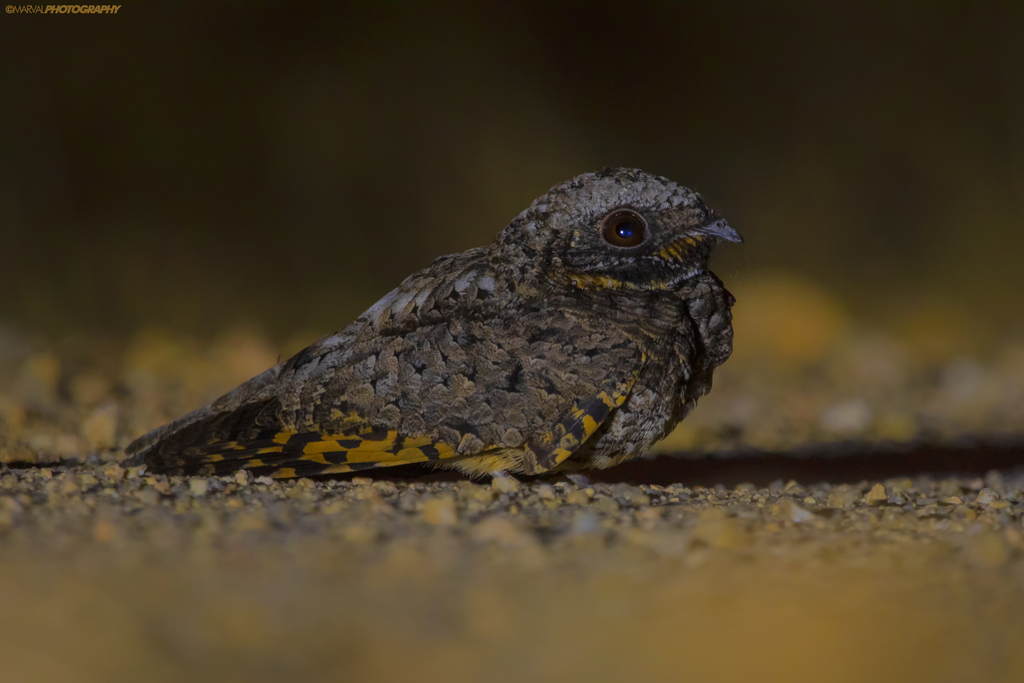
(c) MarvalPhotography19, some rights reserved (CC BY) · licence
Family: Caprimulgidae · Class: Aves · Order: Caprimulgiformes
Phalaenoptilus nuttallii (Common Poorwill) is a California animal in the Caprimulgidae family.
The Common Poorwill is a small, cryptically colored nightjar measuring 19-21 cm (7.5-8.3 inches) in length with a wingspan of 41-46 cm (16-18 inches). Adults weigh 35-60 grams. The plumage consists of mottled brown, gray, and black patterns that provide exceptional camouflage against rocky substrates and tree bark. The upperparts display intricate vermiculations of brown and gray with scattered white spots, while the underparts show buff and brown barring. Males exhibit white patches on the outer tail feathers that are visible during flight displays. The species has a distinctively short tail compared to other nightjars, large dark eyes adapted for nocturnal vision, and a small bill with a wide gape for capturing insects in flight. Common Poorwills range from southern British Columbia through western North America to central Mexico. In California, the species occurs throughout most of the state except for the Central Valley floor and high-elevation Sierra Nevada peaks. The breeding range extends from the Oregon border south to Baja California, with populations found in the Coast Ranges, Sierra Nevada foothills, Transverse Ranges, Peninsular Ranges, and Mojave and Sonoran deserts. Northern populations are migratory, while those in southern California and desert regions may be year-round residents. The species inhabits open woodlands, chaparral, sagebrush, desert scrub, and rocky areas with scattered trees from sea level to approximately 2,750 meters (9,000 feet) elevation. Common Poorwills prefer areas with a combination of open ground for foraging and nearby perches or roost sites such as rock outcrops, fallen logs, or low shrubs. They commonly occur in oak woodlands, pinyon-juniper habitats, and desert areas with Joshua trees or other scattered vegetation. Common Poorwills are primarily nocturnal, becoming active at dusk to hunt flying insects including moths, beetles, flies, and mosquitoes. They employ a sit-and-wait hunting strategy, sallying from low perches to capture prey in flight before returning to the same or nearby perch. The species is notable for entering periods of torpor during cold weather, a behavior unique among North American birds. Breeding occurs from April through August, with females laying two white to pale buff eggs directly on bare ground with minimal or no nest construction. Incubation lasts 20-21 days, and young fledge after 20-23 days. Some pairs produce two broods per season in favorable conditions. The Common Poorwill is not federally or state listed and maintains stable populations across most of its range. The species is classified as Least Concern by the International Union for Conservation of Nature. However, populations may face localized pressures from habitat loss due to urban development, particularly in coastal California, and potentially from pesticide use that reduces insect prey availability. The species benefits from habitat management that maintains open woodlands and reduces dense vegetation encroachment.
Classification
Class: Aves · Order: Caprimulgiformes · Family: Caprimulgidae
Frequently asked questions
How is Phalaenoptilus nuttallii classified?
Phalaenoptilus nuttallii belongs to class Aves, order Caprimulgiformes, family Caprimulgidae.
What family does Phalaenoptilus nuttallii belong to?
Phalaenoptilus nuttallii is in the Caprimulgidae family.
What is Phalaenoptilus nuttallii?
The Common Poorwill is a small, cryptically colored nightjar measuring 19-21 cm (7.5-8.3 inches) in length with a wingspan of 41-46 cm (16-18 inches).
Is Phalaenoptilus nuttallii found in California?
Yes. Phalaenoptilus nuttallii is recorded in California in The California Species Project's catalogue.
Related species
Other California species in the same genus, family, or bioregion.
Data from The California Species Project — 14,000+ California species with verified data from CNPS, CDFW, USFWS, and more.