Phalaropus fulicarius
Red Phalarope
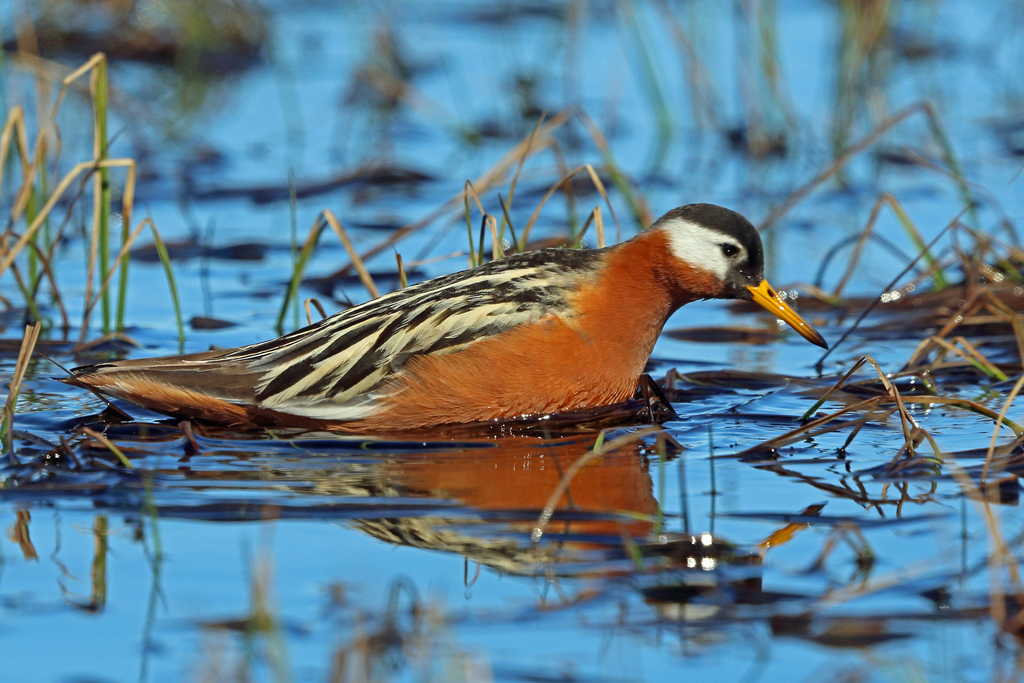
(c) Nigel Voaden, some rights reserved (CC BY) · licence
Family: Scolopacidae · Class: Aves · Order: Charadriiformes
Phalaropus fulicarius (Red Phalarope) is a California animal in the Scolopacidae family.
The Red Phalarope is a small shorebird measuring 20-22 cm (7.9-8.7 inches) in length with a wingspan of 37-40 cm (14.6-15.7 inches). During breeding season, females display striking rufous-red underparts, dark gray upperparts with buff streaks, and a distinctive yellow bill with a black tip. Males are duller with less extensive red plumage. In winter plumage, both sexes are predominantly gray above and white below, with a dark eye patch and a straight, thin black bill. The species exhibits reversed sexual dimorphism, with females being larger and more brightly colored than males. The Red Phalarope breeds in Arctic tundra regions of Alaska, northern Canada, Greenland, and northern Eurasia. In California, the species occurs as a regular migrant along the entire coast from March through May and August through November. During migration, Red Phalaropes are typically observed far offshore, often beyond the continental shelf in oceanic waters. They occasionally appear closer to shore during storms or adverse weather conditions, and rare individuals may be found at inland locations, particularly at saline lakes. This species inhabits pelagic marine environments during migration and winter, preferring areas of upwelling where nutrient-rich waters support abundant plankton. During breeding season, Red Phalaropes occupy wet tundra with shallow ponds, sedge meadows, and marshy areas. They nest on slightly elevated sites near water, often on moss hummocks or among low vegetation. Red Phalaropes exhibit unique feeding behavior among shorebirds, swimming rather than wading and spinning in tight circles to create small whirlpools that bring prey to the surface. Their diet consists primarily of zooplankton, small crustaceans, marine worms, and flying insects. During breeding season, they also consume terrestrial insects and larvae. The species demonstrates complete sex-role reversal: females arrive at breeding grounds first, establish territories, and compete for mates, while males perform all incubation and chick-rearing duties. Females lay 3-4 olive-brown eggs with dark spots in a shallow scrape lined with grass and moss. The incubation period lasts 18-20 days, and males tend the precocial young for approximately 16-20 days until fledging. The Red Phalarope is not federally listed and has no special conservation status in California. According to the North American Bird Conservation Initiative, the species has a global population estimated at 2.5-4 million individuals. However, like many Arctic-breeding shorebirds, Red Phalaropes face threats from climate change affecting their tundra breeding habitats. Warming temperatures alter the timing of insect emergence and may reduce suitable nesting areas. Marine threats include plastic pollution, oil spills, and changes in ocean productivity that affect food availability during migration and winter. The species' dependence on both Arctic terrestrial and marine pelagic ecosystems makes it particularly vulnerable to environmental changes in these rapidly changing systems.
Classification
Class: Aves · Order: Charadriiformes · Family: Scolopacidae
Frequently asked questions
How is Phalaropus fulicarius classified?
Phalaropus fulicarius belongs to class Aves, order Charadriiformes, family Scolopacidae.
What family does Phalaropus fulicarius belong to?
Phalaropus fulicarius is in the Scolopacidae family.
What is Phalaropus fulicarius?
The Red Phalarope is a small shorebird measuring 20-22 cm (7.9-8.7 inches) in length with a wingspan of 37-40 cm (14.6-15.7 inches).
Is Phalaropus fulicarius found in California?
Yes. Phalaropus fulicarius is recorded in California in The California Species Project's catalogue.
Related species
Other California species in the same genus, family, or bioregion.
Data from The California Species Project — 14,000+ California species with verified data from CNPS, CDFW, USFWS, and more.