Phalaropus tricolor
Wilson's Phalarope
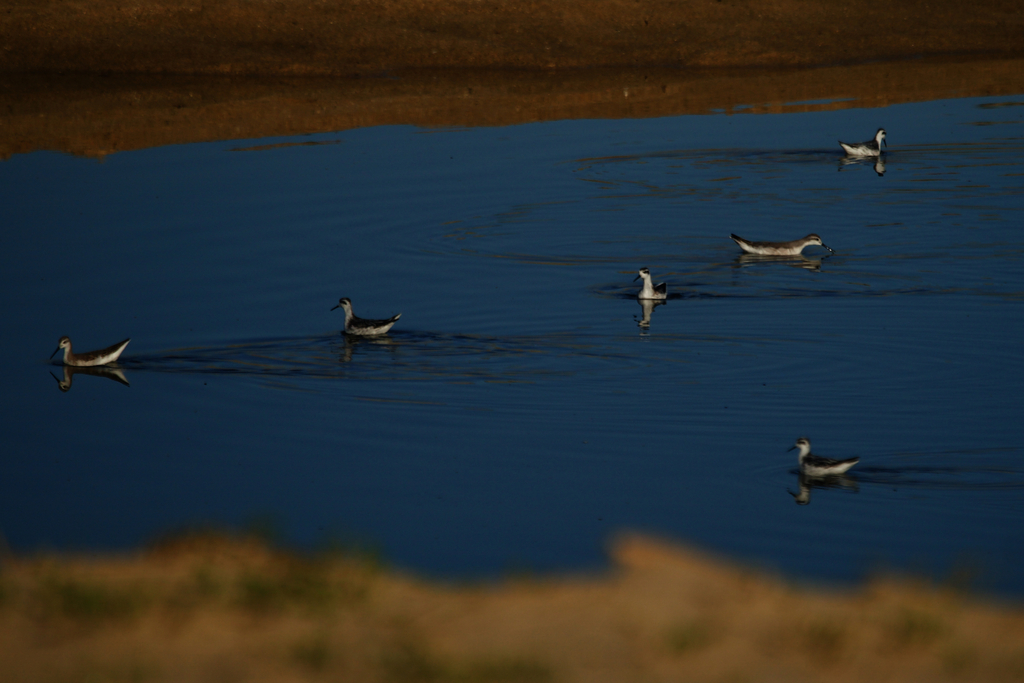
(c) Bill Levine, some rights reserved (CC BY) · licence
Family: Scolopacidae · Class: Aves · Order: Charadriiformes
Phalaropus tricolor (Wilson's Phalarope) is a California animal in the Scolopacidae family.
Wilson's Phalarope is a medium-sized shorebird measuring 22-24 cm (8.7-9.4 inches) in length with a wingspan of 37-40 cm (14.6-15.7 inches). During breeding season, females display more vibrant plumage than males, with a distinctive dark stripe extending from the eye down the neck, chestnut and black markings on the back and shoulders, and a white throat and underparts. Males exhibit more subdued gray and brown tones. In non-breeding plumage, both sexes appear gray above and white below with a dark eye line. The species has a thin, straight, needle-like bill that is longer than the head, and yellow to orange legs. Wilson's Phalarope breeds across the western interior of North America from central Canada to the central United States. In California, the species is primarily found in the Central Valley, Modoc Plateau, and intermountain regions of the Sierra Nevada and Cascade Range during breeding season. The species also occurs in suitable habitat in the Salton Sea area and occasionally along the coast during migration. Post-breeding birds migrate to wintering grounds in South America, primarily in Argentina and Chile. This species inhabits shallow wetlands, including prairie potholes, alkaline lakes, flooded agricultural fields, sewage ponds, and marsh edges. During breeding season, Wilson's Phalaropes prefer areas with emergent vegetation for nesting, typically selecting sites within 100 meters of water. They utilize habitats ranging from sea level to approximately 2,000 meters elevation in California. The species requires areas with abundant invertebrate prey and suitable water depths for foraging. Wilson's Phalaropes exhibit reversed sexual roles, with females being larger, more colorful, and competing for males. Females may mate with multiple males during a single breeding season. Males perform most parental duties, including incubation of the 3-4 buff-colored eggs with dark markings for 18-27 days and caring for the precocial young. Nesting occurs from May through July. The species feeds primarily on aquatic invertebrates, including fly larvae, beetles, crustaceans, and worms, obtained through surface picking, probing, and the characteristic phalarope spinning behavior that creates small whirlpools to concentrate prey. Wilson's Phalarope is not federally or state listed in California as of December 2025. According to the North American Breeding Bird Survey, populations have shown variable trends across different regions, with some areas experiencing declines due to habitat loss from agricultural conversion and water diversions. Climate change poses additional threats through altered precipitation patterns affecting wetland availability. The species' dependence on ephemeral wetlands makes it vulnerable to drought cycles and water management practices. Conservation efforts focus on wetland protection and restoration, particularly in the Central Valley where suitable habitat has been significantly reduced. Partners in Flight considers Wilson's Phalarope a species of moderate conservation concern, emphasizing the need for continued monitoring and habitat management.
Classification
Class: Aves · Order: Charadriiformes · Family: Scolopacidae
Frequently asked questions
How is Phalaropus tricolor classified?
Phalaropus tricolor belongs to class Aves, order Charadriiformes, family Scolopacidae.
What family does Phalaropus tricolor belong to?
Phalaropus tricolor is in the Scolopacidae family.
What is Phalaropus tricolor?
Wilson's Phalarope is a medium-sized shorebird measuring 22-24 cm (8.7-9.4 inches) in length with a wingspan of 37-40 cm (14.6-15.7 inches).
Is Phalaropus tricolor found in California?
Yes. Phalaropus tricolor is recorded in California in The California Species Project's catalogue.
Related species
Other California species in the same genus, family, or bioregion.
Data from The California Species Project — 14,000+ California species with verified data from CNPS, CDFW, USFWS, and more.