Phasianus colchicus
Ring-necked Pheasant
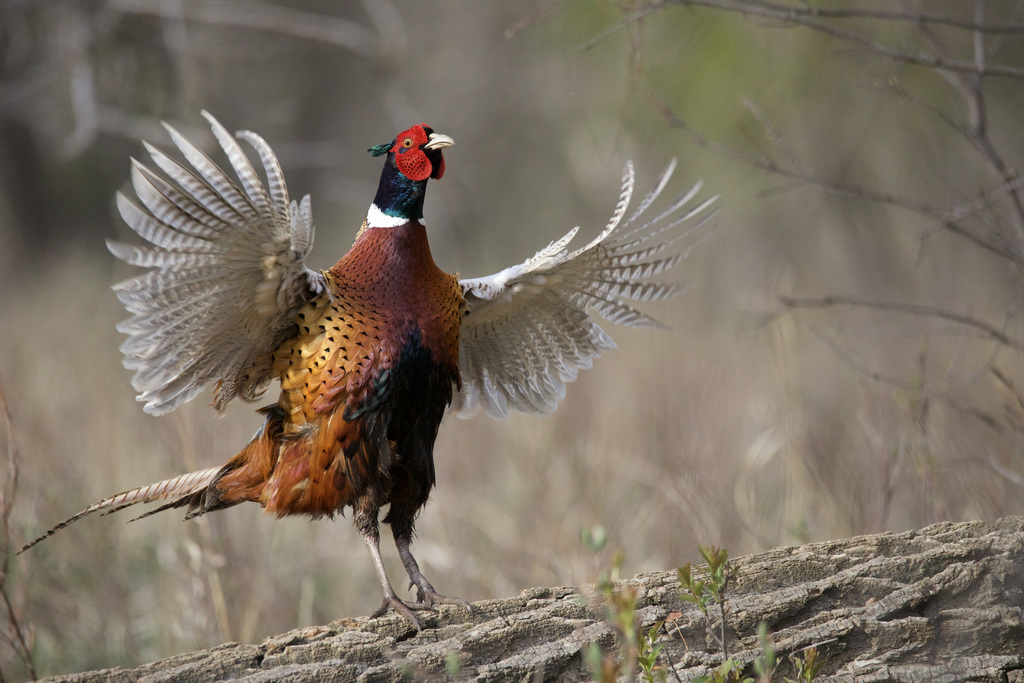
(c) John Krampl, some rights reserved (CC BY) · licence
Family: Phasianidae · Class: Aves · Order: Galliformes
Phasianus colchicus (Ring-necked Pheasant) is a California animal in the Phasianidae family.
The Ring-necked Pheasant is a large, terrestrial game bird introduced to California in the late 1800s. Males (roosters) measure 76 to 89 cm (30 to 35 inches) in total length, including their distinctive long, pointed tail that comprises nearly half their body length. Females (hens) are smaller at 53 to 63 cm (21 to 25 inches). Males display iridescent copper and gold plumage with a distinctive white collar around the neck, dark green head with red facial patches, and a long, barred tail. Females exhibit mottled brown plumage that provides camouflage during nesting. Both sexes have strong legs adapted for ground foraging and short, rounded wings suitable for brief, explosive flights. Originally native to Asia, Ring-necked Pheasants were successfully established in California through multiple introductions beginning in 1889. The species now occurs throughout suitable habitat in the Central Valley, coastal valleys, and agricultural areas from sea level to approximately 1,500 meters (4,900 feet) elevation. Primary populations exist in the Sacramento and San Joaquin valleys, with smaller populations in the Imperial Valley, coastal regions, and intermountain areas of northeastern California. Ring-necked Pheasants inhabit agricultural landscapes, grasslands, wetland edges, and areas with mixed cover including croplands adjacent to uncultivated areas. The species requires a combination of nesting cover, winter shelter, and feeding areas within close proximity. Optimal habitat includes grain fields interspersed with hedgerows, ditches, or wetlands that provide escape cover. Pheasants utilize cattail marshes, riparian vegetation, and brushy fence rows for roosting and thermal cover during winter months. Pheasants are primarily granivorous, consuming waste grain, seeds of grasses and forbs, and agricultural crops including corn, wheat, and barley. During spring and summer, their diet expands to include insects, particularly beneficial for growing chicks. The species exhibits polygynous mating behavior, with dominant males establishing territories and attracting multiple females through elaborate courtship displays and loud crowing calls. Nesting occurs from April through July, with females constructing ground nests in dense vegetation. Clutch size ranges from 8 to 15 eggs, with an incubation period of 23 to 25 days. Chicks are precocial and capable of flight within 10 to 12 days. Ring-necked Pheasants are not federally or state-listed as they are a non-native species managed as a game bird in California. Population trends vary regionally, with declines noted in many agricultural areas due to intensive farming practices that reduce suitable habitat. The California Department of Fish and Wildlife manages pheasant populations through hunting regulations and habitat enhancement programs on wildlife areas. Primary conservation challenges include loss of nesting cover due to clean farming practices, timing of agricultural operations during nesting season, and conversion of suitable habitat to urban development. Conservation efforts focus on maintaining habitat diversity within agricultural landscapes through programs that encourage retention of hedgerows, grassland borders, and wetland edges.
Classification
Class: Aves · Order: Galliformes · Family: Phasianidae
Frequently asked questions
How is Phasianus colchicus classified?
Phasianus colchicus belongs to class Aves, order Galliformes, family Phasianidae.
What family does Phasianus colchicus belong to?
Phasianus colchicus is in the Phasianidae family.
What is Phasianus colchicus?
The Ring-necked Pheasant is a large, terrestrial game bird introduced to California in the late 1800s.
Is Phasianus colchicus found in California?
Yes. Phasianus colchicus is recorded in California in The California Species Project's catalogue.
Related species
Other California species in the same genus, family, or bioregion.
Data from The California Species Project — 14,000+ California species with verified data from CNPS, CDFW, USFWS, and more.