Phenacomys intermedius
Heather Vole
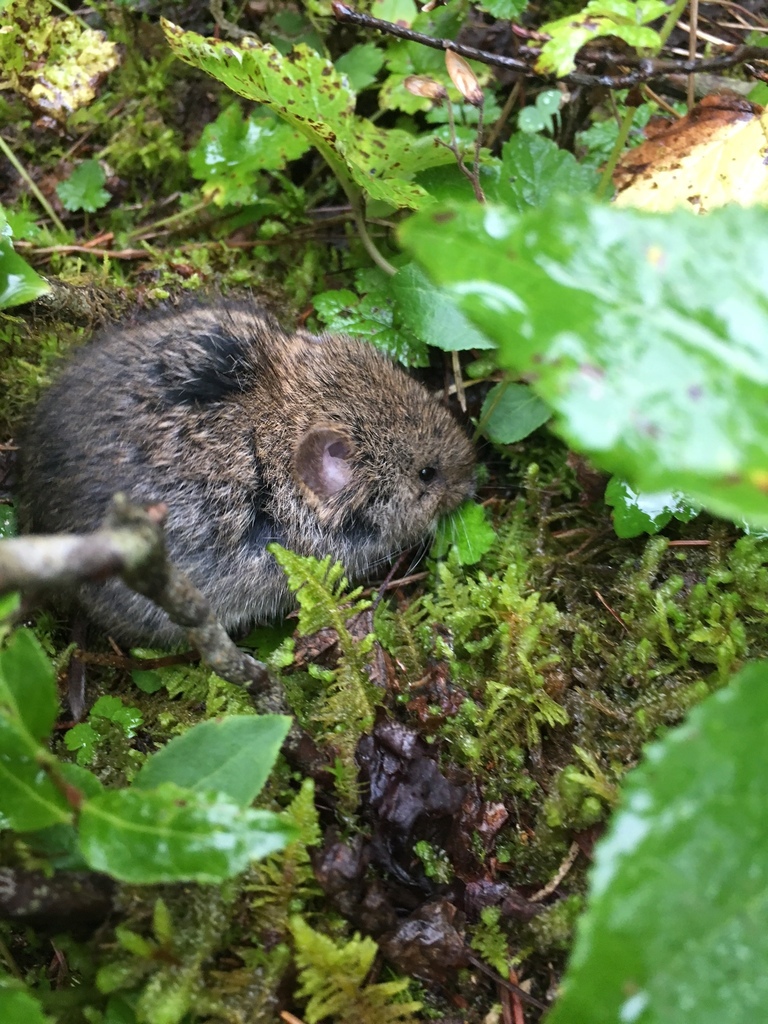
(c) Aerin Jacob, some rights reserved (CC BY) · licence
Family: Cricetidae · Class: Mammalia · Order: Rodentia
Phenacomys intermedius (Heather Vole) is a California animal in the Cricetidae family.
The heather vole is a small rodent in the family Cricetidae, characterized by its compact build and distinctive reddish-brown to grayish-brown dorsal pelage. Adults measure 90 to 140 mm (3.5 to 5.5 inches) in total length, with the tail comprising approximately one-third of this measurement at 25 to 40 mm. Body weight ranges from 25 to 50 grams. The ears are small and nearly concealed by dense fur, while the tail is bicolored with dark fur above and lighter fur below. The ventral surface displays gray to white coloration, and the feet are covered with dense hair that aids in navigation across rocky terrain. Historically, heather voles ranged across mountainous regions of western North America from British Columbia south through the Cascade Range and Sierra Nevada. In California, the species occurs in scattered populations within the Sierra Nevada, primarily in alpine and subalpine zones of the central and northern portions of the range. Populations have been documented in Mono, Tuolumne, Mariposa, and Fresno counties, though distribution appears fragmented across suitable habitat. Heather voles inhabit high-elevation environments typically between 1,800 and 4,000 meters (5,900 to 13,100 feet), favoring areas dominated by heather (Phyllodoce species), alpine willow, and other low-growing shrubs. The species shows strong association with rocky talus slopes, boulder fields, and areas with dense understory vegetation that provides cover and nesting sites. Habitat requirements include proximity to water sources and sufficient vegetation for both food and shelter construction. This species exhibits primarily herbivorous feeding behavior, consuming green vegetation, seeds, berries, and bark of woody plants. Heather voles are active year-round and do not hibernate, instead relying on cached food stores and continued foraging beneath snow cover during winter months. Breeding occurs from May through August, with females producing one to two litters annually. Litter size ranges from two to eight young, with an average of four to five offspring. Gestation period lasts approximately 19 to 24 days. The species constructs elaborate runway systems through vegetation and maintains multiple nest sites within rocky crevices. Heather voles face conservation challenges related to their specialized habitat requirements and limited distribution. Climate change poses a significant threat as warming temperatures may reduce suitable alpine habitat and force upslope migration. Recreational activities in high-elevation areas can disturb habitat and runway systems. The species lacks federal or state listing status in California, though its restricted range and habitat specificity warrant monitoring. Population trends remain poorly understood due to the remote nature of occupied habitat and the species' secretive behavior. Long-term studies are needed to assess population stability and habitat connectivity across the fragmented Sierra Nevada range.
Classification
Class: Mammalia · Order: Rodentia · Family: Cricetidae
Frequently asked questions
How is Phenacomys intermedius classified?
Phenacomys intermedius belongs to class Mammalia, order Rodentia, family Cricetidae.
What family does Phenacomys intermedius belong to?
Phenacomys intermedius is in the Cricetidae family.
What is Phenacomys intermedius?
The heather vole is a small rodent in the family Cricetidae, characterized by its compact build and distinctive reddish-brown to grayish-brown dorsal pelage.
Is Phenacomys intermedius found in California?
Yes. Phenacomys intermedius is recorded in California in The California Species Project's catalogue.
Related species
Other California species in the same genus, family, or bioregion.
Data from The California Species Project — 14,000+ California species with verified data from CNPS, CDFW, USFWS, and more.