Pheucticus ludovicianus
Rose-breasted Grosbeak
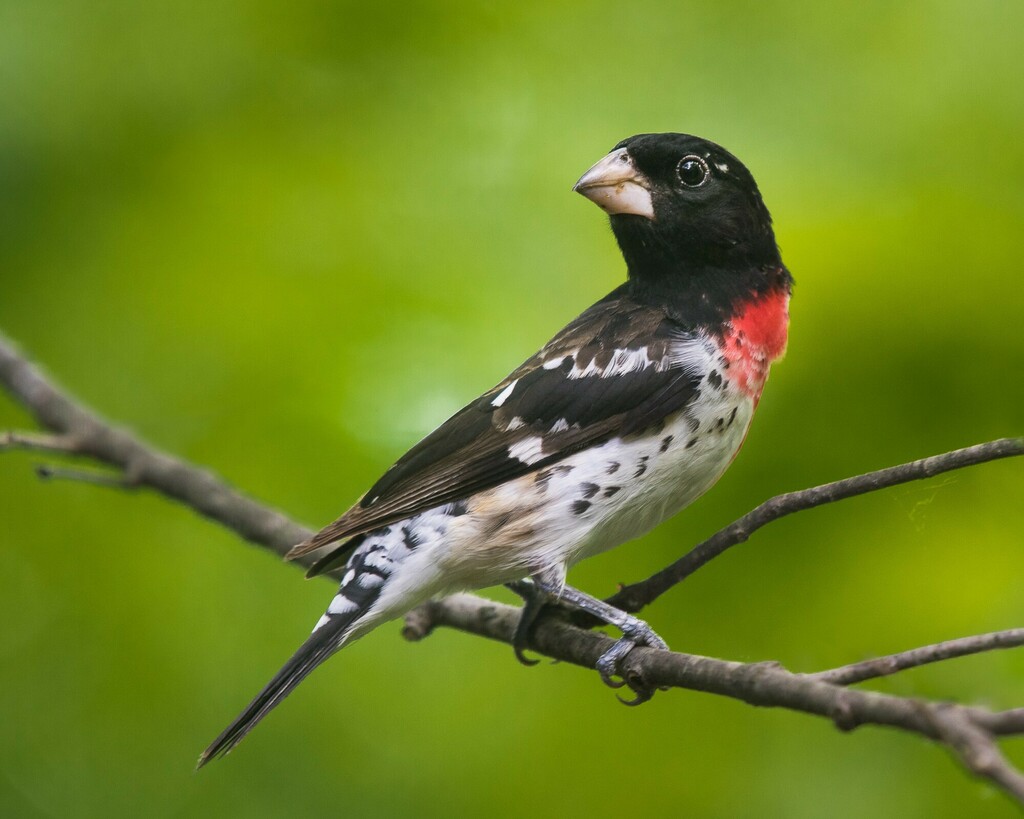
no rights reserved · CC0
Family: Cardinalidae · Class: Aves · Order: Passeriformes
Pheucticus ludovicianus (Rose-breasted Grosbeak) is a California animal in the Cardinalidae family.
The Rose-breasted Grosbeak is a medium-sized songbird in the cardinal family (Cardinalidae). Adult males measure 18-21 cm (7-8.3 inches) in length with a wingspan of 29-33 cm (11.4-13 inches) and weigh 35-65 grams (1.2-2.3 ounces). Breeding males display distinctive black heads, backs, and wings with white wing patches and rump, contrasted by a prominent triangular rose-red patch on the breast and rose-red wing linings visible in flight. Females and immature birds are brown and streaky with white eyebrows, resembling large sparrows, though they retain the species' characteristic thick, pale bill adapted for seed crushing. Historically, Rose-breasted Grosbeaks bred across the eastern deciduous forests of North America from southeastern Canada south to Kansas, Missouri, and northern Georgia. In California, the species occurs primarily as an uncommon migrant during spring (April-May) and fall (August-September). Small numbers have been documented breeding in the northeastern Sierra Nevada and southern Cascade Range, representing the westernmost extent of the breeding range. Most California records come from desert oases, urban parks, and riparian corridors during migration, with coastal observations increasing in recent decades. Breeding habitat consists of mature deciduous and mixed forests with dense canopy cover, particularly areas dominated by oak, maple, and aspen. The species favors forest edges, clearings, and second-growth woodlands with abundant understory. During migration through California, Rose-breasted Grosbeaks utilize riparian woodlands, urban parks with mature trees, and desert oases. They show preference for areas with water sources and dense vegetation for cover. Rose-breasted Grosbeaks are omnivorous, with diet varying seasonally. During breeding, they consume primarily insects including beetles, caterpillars, moths, and aphids, which provide protein for growing nestlings. Seeds, fruits, and tree buds constitute the majority of their diet during migration and winter. The species constructs loose cup nests 1.5-7.5 meters (5-25 feet) high in deciduous trees, typically in a fork of branches. Females lay 3-5 pale blue to blue-green eggs with brown spots, incubated for 12-14 days. Both parents feed nestlings, which fledge after 9-12 days. The species produces one to two broods per season in optimal habitat. The Rose-breasted Grosbeak is not federally listed and maintains stable populations across most of its range, though some regional declines have been documented. According to the North American Breeding Bird Survey, populations declined approximately 1.5% annually between 1966-2019, primarily due to habitat loss in both breeding and wintering areas. In California, the species remains uncommon with no specific conservation status designation. Climate change may affect migration timing and expand the western breeding range. The species benefits from forest management practices that maintain diverse age classes and edge habitats.
Classification
Class: Aves · Order: Passeriformes · Family: Cardinalidae
Frequently asked questions
How is Pheucticus ludovicianus classified?
Pheucticus ludovicianus belongs to class Aves, order Passeriformes, family Cardinalidae.
What family does Pheucticus ludovicianus belong to?
Pheucticus ludovicianus is in the Cardinalidae family.
What is Pheucticus ludovicianus?
The Rose-breasted Grosbeak is a medium-sized songbird in the cardinal family (Cardinalidae).
Is Pheucticus ludovicianus found in California?
Yes. Pheucticus ludovicianus is recorded in California in The California Species Project's catalogue.
Related species
Other California species in the same genus, family, or bioregion.
Data from The California Species Project — 14,000+ California species with verified data from CNPS, CDFW, USFWS, and more.