Pheucticus melanocephalus
Black-headed Grosbeak
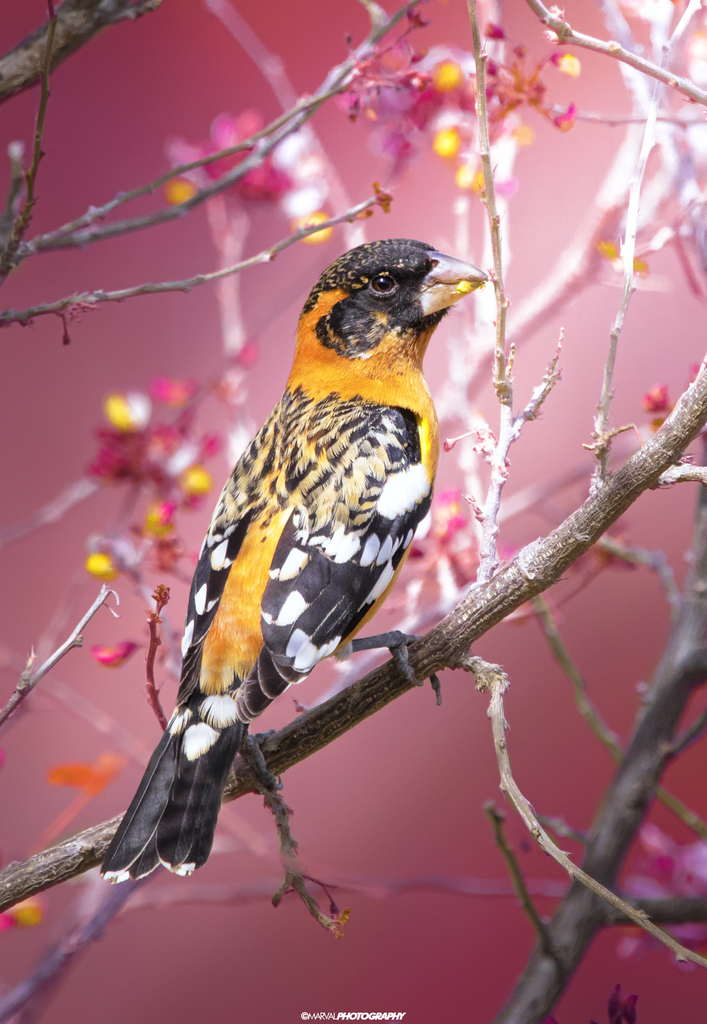
(c) MarvalPhotography19, some rights reserved (CC BY) · licence
Family: Cardinalidae · Class: Aves · Order: Passeriformes
Pheucticus melanocephalus (Black-headed Grosbeak) is a California animal in the Cardinalidae family.
The Black-headed Grosbeak is a medium-sized songbird measuring 18 to 19 centimeters (7.1 to 7.5 inches) in length with a wingspan of 29 to 33 centimeters (11.4 to 13.0 inches). Adult males display distinctive black heads, wings, and tails contrasted by bright orange-rufous underparts and prominent white wing patches visible in flight. The massive, conical bill is pale yellow to horn-colored and perfectly adapted for cracking seeds. Females and juveniles are brown above with buff-colored underparts marked by dark streaking, featuring prominent white eyebrows and wing bars. Both sexes possess the characteristic thick, seed-cracking bill that gives grosbeaks their name. Black-headed Grosbeaks breed throughout western North America from southern British Columbia to central Mexico. In California, they occur in suitable habitat from sea level to 2,400 meters (7,900 feet) elevation, ranging from the Coast Ranges eastward through the Sierra Nevada and southern mountains. The species is present in all California counties except those in the southeastern deserts, with highest densities in foothill and montane regions. They are neotropical migrants, wintering primarily in western and central Mexico. This species inhabits deciduous and mixed woodlands, riparian forests, oak woodlands, and coniferous forests with deciduous understory. Black-headed Grosbeaks prefer edge habitats and forest openings, frequently occurring in parks, orchards, and residential areas with mature trees. They show particular affinity for riparian corridors dominated by cottonwoods, willows, and sycamores, as well as oak-pine associations in foothill regions. Breeding pairs require dense canopy cover for nesting sites and nearby water sources. Black-headed Grosbeaks are omnivorous, consuming seeds, fruits, insects, and occasionally small vertebrates. Their diet shifts seasonally from primarily insects during breeding season to seeds and fruits during migration and winter. Males arrive on breeding grounds in late April to early May and establish territories through song, producing rich, robin-like melodies from prominent perches. Females construct cup-shaped nests 1.5 to 7.5 meters (5 to 25 feet) above ground in deciduous trees, typically placing them in horizontal forks or against tree trunks. Clutches contain 2 to 5 pale blue or blue-green eggs marked with brown spots. Both sexes incubate eggs for 12 to 14 days, with males notably participating more in incubation than most passerine species. Nestlings fledge after 11 to 12 days, and pairs may produce two broods in favorable years. The Black-headed Grosbeak is not federally or state listed and maintains stable populations across most of its range. According to the North American Breeding Bird Survey, populations have remained relatively stable since 1966, with slight increases in some regions. Primary conservation concerns include habitat loss from development and fire management practices that reduce riparian vegetation. Climate change may affect breeding ranges and migration timing, but the species' adaptability to human-modified landscapes provides some resilience. Conservation efforts focus on maintaining riparian corridor integrity and preserving diverse woodland habitats throughout California.
Classification
Class: Aves · Order: Passeriformes · Family: Cardinalidae
Frequently asked questions
How is Pheucticus melanocephalus classified?
Pheucticus melanocephalus belongs to class Aves, order Passeriformes, family Cardinalidae.
What family does Pheucticus melanocephalus belong to?
Pheucticus melanocephalus is in the Cardinalidae family.
What is Pheucticus melanocephalus?
The Black-headed Grosbeak is a medium-sized songbird measuring 18 to 19 centimeters (7.1 to 7.5 inches) in length with a wingspan of 29 to 33 centimeters (11.4 to 13.0 inches).
Is Pheucticus melanocephalus found in California?
Yes. Pheucticus melanocephalus is recorded in California in The California Species Project's catalogue.
Related species
Other California species in the same genus, family, or bioregion.
Data from The California Species Project — 14,000+ California species with verified data from CNPS, CDFW, USFWS, and more.