Phidippus audax
Bold Jumping Spider
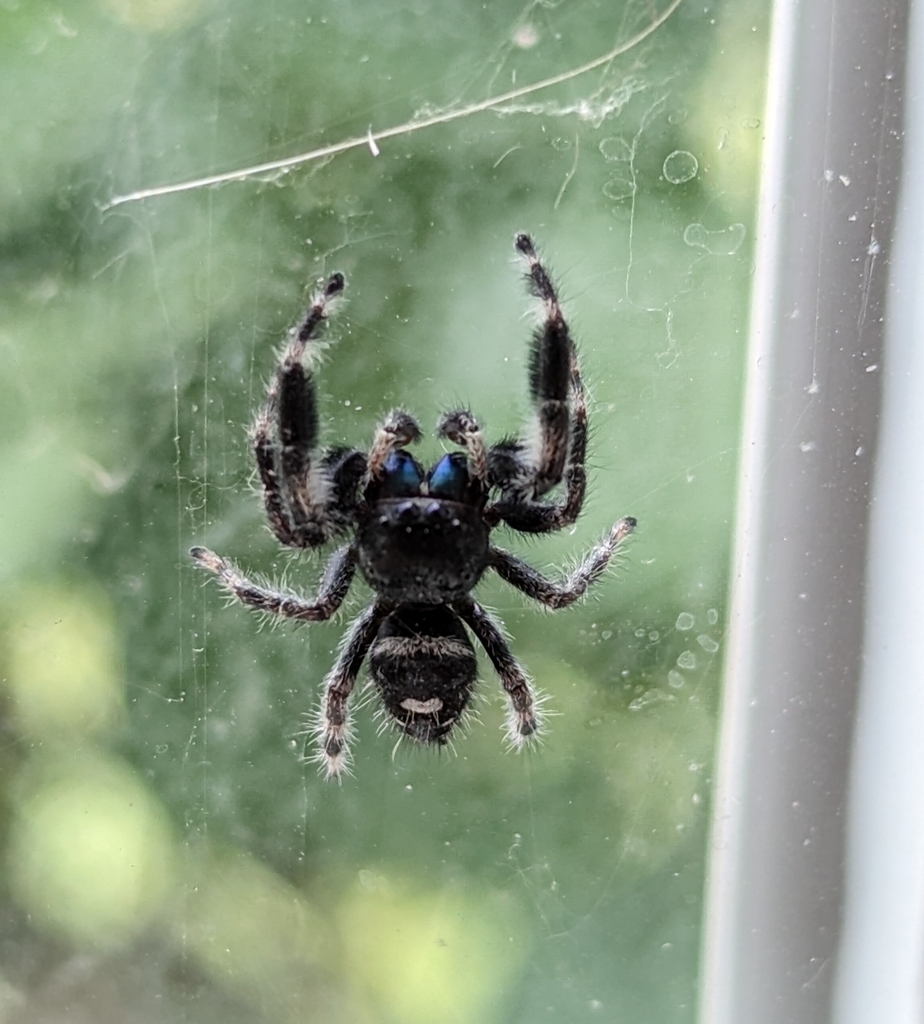
(c) Rebecca Ray, some rights reserved (CC BY) · licence
Family: Salticidae · Class: Arachnida · Order: Araneae
Phidippus audax (Bold Jumping Spider) is a California animal in the Salticidae family.
The bold jumping spider is a medium-sized salticid spider and one of the most widespread jumping spider species in North America. Adults measure 8-15 mm in body length, with females typically larger than males. The species exhibits considerable color variation, with most individuals displaying a black or dark brown cephalothorax and abdomen marked with white spots and bands. Males often show more contrasting patterns, with distinctive white markings on the carapace and chelicerae (mouthparts). The anterior median eyes are notably large and forward-facing, giving these spiders excellent binocular vision. Juveniles may display different coloration patterns, including reddish-brown tones that gradually darken with successive molts. Phidippus audax occurs throughout most of the continental United States and southern Canada, extending from coast to coast. In California, the species is found statewide from sea level to moderate elevations, inhabiting both urban and natural environments. The species' range extends from British Columbia south to northern Mexico, making it one of the most geographically widespread jumping spiders in North America. Bold jumping spiders occupy diverse habitats including gardens, agricultural fields, woodlands, grasslands, and urban environments. They are commonly found on vegetation, fence posts, building exteriors, and other vertical surfaces that provide hunting perches. The species shows broad habitat tolerance, thriving in both disturbed and natural environments. They construct small silk retreats under bark, in rock crevices, or in building crevices for molting, egg-laying, and overwintering. As active visual hunters, bold jumping spiders do not build webs to capture prey. Instead, they stalk and pounce on insects and other small arthropods, using their exceptional eyesight to detect movement from several body lengths away. Their diet includes flies, moths, beetles, other spiders, and various small insects. Mating occurs primarily in spring and early summer, with males performing elaborate courtship displays involving leg waving and body movements. Females construct silk egg sacs containing 100-200 eggs, which they guard until hatching. The species typically produces one to three generations per year, depending on local climate conditions. Adults overwinter in protected locations such as leaf litter, bark crevices, or building eaves. Phidippus audax has no special conservation status at federal or state levels. The species is considered common and stable throughout its range, with populations benefiting from its adaptability to human-modified environments. As a generalist predator, it plays an important role in biological pest control in agricultural and garden settings. The species faces no significant conservation threats and may actually benefit from certain types of habitat modification that create edge environments with abundant prey.
Classification
Class: Arachnida · Order: Araneae · Family: Salticidae
Frequently asked questions
How is Phidippus audax classified?
Phidippus audax belongs to class Arachnida, order Araneae, family Salticidae.
What family does Phidippus audax belong to?
Phidippus audax is in the Salticidae family.
What is Phidippus audax?
The bold jumping spider is a medium-sized salticid spider and one of the most widespread jumping spider species in North America.
Is Phidippus audax found in California?
Yes. Phidippus audax is recorded in California in The California Species Project's catalogue.
Related species
Other California species in the same genus, family, or bioregion.
Data from The California Species Project — 14,000+ California species with verified data from CNPS, CDFW, USFWS, and more.