Phidippus californicus
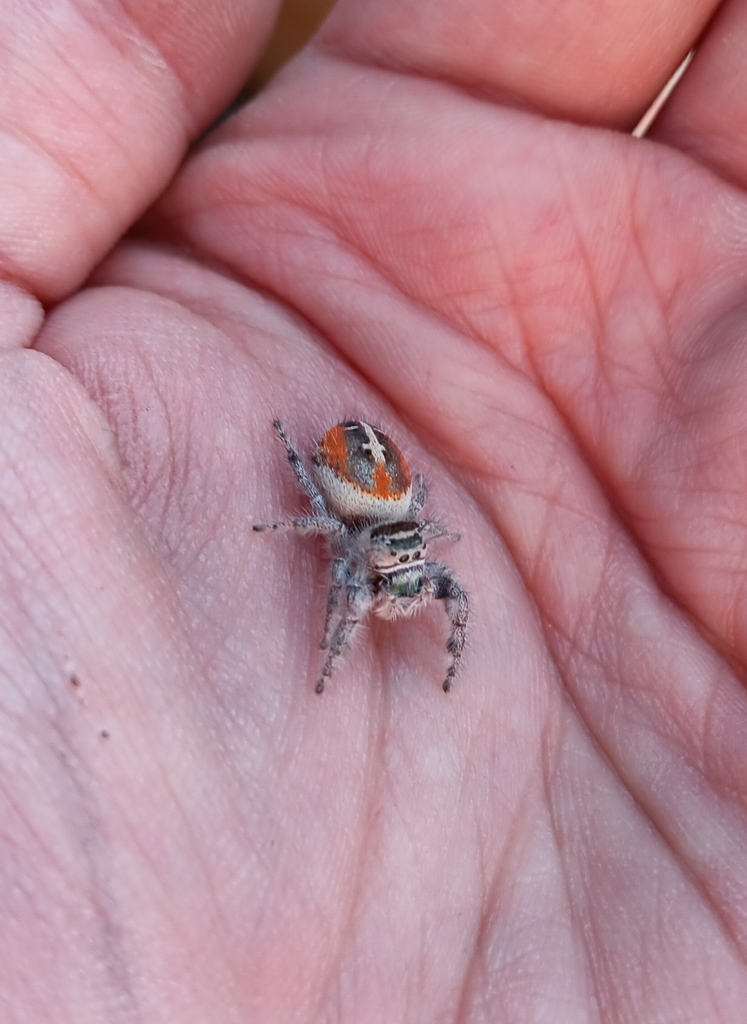
no rights reserved · CC0
Family: Salticidae · Class: Arachnida · Order: Araneae
Phidippus californicus is a California animal in the Salticidae family.
Phidippus californicus is a jumping spider in the family Salticidae, belonging to the otiosus species group within the genus Phidippus. This species exhibits the characteristic robust build and excellent vision typical of jumping spiders, with forward-facing eyes that provide exceptional depth perception for hunting. Males display distinctive coloration patterns, though detailed morphological descriptions remain limited in the scientific literature. This species is endemic to California, with documented occurrences in Orange County. A specimen was photographed and identified from Laguna Beach in July 2020, confirming the species' presence in coastal Southern California (BugGuide.Net 2020). The full extent of its California range requires further documentation, as most Phidippus species have relatively restricted distributions compared to other spider families. Phidippus californicus inhabits coastal environments, based on the Laguna Beach record. Like other members of the genus, this species likely occurs in areas with suitable hunting grounds and retreat sites. Jumping spiders typically require microhabitats that provide both hunting opportunities and protection, such as rock crevices, vegetation, or human-made structures. The coastal location suggests potential adaptation to Mediterranean climate conditions with mild, wet winters and dry summers. As a member of Salticidae, P. californicus is an active visual hunter rather than a web-builder. Jumping spiders are renowned for their stalking behavior, using their exceptional eyesight to locate prey before making precise leaps to capture insects and other small arthropods. Males likely perform elaborate courtship displays involving leg waving, body positioning, and potentially colorful ornamentation to attract females. Reproduction probably follows the typical jumping spider pattern of males approaching females with ritualized displays to avoid being mistaken for prey. The conservation status of Phidippus californicus has not been formally assessed. However, the species appears in habitat conservation planning documents for the Warm Springs area, suggesting it may be a species of local conservation interest (USFWS ECOS database). California's coastal habitats face ongoing pressure from urban development, which could potentially impact populations of endemic arthropods like P. californicus. The limited number of documented records may reflect either genuine rarity or insufficient sampling effort, a common issue with small arthropod species that often receive less attention than vertebrates. Scientific documentation for this species remains limited. The information presented here synthesizes available observations from taxonomic databases and photographic records. Detailed studies of its ecology, distribution, and population status are needed to better understand this California endemic. The species' placement in the otiosus group suggests close relationships with other Phidippus species, but comprehensive taxonomic and phylogenetic studies would clarify its evolutionary relationships and conservation priority.
Classification
Class: Arachnida · Order: Araneae · Family: Salticidae
Frequently asked questions
How is Phidippus californicus classified?
Phidippus californicus belongs to class Arachnida, order Araneae, family Salticidae.
What family does Phidippus californicus belong to?
Phidippus californicus is in the Salticidae family.
What is Phidippus californicus?
Phidippus californicus is a jumping spider in the family Salticidae, belonging to the otiosus species group within the genus Phidippus.
Is Phidippus californicus found in California?
Yes. Phidippus californicus is recorded in California in The California Species Project's catalogue.
Related species
Other California species in the same genus, family, or bioregion.
Data from The California Species Project — 14,000+ California species with verified data from CNPS, CDFW, USFWS, and more.