Phidippus clarus
Brilliant Jumping Spider
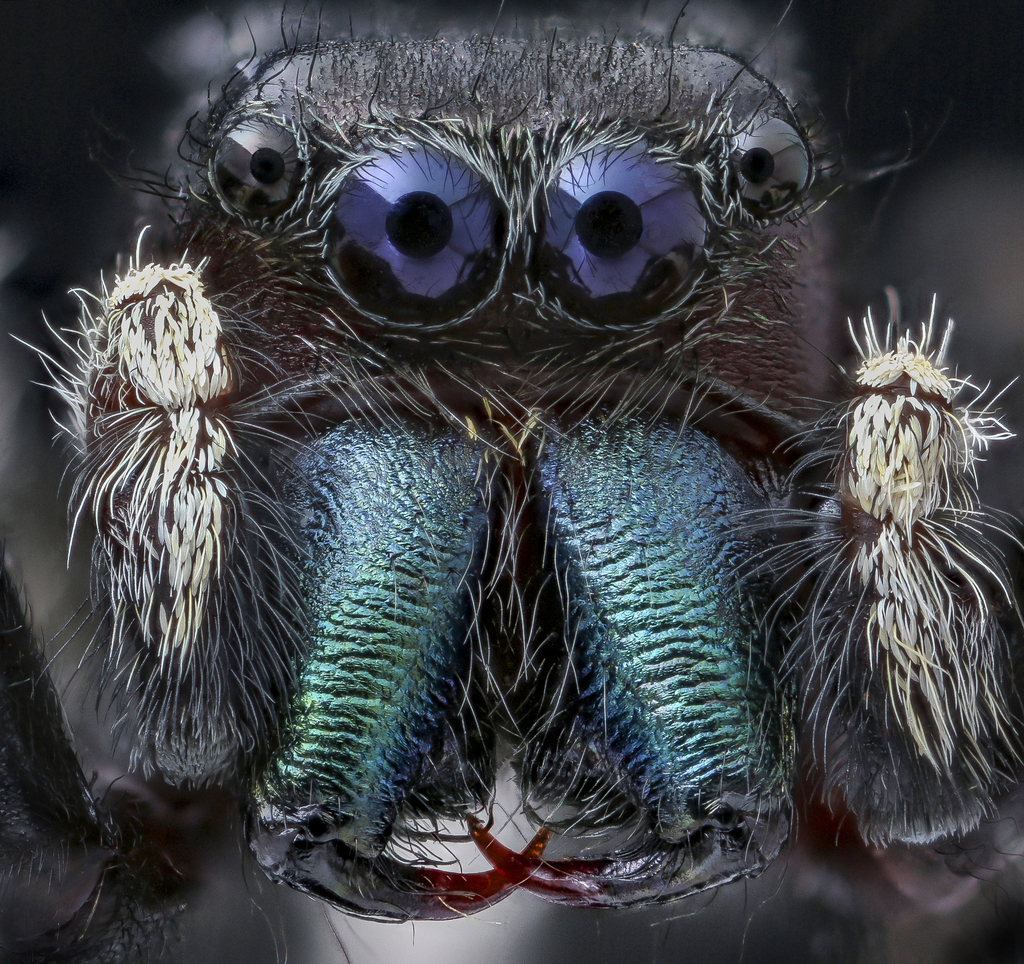
no rights reserved · CC0
Family: Salticidae · Class: Arachnida · Order: Araneae
Phidippus clarus (Brilliant Jumping Spider) is a California animal in the Salticidae family.
Phidippus clarus (C.L. Koch, 1846) is a medium-sized jumping spider in the family Salticidae, characterized by its robust build and distinctive coloration. Adult females measure 10-15 mm in body length, while males are typically smaller at 8-12 mm. The species exhibits sexual dimorphism in coloration: males display iridescent chelicerae (mouthparts) that can appear green or blue depending on lighting, while females are generally more subdued in appearance. Both sexes have compact, muscular bodies typical of jumping spiders, with large anterior median eyes that provide excellent vision for hunting. Phidippus clarus has a broad distribution across North America, ranging from southern Canada through most of the United States, with the notable exception of the desert Southwest (Bradley 2012). The species occurs from coast to coast, with documented populations extending from New England to the Pacific Northwest and south through the southeastern states. In Florida, P. clarus has been documented in St. Lucie and Okeechobee counties, where it co-occurs with related species including P. regius, P. pius, and P. workmani. This species inhabits old fields, prairies, agricultural crops, and other areas dominated by low herbaceous vegetation (Bradley 2012). P. clarus shows a preference for open, sunny habitats with abundant flowering plants that attract insect prey. The spiders are commonly found on wildflowers, grasses, and crop plants where they construct retreats and hunt for small arthropods. Unlike the closely related P. pius, which has been observed utilizing cacti as habitat in Florida, P. clarus appears to avoid succulent vegetation. Phidippus clarus is an active diurnal hunter that relies on its exceptional vision to locate and stalk prey. Like other jumping spiders, it does not construct webs for prey capture but instead uses silk for safety lines and retreat construction. Females create conspicuous white silk retreats and egg cases near the tops of plants, making them relatively easy to locate during field surveys (Bradley 2012). The species exhibits seasonal activity patterns, with males typically active during summer months and females present through summer and autumn. In Florida populations, P. clarus matures later in the season compared to P. pius, with adults appearing primarily in late July and August rather than June. The reproductive behavior includes elaborate courtship displays characteristic of jumping spiders, with males performing visual and vibratory signals to attract females. After mating, females deposit eggs in silk cases within their retreats, where they guard the developing offspring until emergence. Phidippus clarus is not listed under federal or state endangered species legislation and appears to maintain stable populations throughout its range. The species benefits from its adaptability to agricultural and disturbed habitats, though intensive farming practices and habitat conversion may impact local populations. As a generalist predator, P. clarus likely plays an important role in controlling agricultural pest insects. No specific conservation measures are currently needed for this widespread species, though maintaining diverse agricultural landscapes and reducing pesticide use would benefit jumping spider populations generally.
Classification
Class: Arachnida · Order: Araneae · Family: Salticidae
Frequently asked questions
How is Phidippus clarus classified?
Phidippus clarus belongs to class Arachnida, order Araneae, family Salticidae.
What family does Phidippus clarus belong to?
Phidippus clarus is in the Salticidae family.
What is Phidippus clarus?
Phidippus clarus (C.L.
Is Phidippus clarus found in California?
Yes. Phidippus clarus is recorded in California in The California Species Project's catalogue.
Related species
Other California species in the same genus, family, or bioregion.
Data from The California Species Project — 14,000+ California species with verified data from CNPS, CDFW, USFWS, and more.