Phidippus comatus
Hairy Tufted Jumping Spider
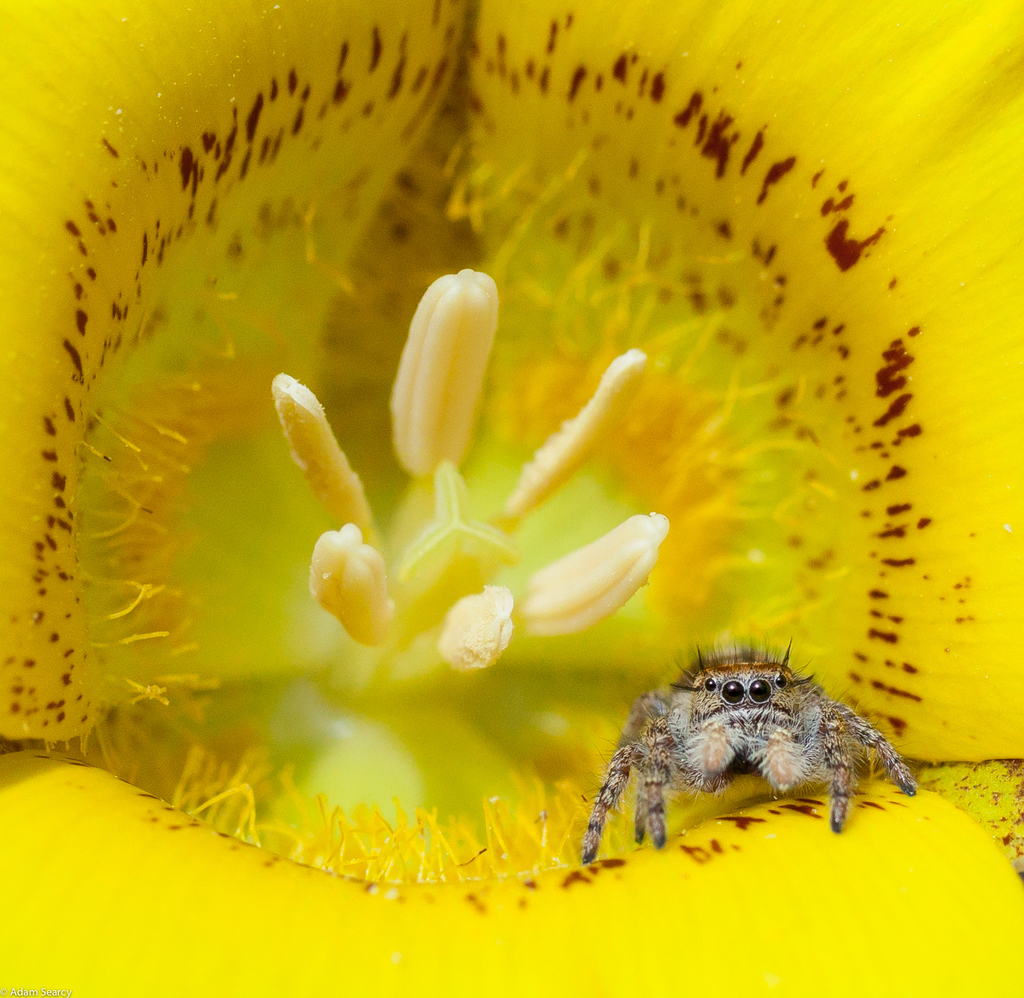
(c) Adam J. Searcy, some rights reserved (CC BY) · licence
Family: Salticidae · Class: Arachnida · Order: Araneae
Phidippus comatus (Hairy Tufted Jumping Spider) is a California animal in the Salticidae family.
Phidippus comatus is a medium to large jumping spider in the family Salticidae, distinguished by its robust build and dense body hair that gives it its common name. Adults typically measure 10-15 mm (0.4-0.6 inches) in body length, with females generally larger than males. The species exhibits the characteristic stocky build of the Phidippus genus, with a high carapace and prominent anterior median eyes. Body coloration ranges from grayish-brown to darker brown, with dense setae covering the entire body creating a distinctly hairy appearance. Males often display more contrasting patterns and may show iridescent chelicerae during courtship displays. Phidippus comatus occurs in western North America, with documented populations in California, Nevada, and other western states. In California, the species has been recorded from various counties including Inyo County, where specimens have been observed in the eastern Sierra Nevada region (BugGuide 2015). The species appears to have a relatively broad elevational range, from desert valleys to montane areas, though specific elevation limits have not been well documented in the literature. This jumping spider inhabits diverse terrestrial environments including desert scrublands, chaparral, oak woodlands, and pine forests. Phidippus comatus demonstrates adaptability to human-modified environments and has been found hunting along building walls and in residential areas. The species appears to prefer areas with adequate prey availability and suitable surfaces for web construction, though like most jumping spiders, it does not rely primarily on webs for prey capture. Phidippus comatus is an active visual predator that hunts during daylight hours using its excellent vision. The large anterior median eyes provide acute visual acuity for detecting and stalking prey, which consists primarily of flying insects, other spiders, and small arthropods. Hunting behavior involves careful stalking followed by a precisely timed jumping attack. Males perform elaborate courtship displays involving leg waving, body positioning, and cheliceral displays to attract females. Mating typically occurs during warmer months, with females constructing silk egg sacs that they guard until spiderlings emerge. Like other Phidippus species, this jumping spider constructs silk retreats under rocks, bark, or other protected locations where individuals molt and females deposit eggs. Phidippus comatus currently holds no federal or state conservation listing status. The species appears to maintain stable populations throughout its range, though comprehensive population surveys have not been conducted. Urban development and habitat modification may impact local populations, but the species' apparent adaptability to human-modified environments suggests it faces fewer conservation challenges than more habitat-specialized spiders. Climate change effects on prey availability and habitat suitability remain largely unstudied for this species. No specific conservation measures are currently in place, though habitat preservation efforts benefiting general arthropod communities would support P. comatus populations.
Classification
Class: Arachnida · Order: Araneae · Family: Salticidae
Frequently asked questions
How is Phidippus comatus classified?
Phidippus comatus belongs to class Arachnida, order Araneae, family Salticidae.
What family does Phidippus comatus belong to?
Phidippus comatus is in the Salticidae family.
What is Phidippus comatus?
Phidippus comatus is a medium to large jumping spider in the family Salticidae, distinguished by its robust build and dense body hair that gives it its common name.
Is Phidippus comatus found in California?
Yes. Phidippus comatus is recorded in California in The California Species Project's catalogue.
Related species
Other California species in the same genus, family, or bioregion.
Data from The California Species Project — 14,000+ California species with verified data from CNPS, CDFW, USFWS, and more.