Phidippus johnsoni
Johnson's Jumping Spider
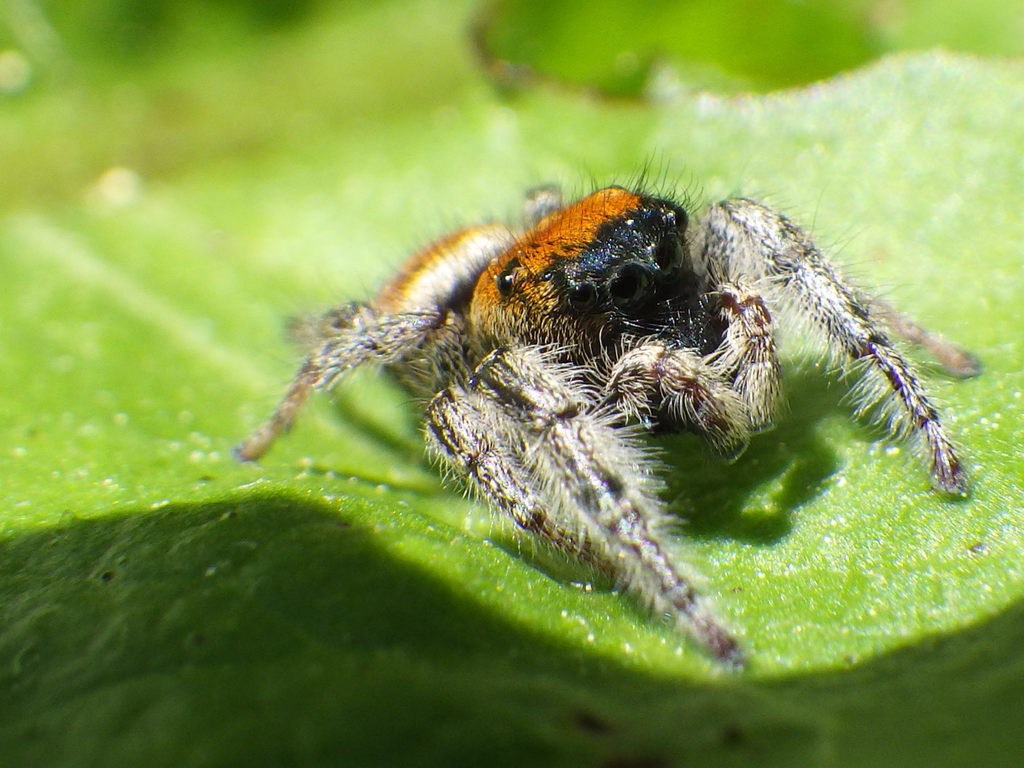
(c) Ben Armstrong, some rights reserved (CC BY) · licence
Family: Salticidae · Class: Arachnida · Order: Araneae
Phidippus johnsoni (Johnson's Jumping Spider) is a California animal in the Salticidae family.
Phidippus johnsoni is a medium-sized jumping spider belonging to the family Salticidae. Adults typically measure 8 to 15 millimeters (0.3 to 0.6 inches) in body length, with females generally larger than males. Males display distinctive iridescent chelicerae (mouthparts) that appear metallic green or blue depending on lighting conditions. The species exhibits pronounced sexual dimorphism, with males featuring black bodies marked by white spots or stripes, while females are typically brown or gray with similar white markings. Both sexes possess the characteristic large, forward-facing anterior median eyes that provide exceptional vision for hunting and courtship behaviors. Phidippus johnsoni occurs throughout much of western North America, with confirmed populations extending from British Columbia south through California and east to Colorado and New Mexico. In California, the species has been documented across diverse regions from coastal areas to inland valleys and mountainous terrain. The species appears to have a broad elevational range, occurring from near sea level to moderate elevations in montane environments. This species inhabits a variety of terrestrial ecosystems including chaparral, oak woodlands, grasslands, and urban gardens. Phidippus johnsoni demonstrates considerable habitat flexibility, utilizing both natural and anthropogenic environments. The species has been documented in the Ballona Wetlands area, indicating its presence in coastal sage scrub and wetland edge habitats (Mattoni 1991). Adults are commonly found on vegetation, fences, building walls, and other vertical surfaces where they actively hunt for prey. As an active predator, Phidippus johnsoni employs visual hunting strategies characteristic of jumping spiders. The species feeds primarily on small arthropods including flies, mosquitoes, moths, and other spiders. Males perform elaborate courtship displays involving leg waving, body positioning, and movements designed to showcase their iridescent chelicerae to potential mates. Mating typically occurs during warmer months, with females producing egg sacs containing 15 to 50 eggs. Development from egg to adult generally requires one year, with spiderlings overwintering in silk retreats under bark, rocks, or in vegetation. Phidippus johnsoni currently holds no federal or state conservation listing status. According to NatureServe, the species is ranked G4 (Apparently Secure) globally, indicating stable populations across its range (NatureServe Explorer). The species appears to be relatively common throughout most of its distribution and has demonstrated adaptability to human-modified landscapes. While the species has been included on species of greatest conservation need lists in some states such as Arkansas and New Mexico, this designation reflects knowledge gaps rather than documented population declines (BugGuide). The species' broad habitat tolerance and apparent stability suggest it faces no immediate conservation concerns, though continued monitoring of populations in urbanizing areas would be beneficial to assess long-term trends.
Classification
Class: Arachnida · Order: Araneae · Family: Salticidae
Frequently asked questions
How is Phidippus johnsoni classified?
Phidippus johnsoni belongs to class Arachnida, order Araneae, family Salticidae.
What family does Phidippus johnsoni belong to?
Phidippus johnsoni is in the Salticidae family.
What is Phidippus johnsoni?
Phidippus johnsoni is a medium-sized jumping spider belonging to the family Salticidae.
Is Phidippus johnsoni found in California?
Yes. Phidippus johnsoni is recorded in California in The California Species Project's catalogue.
Related species
Other California species in the same genus, family, or bioregion.
Data from The California Species Project — 14,000+ California species with verified data from CNPS, CDFW, USFWS, and more.