Phidippus phoenix
Phoenix Jumping Spider
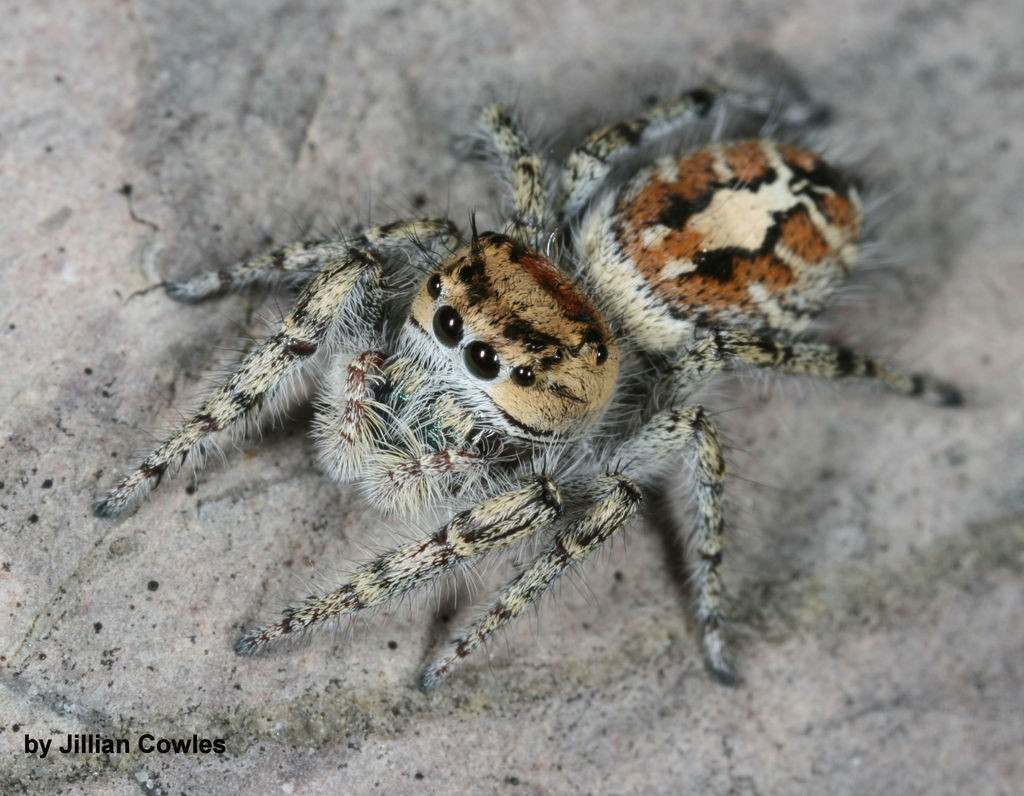
(c) jcowles, some rights reserved (CC BY) · licence
Family: Salticidae · Class: Arachnida · Order: Araneae
Phidippus phoenix (Phoenix Jumping Spider) is a California animal in the Salticidae family.
The Phoenix jumping spider (Phidippus phoenix) is a member of the family Salticidae, the largest family of spiders worldwide. Like other jumping spiders, this species possesses large forward-facing eyes that provide acute vision for hunting and navigation. The body structure is compact and robust, typical of the genus Phidippus, with powerful legs adapted for jumping and precise movements during prey capture. The range and distribution of Phidippus phoenix remain poorly documented in the scientific literature. According to NatureServe Explorer, the species has a global conservation status of GNR (Global Not Ranked) and a national status of NNR (National Not Ranked), indicating insufficient data for formal conservation assessment. The specific geographic range within California, if present, has not been thoroughly surveyed or documented in available databases. Habitat requirements for this species are not well established in the literature. As a member of the jumping spider family, P. phoenix likely inhabits areas with sufficient prey availability and suitable surfaces for hunting and web construction. Most Phidippus species utilize diverse microhabitats including vegetation, rock surfaces, and human-modified environments, though specific substrate preferences for P. phoenix remain undocumented. Jumping spiders are active daytime hunters that rely on their exceptional vision to locate and stalk prey (BugGuide). Members of this family are known for their cat-like stalking behavior, approaching prey slowly before executing precise jumps to capture their target. They construct small silk retreats rather than prey-capture webs, using silk primarily for safety lines during jumps and for egg sac construction. Reproductive behavior typically involves complex courtship displays where males use visual signals and movements to attract females, though specific mating behaviors for P. phoenix have not been documented. The genus Phidippus contains 77 recognized species distributed across North America from Alaska to Costa Rica, including the Bahamas, Bermuda, Easter Island, Hawaii, and the Greater Antilles (BugGuide). However, detailed ecological studies and taxonomic research on P. phoenix specifically are lacking in the available literature. Conservation status information for this species is extremely limited. The lack of ranking by NatureServe suggests that insufficient data exists to assess population trends, threats, or conservation needs. No federal or state listing status has been assigned to P. phoenix, and it does not appear in current U.S. Fish and Wildlife Service databases for threatened or endangered species. Scientific documentation for this species remains limited. The information presented here is based on available sources including NatureServe Explorer and BugGuide taxonomic databases. If you have additional verified information about this species' biology, distribution, or ecology, please contact us to help improve this species account.
Classification
Class: Arachnida · Order: Araneae · Family: Salticidae
Frequently asked questions
How is Phidippus phoenix classified?
Phidippus phoenix belongs to class Arachnida, order Araneae, family Salticidae.
What family does Phidippus phoenix belong to?
Phidippus phoenix is in the Salticidae family.
What is Phidippus phoenix?
The Phoenix jumping spider (Phidippus phoenix) is a member of the family Salticidae, the largest family of spiders worldwide.
Is Phidippus phoenix found in California?
Yes. Phidippus phoenix is recorded in California in The California Species Project's catalogue.
Related species
Other California species in the same genus, family, or bioregion.
Data from The California Species Project — 14,000+ California species with verified data from CNPS, CDFW, USFWS, and more.