Phigalia plumogeraria
Walnut Spanworm Moth
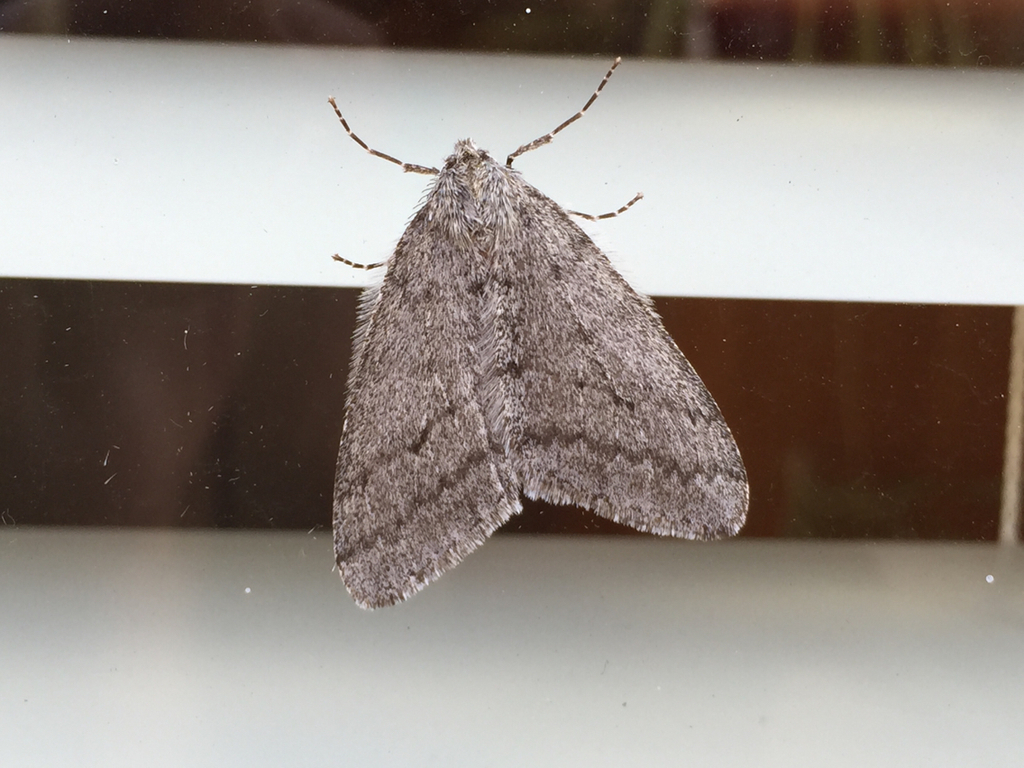
(c) Lindsey K. Wise, some rights reserved (CC BY) · licence
Family: Geometridae · Class: Insecta · Order: Lepidoptera
Phigalia plumogeraria (Walnut Spanworm Moth) is a California animal in the Geometridae family.
The walnut spanworm moth (Phigalia plumogeraria) is a geometrid moth species characterized by extreme sexual dimorphism. Males possess well-developed wings with a wingspan of approximately 35-40 mm (1.4-1.6 inches), displaying mottled gray-brown coloration with darker crosslines and lighter patches that provide camouflage against tree bark. Females are wingless or nearly so, with vestigial wing stubs, and have a robust, cylindrical body adapted for climbing tree trunks. The antennae of males are broadly bipectinate (feather-like), while female antennae are simple and thread-like. This species ranges across western North America from British Columbia south through California, extending eastward to Utah and Wyoming. Within this distribution, populations occur in areas where suitable host plants are present, typically in foothill and montane regions. The species' range corresponds closely with the distribution of its primary host plant, antelope bitterbrush (Purshia tridentata), which is most abundant in the Great Basin and adjacent mountainous regions. Walnut spanworm moths inhabit shrublands, open woodlands, and riparian areas where host plants occur. They are most commonly found in sagebrush-steppe ecosystems, oak woodlands, and mixed coniferous forests at elevations ranging from valley floors to approximately 2,400 meters (7,900 feet). The species shows a particular association with areas containing antelope bitterbrush, but also utilizes walnut species (Juglans) and willow (Salix) as larval host plants. Adult moths emerge in late fall to early winter, typically from October through December, with peak activity occurring during November. This timing coincides with the dormant season of deciduous host plants. Mating occurs on host plant branches, where the wingless females release pheromones to attract flying males. After mating, females deposit eggs in bark crevices or on twigs of host plants, where they overwinter. Larvae hatch in spring and feed on emerging foliage, exhibiting the characteristic looping locomotion typical of geometrid caterpillars. The caterpillars are green to brown with longitudinal stripes, effectively camouflaged on host plant foliage. Pupation occurs in soil or leaf litter during summer. Larvae are specialist feeders on rosaceous shrubs and trees, with antelope bitterbrush serving as the primary host in much of their range. On walnut and willow hosts, feeding typically occurs on young leaves and developing buds. The species completes one generation per year, with the extended egg stage allowing survival through harsh winter conditions. The conservation status of the walnut spanworm moth has not been formally assessed at federal or state levels. However, like many specialist herbivores, populations may be vulnerable to habitat loss and fragmentation affecting host plant communities. In California, conversion of shrubland habitat to agriculture and urban development potentially impacts local populations. The species' dependence on specific host plants makes it sensitive to changes in plant community composition caused by invasive species, altered fire regimes, or climate change effects on host plant distribution.
Classification
Class: Insecta · Order: Lepidoptera · Family: Geometridae
Frequently asked questions
How is Phigalia plumogeraria classified?
Phigalia plumogeraria belongs to class Insecta, order Lepidoptera, family Geometridae.
What family does Phigalia plumogeraria belong to?
Phigalia plumogeraria is in the Geometridae family.
What is Phigalia plumogeraria?
The walnut spanworm moth (Phigalia plumogeraria) is a geometrid moth species characterized by extreme sexual dimorphism.
Is Phigalia plumogeraria found in California?
Yes. Phigalia plumogeraria is recorded in California in The California Species Project's catalogue.
Related species
Other California species in the same genus, family, or bioregion.
Data from The California Species Project — 14,000+ California species with verified data from CNPS, CDFW, USFWS, and more.