Philotes sonorensis
Sonoran Blue
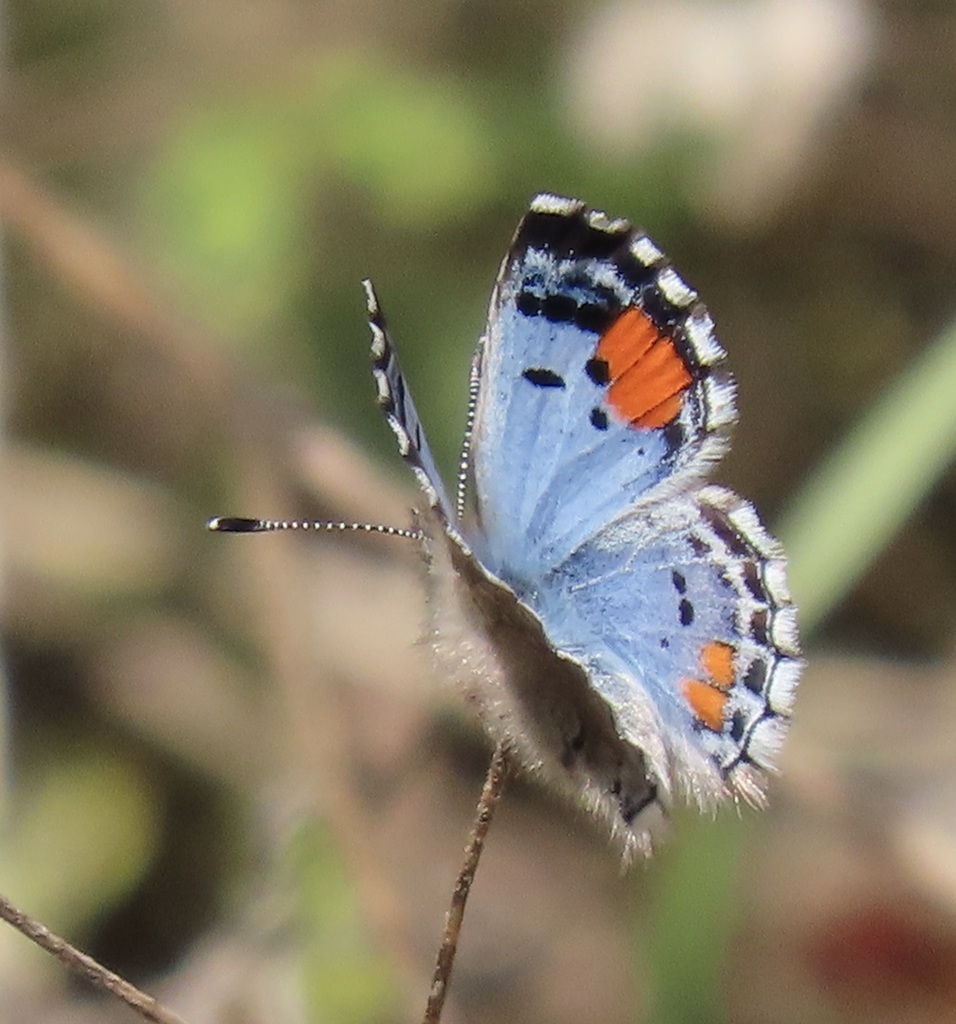
(c) John Hibbard, some rights reserved (CC BY) · licence
Family: Lycaenidae · Class: Insecta · Order: Lepidoptera
Philotes sonorensis (Sonoran Blue) is a California animal in the Lycaenidae family.
The Sonoran blue is a small butterfly in the gossamer-wing family Lycaenidae. Adults have a wingspan of approximately 18-25 mm (0.7-1.0 inches). Males display iridescent blue dorsal wing surfaces, while females are typically brown with blue scaling near the wing bases. The undersides of both sexes are pale gray to white with distinct black spots and orange marginal markings characteristic of the Lycaenidae family. Philotes sonorensis occurs in a disjunct distribution pattern across western North America. In California, the species ranges from Placer County in the north, west to Santa Clara County, then continues along the coast through southern California into Baja California, Mexico. The range extends eastward into Colorado and northern Mexico, forming isolated populations across desert regions. According to iNaturalist, Philotes is a monotypic genus containing only P. sonorensis. The species inhabits rocky desert environments including washes, outcrops, and cliffs. These butterflies are closely associated with their host plants in the stonecrop family (Crassulaceae), specifically Dudleya species. The habitat consists of arid landscapes where these succulent plants grow on rocky substrates, typically in areas with good drainage and sun exposure. Elevations range from sea level coastal areas to higher desert elevations. Sonoran blues are obligately associated with Dudleya species throughout their life cycle. Females lay eggs directly on the succulent leaves, and larvae feed exclusively on the stonecrop tissues. The species likely has one generation per year, synchronized with the growing season of its host plants. Adults are most active during spring months when Dudleya plants are in bloom, providing both larval food resources and adult nectar sources. The butterflies exhibit strong site fidelity, remaining close to colonies of suitable host plants. The conservation status of Philotes sonorensis varies significantly across its range due to habitat fragmentation and subspecific variation. The subspecies P. s. extinctis, which occurred in the upper San Gabriel River wash in southern California, has been extinct since 1968 when its habitat was destroyed (Butterflies and Moths of North America). This local extinction demonstrates the vulnerability of isolated populations to habitat loss. The species faces ongoing threats from urban development, quarrying activities that destroy rocky habitat, and invasive plant species that compete with native Dudleya populations. Climate change may also impact the distribution of suitable habitat, particularly at the margins of the species' range. Current population trends and specific conservation measures for remaining populations have not been well documented, highlighting the need for systematic surveys and monitoring programs to assess the status of this specialized desert butterfly across its fragmented range.
Classification
Class: Insecta · Order: Lepidoptera · Family: Lycaenidae
Frequently asked questions
How is Philotes sonorensis classified?
Philotes sonorensis belongs to class Insecta, order Lepidoptera, family Lycaenidae.
What family does Philotes sonorensis belong to?
Philotes sonorensis is in the Lycaenidae family.
What is Philotes sonorensis?
The Sonoran blue is a small butterfly in the gossamer-wing family Lycaenidae.
Is Philotes sonorensis found in California?
Yes. Philotes sonorensis is recorded in California in The California Species Project's catalogue.
Related species
Other California species in the same genus, family, or bioregion.
Data from The California Species Project — 14,000+ California species with verified data from CNPS, CDFW, USFWS, and more.