Philotiella speciosa
Small Dotted-Blue
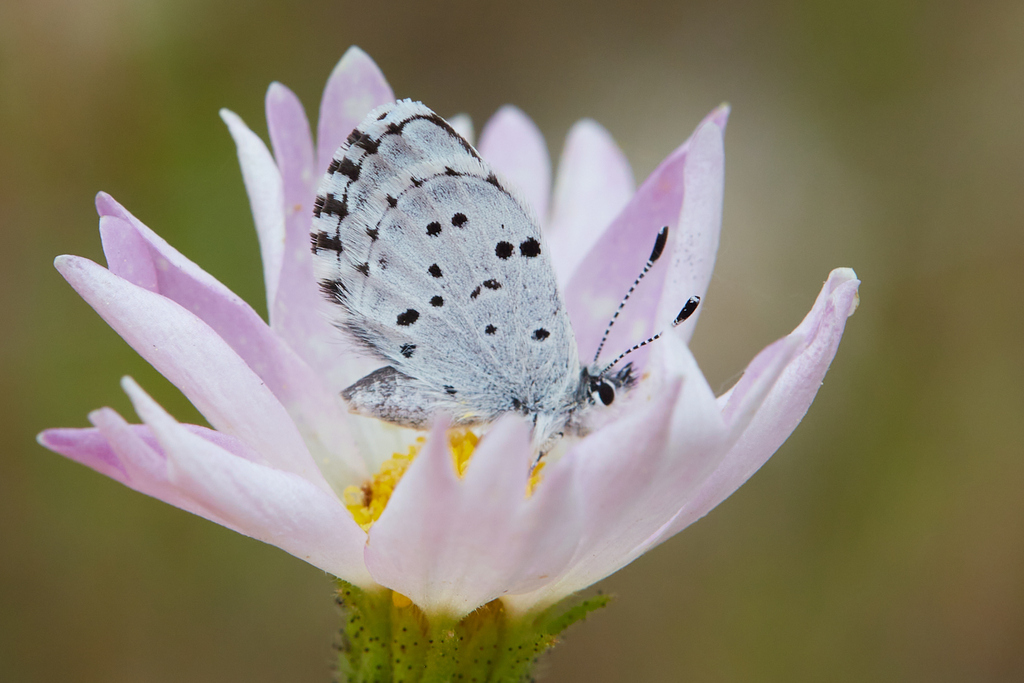
(c) Ken-ichi Ueda, some rights reserved (CC BY) · licence
Family: Lycaenidae · Class: Insecta · Order: Lepidoptera
Philotiella speciosa (Small Dotted-Blue) is a California animal in the Lycaenidae family.
The Small Dotted-Blue (Philotiella speciosa) is a diminutive butterfly in the gossamer-wing family Lycaenidae. Adults have a wingspan of approximately 18-25 mm (0.7-1.0 inches). Males display bright blue dorsal wing surfaces with narrow black borders and white fringe, while females typically show brown dorsal coloration with varying degrees of blue scaling near the wing bases. The ventral wing surfaces of both sexes are pale gray to white with distinctive black spots outlined in white, giving the species its 'dotted' common name. The hindwings bear small orange crescents along the outer margins, and males possess scent patches on their forewings used in courtship. The Small Dotted-Blue occurs in western Nevada and eastern and southeastern California, where it maintains local and uncommon populations. In California, the species is documented from the eastern Sierra Nevada, Mojave Desert, and portions of the Sonoran Desert region. The range extends into Nevada's western counties, particularly in areas with suitable host plant communities. This distribution pattern reflects the species' adaptation to arid and semi-arid environments of the Great Basin and Mojave Desert ecoregions. The species inhabits open desert flats, rocky slopes, and canyon washes at elevations typically ranging from 300 to 2,100 meters (1,000 to 6,900 feet). Small Dotted-Blues are closely associated with their host plants, which include species of Oxytheca and Eriogonum in the buckwheat family (Polygonaceae). These plants thrive in sandy or gravelly soils with good drainage, often in areas receiving limited annual precipitation. The butterfly's habitat is characterized by sparse vegetation cover and exposed mineral soil, typical of desert shrubland and pinyon-juniper woodland edge communities. Adult Small Dotted-Blues are active during daylight hours, with males establishing territories near host plant patches where they await females. Flight period typically occurs from April through September, with peak activity during late spring and early summer months when host plants are flowering. Females lay their eggs singly on flower buds or young leaves of Oxytheca and Eriogonum species. Larvae feed within the flower heads and developing seed structures, often attended by ants that provide protection in exchange for sugary secretions. The species likely overwinters as pupae, though detailed life cycle information remains limited. The Small Dotted-Blue lacks formal conservation listing at federal or state levels, though its local and uncommon status suggests potential vulnerability to habitat modification. Desert development, off-road vehicle use, and invasive plant species may impact populations by degrading host plant communities. Climate change poses additional concerns through altered precipitation patterns and increased temperatures that could affect both butterfly and host plant phenology. The species' restricted distribution and specialized habitat requirements make population monitoring important for detecting potential declines.
Classification
Class: Insecta · Order: Lepidoptera · Family: Lycaenidae
Frequently asked questions
How is Philotiella speciosa classified?
Philotiella speciosa belongs to class Insecta, order Lepidoptera, family Lycaenidae.
What family does Philotiella speciosa belong to?
Philotiella speciosa is in the Lycaenidae family.
What is Philotiella speciosa?
The Small Dotted-Blue (Philotiella speciosa) is a diminutive butterfly in the gossamer-wing family Lycaenidae.
Is Philotiella speciosa found in California?
Yes. Philotiella speciosa is recorded in California in The California Species Project's catalogue.
Related species
Other California species in the same genus, family, or bioregion.
Data from The California Species Project — 14,000+ California species with verified data from CNPS, CDFW, USFWS, and more.