Philotiella speciosa bohartorum
Boharts' Blue Butterfly
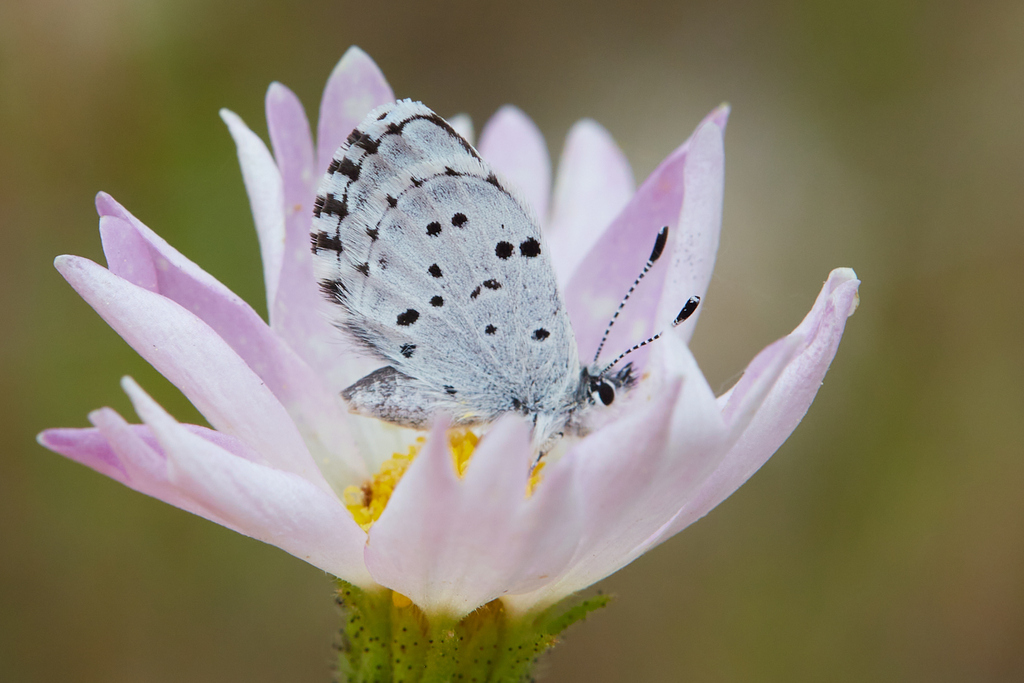
(c) Ken-ichi Ueda, some rights reserved (CC BY) · licence
Family: Lycaenidae · Class: Insecta · Order: Lepidoptera
Conservation status: G3T1 S1
Philotiella speciosa bohartorum (Boharts' Blue Butterfly) is a California animal in the Lycaenidae family.
Boharts' Blue Butterfly (Philotiella speciosa bohartorum) is a small lycaenid butterfly endemic to California. This subspecies represents one of the rarest blue butterflies in North America, with extremely limited distribution and population size. Adults have a wingspan of approximately 18-25 mm (0.7-1.0 inches). Males display iridescent blue dorsal wing surfaces with narrow dark borders, while females are predominantly brown with blue scaling at the wing bases. The ventral wing surfaces of both sexes are pale gray with distinctive white-ringed black spots and orange marginal crescents typical of the Lycaenidae family. The subspecies is known only from a single location in the Antioch Dunes National Wildlife Refuge in Contra Costa County, California. This represents one of the most restricted ranges of any North American butterfly. The historical range may have included additional sand dune habitats in the eastern San Francisco Bay area, but urban development and habitat modification have eliminated these areas. The current population occupies less than 100 acres of remaining native dune habitat. Boharts' Blue Butterfly requires specialized sand dune habitat characterized by loose, well-drained sandy soils and sparse vegetation cover. The species is closely associated with its host plant, Antioch Dunes evening primrose (Oenothera deltoides howellii), which is also federally endangered. Adults are typically found within 50 meters of host plant populations. The habitat experiences a Mediterranean climate with dry summers and mild, wet winters. Elevations range from sea level to approximately 50 feet. Adults are active from late March through May, with peak flight occurring in April. The species has a single generation per year. Females lay eggs individually on or near the host plant. Larvae feed exclusively on Antioch Dunes evening primrose, consuming leaves and flower buds. Pupation occurs in shallow depressions in the sand, often at the base of the host plant. Adults nectar on various flowers including the host plant and introduced species such as red-stemmed filaree. Males establish territories around host plant clusters and engage in patrolling behavior to locate females. The subspecies holds a global rank of G3T1, indicating it is critically imperiled with typically 5 or fewer occurrences. California ranks it as S1, reflecting its extreme rarity within the state. The primary threats include habitat loss and fragmentation, invasive plant species that alter dune structure and compete with the host plant, recreational activities that disturb the fragile dune ecosystem, and climate change effects on the specialized microhabitat. The small population size makes the subspecies vulnerable to stochastic events and genetic bottlenecks. Conservation efforts focus on habitat restoration, invasive species control, and protection of the remaining dune ecosystem at Antioch Dunes National Wildlife Refuge.
Classification
Class: Insecta · Order: Lepidoptera · Family: Lycaenidae
Conservation status
G3T1 S1
Frequently asked questions
How is Philotiella speciosa bohartorum classified?
Philotiella speciosa bohartorum belongs to class Insecta, order Lepidoptera, family Lycaenidae.
What family does Philotiella speciosa bohartorum belong to?
Philotiella speciosa bohartorum is in the Lycaenidae family.
Is Philotiella speciosa bohartorum protected or of conservation concern?
Philotiella speciosa bohartorum carries the following status: G3T1 S1.
What is Philotiella speciosa bohartorum?
Boharts' Blue Butterfly (Philotiella speciosa bohartorum) is a small lycaenid butterfly endemic to California.
Is Philotiella speciosa bohartorum found in California?
Yes. Philotiella speciosa bohartorum is recorded in California in The California Species Project's catalogue.
Related species
Other California species in the same genus, family, or bioregion.
Data from The California Species Project — 14,000+ California species with verified data from CNPS, CDFW, USFWS, and more.