Phloeodes diabolicus
Diabolical Ironclad Beetle
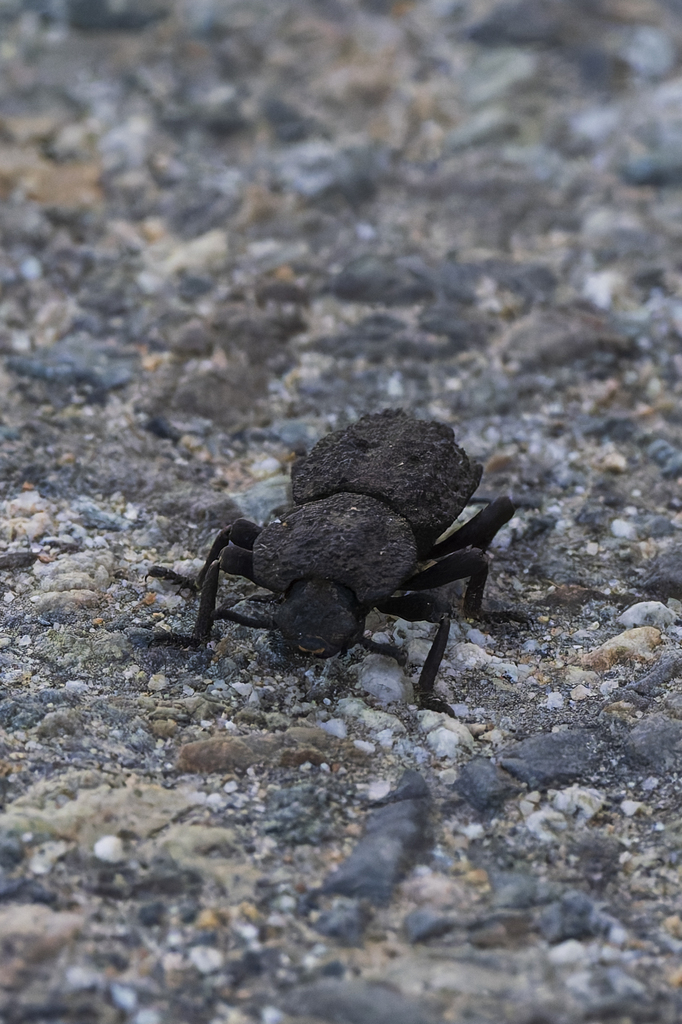
(c) William Walker, some rights reserved (CC BY) · licence
Family: Zopheridae · Class: Insecta · Order: Coleoptera
Phloeodes diabolicus (Diabolical Ironclad Beetle) is a California animal in the Zopheridae family.
The Diabolical Ironclad Beetle is a robust member of the ironclad beetle family Zopheridae, measuring 15 to 25 mm in total length, with elytra plus prothorax spanning 16 to 22 mm (García-Paris et al. 2006). The dorsal coloration varies from pale brown to dark gray, with the apical portions of the elytra and shoulders often displaying creamy brown to golden patches. This species exhibits the characteristic heavily armored exoskeleton typical of ironclad beetles, with a notably thick and durable body structure that has made it a subject of biomechanical research. Phloeodes diabolicus occurs in California, Arizona, and Baja California (García-Paris et al. 2006). In California, the species has been documented in Los Angeles County, including urban habitat fragments such as Elysian Park and The Huntington Botanical Gardens. The species appears to persist in relatively disturbed environments within its range, though it is reportedly less abundant than sympatric darkling beetles in the genera Nyctoporis and Eleodes. This beetle inhabits woodland environments and is typically found under loose bark of oak and cottonwood trees (BugGuide). The species demonstrates adaptability to fragmented habitats, occurring in botanical gardens and urban parks where sufficient woody debris and bark microhabitats remain available. Adults are found in association with decaying organic matter beneath bark, which provides both shelter and foraging opportunities. Diabolical Ironclad Beetles are detritivores that feed on decaying organic material, including senescent fungi. Field observations document individuals consuming decomposing mushrooms in weedy, overgrown areas. The species appears to be poor dispersers, with populations persisting in habitat fragments despite surrounding urbanization. Adults are active during daylight hours and can be found year-round in suitable microhabitats, with documented activity from February through July based on field observations. The species was originally described by LeConte in 1851 and has undergone taxonomic revision, most notably by García-Paris et al. (2006), who provided a comprehensive redescription and evaluation of the genus Phloeodes. While Phloeodes diabolicus does not currently hold federal or state conservation status, its apparent poor dispersal ability and dependence on specific bark microhabitats may render local populations vulnerable to habitat fragmentation and urbanization. The species' persistence in urban botanical gardens and parks suggests some tolerance for human-modified landscapes, provided that mature trees and associated bark debris remain available. Scientific documentation of this species' detailed ecology and population trends remains limited, indicating a need for additional research to better understand its conservation requirements and population status throughout its range.
Classification
Class: Insecta · Order: Coleoptera · Family: Zopheridae
Frequently asked questions
How is Phloeodes diabolicus classified?
Phloeodes diabolicus belongs to class Insecta, order Coleoptera, family Zopheridae.
What family does Phloeodes diabolicus belong to?
Phloeodes diabolicus is in the Zopheridae family.
What is Phloeodes diabolicus?
The Diabolical Ironclad Beetle is a robust member of the ironclad beetle family Zopheridae, measuring 15 to 25 mm in total length, with elytra plus prothorax spanning 16 to 22 mm (García-Paris et al.
Is Phloeodes diabolicus found in California?
Yes. Phloeodes diabolicus is recorded in California in The California Species Project's catalogue.
Related species
Other California species in the same genus, family, or bioregion.
Data from The California Species Project — 14,000+ California species with verified data from CNPS, CDFW, USFWS, and more.