Phocoena phocoena
Harbor Porpoise
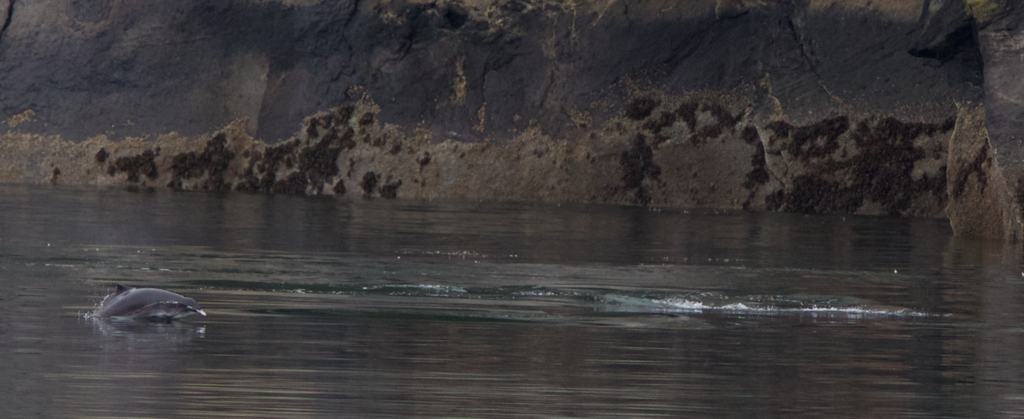
(c) Nodnarb Nedloh, some rights reserved (CC BY-SA) · licence
Family: Phocoenidae · Class: Mammalia · Order: Artiodactyla
Phocoena phocoena (Harbor Porpoise) is a California animal in the Phocoenidae family.
The harbor porpoise is a small, robust cetacean and the smallest marine mammal found along the California coast. Adults measure 1.4 to 1.9 meters (4.6 to 6.2 feet) in length and weigh 45 to 70 kilograms (99 to 154 pounds), with females typically larger than males. The body is compact and torpedo-shaped with a small, rounded head lacking a prominent beak. The dorsal coloration is dark gray to black, fading to lighter gray on the sides and white on the ventral surface. A distinctive triangular dorsal fin is positioned at the midpoint of the back. The flippers are small and oval-shaped, and the flukes have a slight notch at the center. Harbor porpoises inhabit coastal waters along the eastern North Pacific from Alaska to California. In California, they occur primarily in nearshore waters north of Point Conception, with the highest densities found in the San Francisco Bay area, Monterey Bay, and along the northern California coast. The species exhibits seasonal movements, with animals moving closer to shore during summer months and into deeper waters during winter. According to NOAA Fisheries, the California-Oregon-Washington stock is estimated to contain approximately 76,000 individuals as of the most recent assessment. This species occupies shallow coastal waters typically less than 200 meters (656 feet) deep, though they occasionally venture into deeper offshore areas. Harbor porpoises prefer areas with high prey density, including estuaries, bays, and regions with upwelling currents. They are commonly found over sandy and muddy substrates where their preferred prey species aggregate. Water temperatures in their habitat range from 10 to 15 degrees Celsius (50 to 59 degrees Fahrenheit). Harbor porpoises are opportunistic feeders, consuming primarily small schooling fish including anchovies, sardines, herring, and juvenile rockfish. They also feed on squid and crustaceans when available. Foraging typically occurs during daylight hours in shallow waters. The species exhibits a polygynous mating system, with breeding occurring from May through August. Gestation lasts approximately 10 to 11 months, and females give birth to a single calf every one to two years. Calves measure about 70 centimeters (28 inches) at birth and nurse for 8 to 12 months. Harbor porpoises are generally solitary or found in small groups of two to five individuals, though larger aggregations may form in areas with abundant prey. Currently, harbor porpoises are not federally listed under the Endangered Species Act, and their conservation status is considered stable along the California coast as of December 2025. However, the species faces several threats including entanglement in fishing gear, particularly gillnets, underwater noise from vessel traffic and construction activities, pollution from agricultural runoff and urban sources, and prey depletion from commercial fishing. Climate change may affect prey distribution and availability. NOAA Fisheries implements various conservation measures including gear modifications to reduce bycatch and vessel speed restrictions in critical habitat areas.
Classification
Class: Mammalia · Order: Artiodactyla · Family: Phocoenidae
Frequently asked questions
How is Phocoena phocoena classified?
Phocoena phocoena belongs to class Mammalia, order Artiodactyla, family Phocoenidae.
What family does Phocoena phocoena belong to?
Phocoena phocoena is in the Phocoenidae family.
What is Phocoena phocoena?
The harbor porpoise is a small, robust cetacean and the smallest marine mammal found along the California coast.
Is Phocoena phocoena found in California?
Yes. Phocoena phocoena is recorded in California in The California Species Project's catalogue.
Related species
Other California species in the same genus, family, or bioregion.
Data from The California Species Project — 14,000+ California species with verified data from CNPS, CDFW, USFWS, and more.