Phocoenoides dalli
Dall's Porpoise
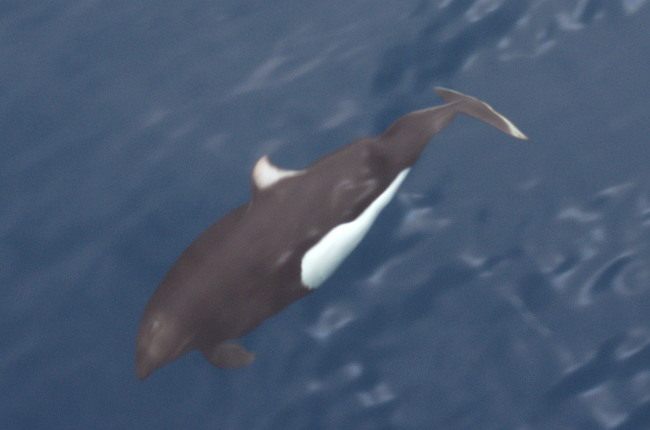
(c) Георгий Виноградов (Georgy Vinogradov), some rights reserved (CC BY) · licence
Family: Phocoenidae · Class: Mammalia · Order: Artiodactyla
Phocoenoides dalli (Dall's Porpoise) is a California animal in the Phocoenidae family.
Dall's porpoise is a robust, fast-swimming marine mammal endemic to the North Pacific Ocean. Adults measure 1.7 to 2.4 meters (5.6 to 7.9 feet) in length and weigh 130 to 220 kilograms (290 to 485 pounds), with males typically larger than females. The species displays distinctive black and white coloration, with a predominantly black body and prominent white patches on the flanks and belly. A white patch extends from the ventral surface upward along the sides, creating a characteristic pattern. The dorsal fin is triangular and positioned at the body's midpoint, often with white coloring on the posterior edge. The head is small relative to body size, with a poorly defined beak and small flippers. Dall's porpoise ranges throughout the cold temperate and subarctic waters of the North Pacific, from Japan and the Sea of Okhotsk eastward to the Bering Sea and south along the North American coast to Baja California, Mexico. Along the California coast, the species occurs primarily in offshore waters beyond the continental shelf edge, typically in depths exceeding 180 meters (590 feet). Seasonal movements bring some individuals closer to shore during upwelling periods when prey abundance increases. The species inhabits deep, cold oceanic waters with temperatures ranging from 2 to 18 degrees Celsius (36 to 64 degrees Fahrenheit). Dall's porpoise prefers areas with strong currents and upwelling zones that concentrate prey species. In California waters, they are most commonly observed in the California Current system, particularly near submarine canyons and areas of high productivity. The species typically remains in waters deeper than the continental shelf but may venture into shallower areas when following prey. Dall's porpoise is primarily piscivorous, feeding on small schooling fish including lanternfish, sardines, anchovies, and juvenile salmon. Cephalopods, particularly squid, comprise a secondary prey component. The species exhibits opportunistic feeding behavior, often foraging at night when many prey species undergo diel vertical migration toward the surface. Dall's porpoise can dive to depths exceeding 500 meters (1,640 feet) and remain submerged for up to 6 minutes. Reproduction occurs through a seasonal breeding cycle, with mating typically occurring in summer. Gestation lasts 10 to 11 months, and females give birth to single calves. The species is known for its high-speed swimming ability, reaching speeds up to 55 kilometers per hour (34 miles per hour), and creates distinctive spray patterns when surfacing rapidly. Dall's porpoise is not federally listed under the Endangered Species Act, nor does it have special status under California state regulations as of December 2025. According to NOAA Fisheries, the species maintains stable population levels throughout its range, with the North Pacific population estimated at approximately 1.2 million individuals. Primary threats include incidental capture in fishing operations, particularly gillnet and trawl fisheries, ship strikes, and potential impacts from climate change affecting prey distribution. Commercial whaling historically impacted some populations, but direct hunting pressure has decreased significantly since international protections were implemented.
Classification
Class: Mammalia · Order: Artiodactyla · Family: Phocoenidae
Frequently asked questions
How is Phocoenoides dalli classified?
Phocoenoides dalli belongs to class Mammalia, order Artiodactyla, family Phocoenidae.
What family does Phocoenoides dalli belong to?
Phocoenoides dalli is in the Phocoenidae family.
What is Phocoenoides dalli?
Dall's porpoise is a robust, fast-swimming marine mammal endemic to the North Pacific Ocean.
Is Phocoenoides dalli found in California?
Yes. Phocoenoides dalli is recorded in California in The California Species Project's catalogue.
Related species
Other California species in the same genus, family, or bioregion.
Data from The California Species Project — 14,000+ California species with verified data from CNPS, CDFW, USFWS, and more.