Phoebastria nigripes
Black-footed Albatross
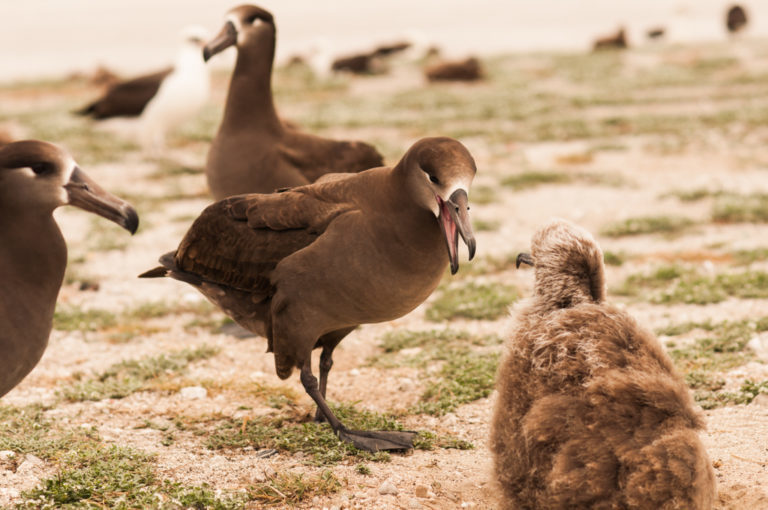
(c) James Weaver, some rights reserved (CC BY) · licence
Family: Diomedeidae · Class: Aves · Order: Procellariiformes
Phoebastria nigripes (Black-footed Albatross) is a California animal in the Diomedeidae family.
The black-footed albatross is a large seabird with a wingspan reaching 2.1 meters (7 feet) and body length of 68 to 74 centimeters (27 to 29 inches). Adults weigh between 2.6 to 4.3 kilograms (5.7 to 9.5 pounds). The species is characterized by predominantly dark brown to blackish plumage, contrasting with a whitish rump patch and undertail coverts. The face displays variable amounts of white, particularly around the bill base and eyes, which increases with age. The large, hooked bill is dark gray to black with a pinkish tip, and the feet are black, giving the species its common name. Juveniles appear entirely dark brown, while older birds develop more extensive white markings on the head and underwing coverts. The black-footed albatross has a North Pacific distribution, breeding primarily on remote islands in the Northwestern Hawaiian Islands, including Laysan Island, Midway Atoll, and Kure Atoll. Small populations also nest on islands off Japan and Mexico. During the non-breeding season, the species ranges widely across the North Pacific Ocean, regularly occurring in waters off California, Oregon, Washington, and Alaska. California waters serve as important foraging habitat, particularly during summer and fall months when birds concentrate along the continental shelf edge and over submarine canyons. The species inhabits pelagic marine environments, spending most of its life over deep ocean waters beyond the continental shelf. Black-footed albatrosses forage primarily in areas where cold, nutrient-rich waters upwell, supporting abundant prey populations. They are typically found in waters with sea surface temperatures between 10 to 25 degrees Celsius and are associated with frontal zones where different water masses meet. Black-footed albatrosses are dynamic soaring specialists, using wind patterns over ocean waves to travel vast distances with minimal energy expenditure. They feed primarily on squid, flying fish, fish eggs, and crustaceans, obtained through surface seizing and shallow diving to depths of 1 to 2 meters. The species also follows fishing vessels to scavenge discards and offal. Breeding occurs in colonies on sandy areas of low-lying islands, where pairs engage in elaborate courtship displays involving bill clacking, preening, and sky-pointing behaviors. The breeding cycle spans nearly a year, with a single white egg laid between November and January. Both parents share incubation duties for approximately 65 days, followed by a lengthy chick-rearing period of 140 to 180 days. The black-footed albatross is classified as Near Threatened by the International Union for Conservation of Nature. The global population is estimated at approximately 129,000 breeding pairs, with about 97% nesting in the Hawaiian archipelago. Primary threats include bycatch in commercial longline and gillnet fisheries, plastic ingestion, lead poisoning from lead-based paint on Midway Atoll buildings, sea level rise affecting low-lying breeding islands, and introduced predators at nesting colonies. Climate change poses additional challenges through altered ocean productivity and increased storm intensity. Conservation efforts include fisheries bycatch reduction measures, habitat restoration on breeding islands, and removal of marine debris from nesting areas.
Classification
Class: Aves · Order: Procellariiformes · Family: Diomedeidae
Frequently asked questions
How is Phoebastria nigripes classified?
Phoebastria nigripes belongs to class Aves, order Procellariiformes, family Diomedeidae.
What family does Phoebastria nigripes belong to?
Phoebastria nigripes is in the Diomedeidae family.
What is Phoebastria nigripes?
The black-footed albatross is a large seabird with a wingspan reaching 2.1 meters (7 feet) and body length of 68 to 74 centimeters (27 to 29 inches).
Is Phoebastria nigripes found in California?
Yes. Phoebastria nigripes is recorded in California in The California Species Project's catalogue.
Related species
Other California species in the same genus, family, or bioregion.
Data from The California Species Project — 14,000+ California species with verified data from CNPS, CDFW, USFWS, and more.