Phoebetria palpebrata
Light-mantled Albatross
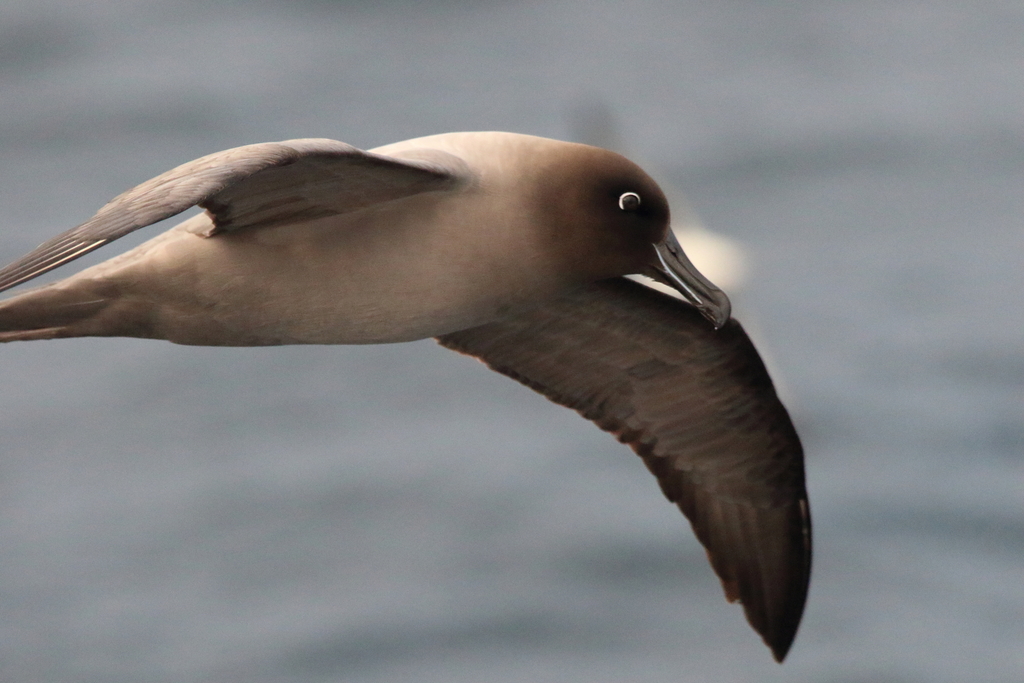
(c) Jacob Littlejohn, some rights reserved (CC BY-SA) · licence
Family: Diomedeidae · Class: Aves · Order: Procellariiformes
Phoebetria palpebrata (Light-mantled Albatross) is a California animal in the Diomedeidae family.
The Light-mantled Albatross is a medium-sized seabird with distinctive plumage that sets it apart from other albatross species. Adults measure 78 to 89 centimeters (31 to 35 inches) in length with a wingspan ranging from 183 to 218 centimeters (72 to 86 inches). Body weight typically ranges from 2.5 to 3.7 kilograms (5.5 to 8.2 pounds). The species displays a characteristic pale gray mantle contrasting with darker gray-brown head, neck, and underparts. The back and upper wing surfaces are distinctly lighter than the body, creating the "light mantle" appearance that gives the species its common name. Adult birds have a dark eye-stripe extending from the bill to behind the eye, and the bill is black with a distinctive pale groove along the lower mandible. The Light-mantled Albatross has a circumpolar distribution in the Southern Ocean, breeding on sub-Antarctic islands between approximately 46°S and 55°S latitude. Primary breeding colonies occur on South Georgia, Prince Edward Islands, Crozet Islands, Kerguelen Islands, Heard Island, Macquarie Island, and Auckland Islands. The species ranges widely across the Southern Ocean during non-breeding periods, with individuals recorded as far north as 30°S latitude. In California waters, this species is considered a rare vagrant, with occasional sightings documented off the coast during pelagic surveys, particularly in deep offshore waters beyond the continental shelf. This albatross inhabits pelagic marine environments, spending most of its life over deep oceanic waters. During breeding season, pairs select nesting sites on steep coastal cliffs and tussock grasslands on sub-Antarctic islands. Nests are typically constructed on ledges or slopes with good access to prevailing winds for takeoff. The species shows preference for areas with minimal ground vegetation, often choosing sites 50 to 200 meters above sea level. Light-mantled Albatrosses are highly pelagic, feeding primarily on squid, fish, and crustaceans obtained through surface-seizing and shallow diving. The species demonstrates dynamic soaring flight patterns, utilizing wind gradients to cover vast distances with minimal energy expenditure. Breeding occurs biennially, with pairs laying a single white egg between September and November. The incubation period lasts approximately 65 to 75 days, shared by both parents in alternating shifts. Chicks fledge after 140 to 170 days, representing one of the longest fledging periods among albatross species. Sexual maturity is reached at 8 to 15 years of age. The Light-mantled Albatross is classified as Near Threatened by the International Union for Conservation of Nature as of 2024. Global population estimates suggest approximately 58,000 breeding pairs across all colonies. Primary conservation concerns include longline fisheries bycatch, particularly in the Southern Ocean tuna and toothfish fisheries, plastic pollution ingestion, and climate change impacts on breeding habitat and prey distribution. Several breeding populations have shown declining trends, with some colonies experiencing reductions of 1 to 3 percent annually over the past two decades.
Classification
Class: Aves · Order: Procellariiformes · Family: Diomedeidae
Frequently asked questions
How is Phoebetria palpebrata classified?
Phoebetria palpebrata belongs to class Aves, order Procellariiformes, family Diomedeidae.
What family does Phoebetria palpebrata belong to?
Phoebetria palpebrata is in the Diomedeidae family.
What is Phoebetria palpebrata?
The Light-mantled Albatross is a medium-sized seabird with distinctive plumage that sets it apart from other albatross species.
Is Phoebetria palpebrata found in California?
Yes. Phoebetria palpebrata is recorded in California in The California Species Project's catalogue.
Related species
Other California species in the same genus, family, or bioregion.
Data from The California Species Project — 14,000+ California species with verified data from CNPS, CDFW, USFWS, and more.