Phoebis agarithe
Large Orange Sulphur
(c) Carlos Domínguez-Rodríguez, some rights reserved (CC BY) · licence
Family: Pieridae · Class: Insecta · Order: Lepidoptera
Phoebis agarithe (Large Orange Sulphur) is a California animal in the Pieridae family.
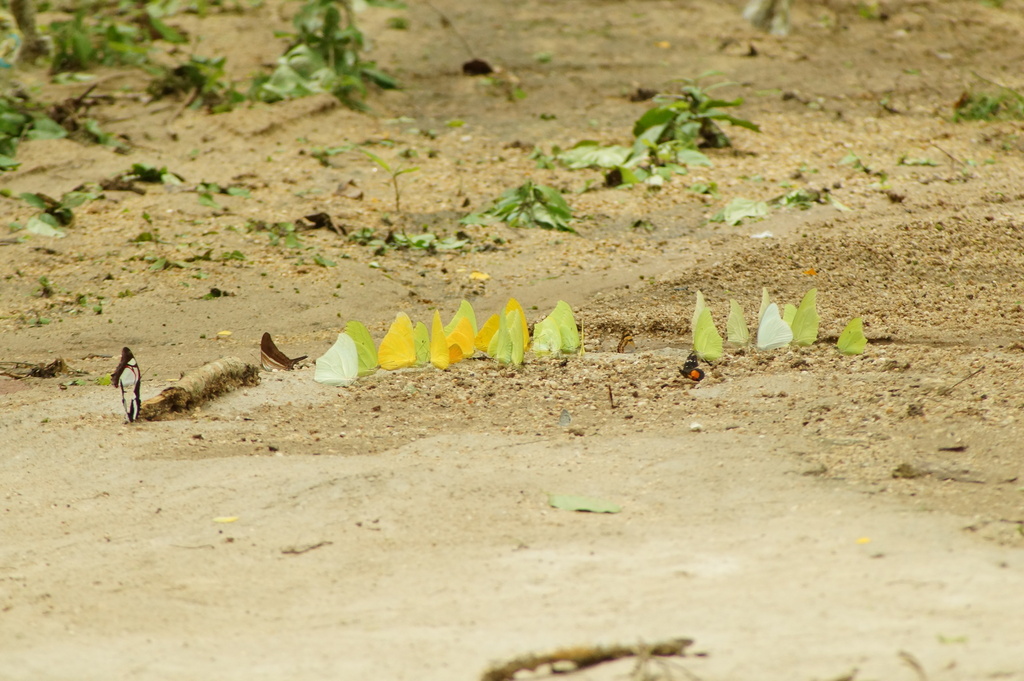
The Large Orange Sulphur is a neotropical butterfly species that occasionally strays into the southwestern United States. Adults measure 65-75 mm (2.6-3.0 inches) in wingspan, making this one of the larger sulphur species in North America. Males display bright orange dorsal wing surfaces with narrow black borders along the wing edges. Females are more variable, ranging from pale yellow to orange, with broader black marginal bands and often showing irregular dark spotting. The ventral wing surfaces are pale yellow to orange-yellow in both sexes, with small silver spots outlined in red on the hindwings. The forewings are elongated and pointed, characteristic of the genus Phoebis. The Large Orange Sulphur ranges from Peru north through Central America and Mexico to southern Texas and peninsular Florida. The species maintains resident populations in tropical and subtropical regions but occurs only as a rare stray in most of the United States. Documented vagrant records extend north to Colorado, South Dakota, Wisconsin, and New Jersey, typically representing wind-dispersed individuals during migration periods. In California, this species is not established but could potentially occur as an extremely rare vagrant in desert regions or along the Mexican border. This species inhabits tropical and subtropical lowlands, typically below 1,000 meters (3,280 feet) elevation. Adults frequent open areas including forest edges, clearings, gardens, and disturbed habitats where host plants occur. The species shows strong fidelity to areas supporting leguminous trees and shrubs, particularly in riparian zones and moist woodland edges. Large Orange Sulphur larvae feed exclusively on plants in the pea family (Fabaceae), with primary host plants including Pithecellobium and Inga species. Adults are strong fliers and highly mobile, often traveling considerable distances from breeding areas. Males engage in patrolling behavior, flying rapidly through suitable habitat in search of females. Mating typically occurs during the wet season when host plants produce new growth. Females deposit single eggs on young leaves or flower buds of host plants. The species is multivoltine in tropical areas, producing continuous generations throughout the year where conditions permit. Adult Large Orange Sulphurs feed on nectar from various flowering plants, showing particular attraction to red and orange tubular flowers. They also engage in puddling behavior, congregating at mud puddles, animal dung, and other moisture sources to obtain minerals. Flight is rapid and erratic, with individuals capable of sustained long-distance movement. The Large Orange Sulphur has no special conservation status and is considered secure throughout most of its range. As a naturally rare vagrant in the United States, the species faces no significant threats in regions where it occurs as a stray. Climate change could potentially alter the northern limits of vagrancy, but this would not affect the species' overall conservation status given its extensive tropical range and stable populations in Central and South America.
Classification
Class: Insecta · Order: Lepidoptera · Family: Pieridae
Frequently asked questions
How is Phoebis agarithe classified?
Phoebis agarithe belongs to class Insecta, order Lepidoptera, family Pieridae.
What family does Phoebis agarithe belong to?
Phoebis agarithe is in the Pieridae family.
What is Phoebis agarithe?
The Large Orange Sulphur is a neotropical butterfly species that occasionally strays into the southwestern United States.
Is Phoebis agarithe found in California?
Yes. Phoebis agarithe is recorded in California in The California Species Project's catalogue.
Related species
Other California species in the same genus, family, or bioregion.
Data from The California Species Project — 14,000+ California species with verified data from CNPS, CDFW, USFWS, and more.