Phoebis philea
Orange-barred Sulphur
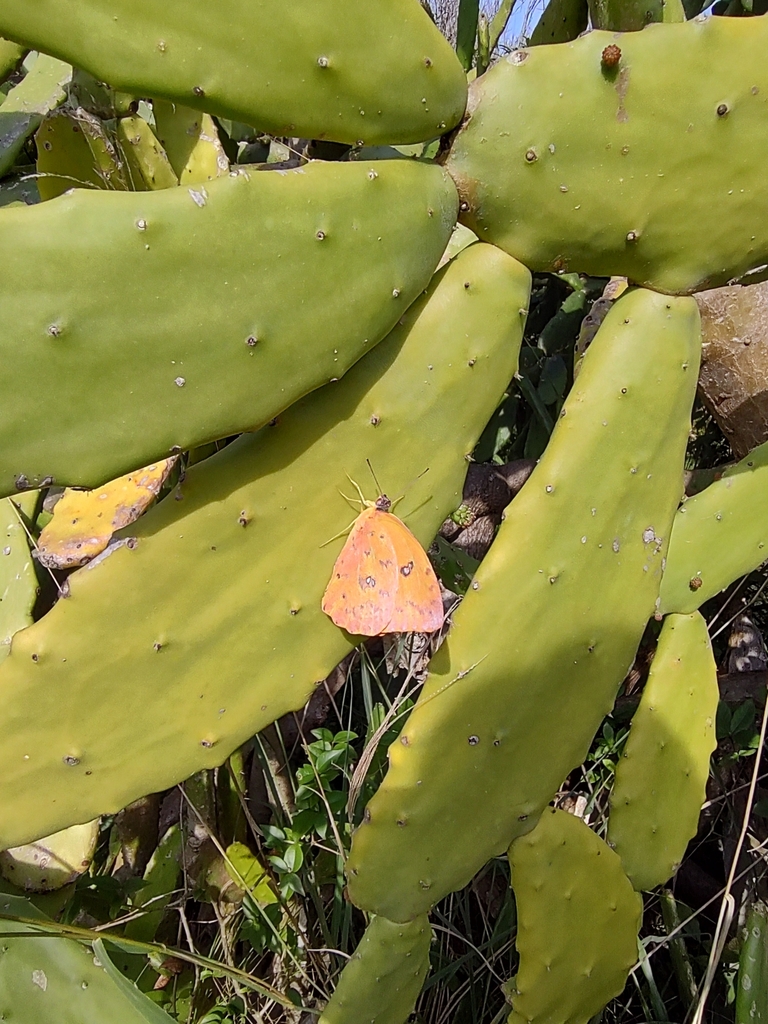
(c) André Nogueira Thomas, some rights reserved (CC BY) · licence
Family: Pieridae · Class: Insecta · Order: Lepidoptera
Phoebis philea (Orange-barred Sulphur) is a California animal in the Pieridae family.
The Orange-barred Sulphur is a large tropical butterfly with distinctive sexual dimorphism. Males display bright orange forewings with prominent black borders and a characteristic orange bar across the upper forewing, from which the species derives its common name. The hindwings are yellow with narrow black margins. Females are predominantly yellow with broader black wing borders and more subdued coloration. Both sexes have a wingspan ranging from 68 to 89 mm (2.7 to 3.5 inches), making this one of the larger North American sulphurs. The undersides of both sexes are pale yellow with subtle markings that provide camouflage when at rest. Phoebis philea is resident from Brazil north through Central America and the Caribbean to peninsular Florida and the Florida Keys. The species occurs as an irregular wanderer to south Texas, with extremely rare vagrant records documented in Colorado, Minnesota, Wisconsin, and Connecticut. In its core range, the butterfly maintains year-round breeding populations, while northern occurrences typically represent temporary colonization events or wind-assisted dispersal. This species inhabits tropical and subtropical environments including coastal areas, gardens, parks, and forest edges. In Florida, Orange-barred Sulphurs are found in disturbed habitats, residential areas with ornamental plantings, and natural areas where host plants occur. The species shows a preference for open, sunny locations with access to nectar sources and suitable breeding sites. Adults are strong fliers capable of long-distance movements, contributing to their ability to colonize new areas temporarily. Orange-barred Sulphurs are multivoltine in their southern range, producing multiple generations per year with continuous breeding in tropical areas. Eggs are laid singly on host plants in the genus Cassia (family Fabaceae), including both native and introduced species. Larvae feed exclusively on Cassia foliage, developing through five instars before pupating. Adults are active year-round in frost-free areas, with peak abundance often coinciding with favorable weather conditions and host plant availability. Males exhibit territorial behavior, perching on prominent vegetation and pursuing potential mates. Both sexes visit a variety of flowering plants for nectar, showing particular attraction to red and orange blossoms. The Orange-barred Sulphur is not federally or state-listed and appears secure throughout its native range. However, northern populations in the United States are inherently unstable due to the species' inability to survive freezing temperatures. Climate change may potentially expand the species' permanent range northward, allowing for establishment of breeding populations in areas where it currently occurs only as a vagrant. In urban and suburban areas of South Florida, the species benefits from ornamental plantings of Cassia species, though habitat modification and pesticide use may locally impact populations. The species' strong dispersal ability and broad host plant usage contribute to its overall population stability within its primary range.
Classification
Class: Insecta · Order: Lepidoptera · Family: Pieridae
Frequently asked questions
How is Phoebis philea classified?
Phoebis philea belongs to class Insecta, order Lepidoptera, family Pieridae.
What family does Phoebis philea belong to?
Phoebis philea is in the Pieridae family.
What is Phoebis philea?
The Orange-barred Sulphur is a large tropical butterfly with distinctive sexual dimorphism.
Is Phoebis philea found in California?
Yes. Phoebis philea is recorded in California in The California Species Project's catalogue.
Related species
Other California species in the same genus, family, or bioregion.
Data from The California Species Project — 14,000+ California species with verified data from CNPS, CDFW, USFWS, and more.