Pholisora catullus
Common Sootywing
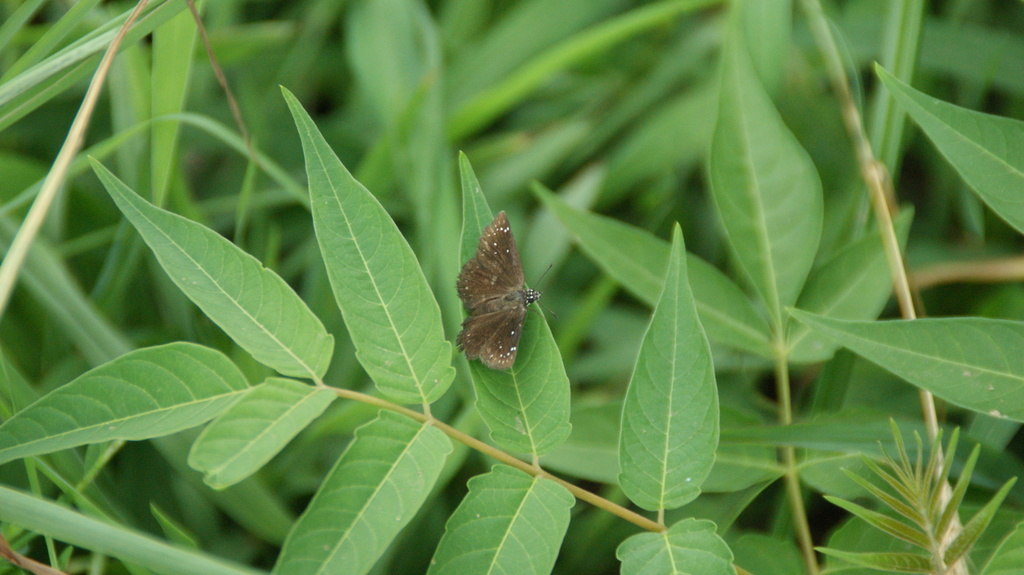
(c) daksu, some rights reserved (CC BY) · licence
Family: Hesperiidae · Class: Insecta · Order: Lepidoptera
Pholisora catullus (Common Sootywing) is a California animal in the Hesperiidae family.
The Common Sootywing is a small, dark skipper butterfly with distinctive sooty-brown to black wings. Adults have a wingspan of 19 to 32 mm (0.75 to 1.25 inches). The forewings are dark brown to black with small white spots arranged in irregular patterns, while the hindwings are uniformly dark with subtle white markings near the outer edges. Males possess a distinctive stigma, a specialized scent patch on the forewings used during courtship. The underside of the wings is lighter brown with more prominent white spotting. Antennae are short with distinctive curved clubs, and the body is robust and covered in dark scales. The Common Sootywing ranges across the central United States south to central Mexico, with the species occasionally straying and establishing temporary colonies as far north as southern British Columbia, northern Michigan, southern Quebec, and southern Maine. The species does not occur in peninsular Florida. In California, populations are documented primarily in the Central Valley and southern regions, particularly in agricultural areas and disturbed habitats where host plants are abundant. This species inhabits open, sunny areas including agricultural fields, vacant lots, roadsides, gardens, and disturbed ground where weedy host plants grow. Common Sootywings prefer areas with bare soil or sparse vegetation for basking and territorial behavior. They are commonly found at elevations from sea level to approximately 2,000 meters (6,600 feet), though most populations occur below 1,500 meters (4,900 feet). The species thrives in human-modified landscapes and is often more abundant in agricultural regions than in natural habitats. Common Sootywing larvae feed exclusively on plants in the amaranth family (Amaranthaceae), including lambsquarters (Chenopodium album), various amaranths (Amaranthus species), and cockscomb (Celosia). Females lay single eggs on host plant leaves, typically on the undersides. Larvae construct silk shelters by folding and tying leaves together, feeding within these protective structures. The species produces multiple broods per year in warmer climates, with continuous breeding from spring through fall where conditions permit. Adults are active during daylight hours and exhibit rapid, erratic flight patterns typical of skipper butterflies. Males establish territories in open areas and engage in aggressive chasing behavior toward other butterflies. The Common Sootywing is not federally or state listed and appears to have stable populations throughout most of its range. The species has likely benefited from human activities that create disturbed habitats suitable for its weedy host plants. Agricultural expansion and urbanization have potentially increased available habitat in many regions. Climate change may be facilitating range expansion northward, as evidenced by occasional colonization events in northern areas. Unlike many native butterflies, the Common Sootywing shows strong adaptability to human-modified environments and does not face significant conservation threats at this time. However, intensive agricultural practices that eliminate all weedy vegetation could locally impact populations.
Classification
Class: Insecta · Order: Lepidoptera · Family: Hesperiidae
Frequently asked questions
How is Pholisora catullus classified?
Pholisora catullus belongs to class Insecta, order Lepidoptera, family Hesperiidae.
What family does Pholisora catullus belong to?
Pholisora catullus is in the Hesperiidae family.
What is Pholisora catullus?
The Common Sootywing is a small, dark skipper butterfly with distinctive sooty-brown to black wings.
Is Pholisora catullus found in California?
Yes. Pholisora catullus is recorded in California in The California Species Project's catalogue.
Related species
Other California species in the same genus, family, or bioregion.
Data from The California Species Project — 14,000+ California species with verified data from CNPS, CDFW, USFWS, and more.