Pholisora crestar
Crestar Sootywing
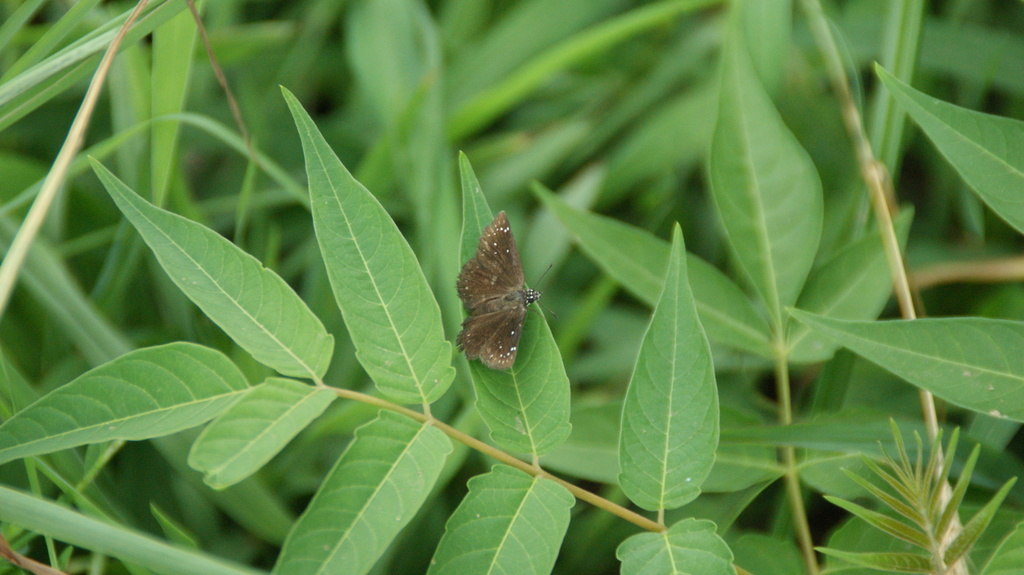
(c) daksu, some rights reserved (CC BY) · licence
Family: Hesperiidae · Class: Insecta · Order: Lepidoptera
Pholisora crestar (Crestar Sootywing) is a California animal in the Hesperiidae family.
The Crestar Sootywing is a small butterfly in the skipper family (Hesperiidae) found in California's southern Sierra Nevada region. This subspecies represents the distinctive montane form of the more widespread Common Sootywing (Pholisora catullus). Adults are typically dark brown to black with white spotting on the forewings, characteristic of the sootywing group. The wingspan measures approximately 25-30 mm, with males generally smaller and more distinctly marked than females. The forewings display small white translucent spots arranged in irregular bands, while the hindwings are uniformly dark with minimal markings. Pholisora crestar occurs exclusively in Kern and Tulare counties, California, representing a highly restricted endemic distribution (Zhang et al. 2020). According to NatureServe Explorer, the species has an estimated six element occurrences, indicating extremely limited populations. Recent lepidopterist surveys have documented the subspecies in specific montane locations, including areas near Whitney Portal in Inyo County, confirming its presence in the eastern Sierra Nevada (Lepidopterists' Society 2019). The range appears to be confined to elevations between approximately 6,000 and 9,000 feet in the southern Sierra Nevada. The species inhabits rocky canyon environments and montane chaparral communities within its limited range. Preferred habitats include areas with exposed rock surfaces, scattered shrubs, and open spaces that provide suitable conditions for both larval development and adult nectaring. The subspecies appears to favor ravines and canyon settings with moderate moisture availability, distinguishing it from desert-dwelling relatives. These montane environments experience significant seasonal temperature variation and receive winter precipitation primarily as snow. Crestar Sootywings are likely univoltine, producing one generation per year due to the harsh montane climate. Adults are most commonly observed during summer months, typically from July through August when temperatures are favorable for flight activity. Like other sootywings, larvae presumably feed on plants in the goosefoot family (Chenopodiaceae) or amaranth family (Amaranthaceae), though specific host plant relationships for this subspecies have not been well documented. Adults nectar on various flowering plants available in their montane habitat. The Crestar Sootywing faces significant conservation challenges due to its extremely restricted range and small population size. With only six known element occurrences, the subspecies is among California's rarest butterflies. Climate change poses a particular threat to this montane endemic, as warming temperatures may eliminate suitable habitat at lower elevations while preventing upslope migration due to topographic constraints. The species lacks federal or state listing protection despite its limited distribution. Habitat disturbance from recreational activities, potential development, and altered fire regimes represent additional threats to remaining populations. Long-term monitoring and habitat protection are essential for the persistence of this endemic Sierra Nevada subspecies. Detailed ecological studies of this subspecies remain limited. The information presented here is based on available taxonomic sources and recent field observations. Enhanced research on host plant relationships, population dynamics, and specific habitat requirements would support more effective conservation planning for this rare California endemic.
Classification
Class: Insecta · Order: Lepidoptera · Family: Hesperiidae
Frequently asked questions
How is Pholisora crestar classified?
Pholisora crestar belongs to class Insecta, order Lepidoptera, family Hesperiidae.
What family does Pholisora crestar belong to?
Pholisora crestar is in the Hesperiidae family.
What is Pholisora crestar?
The Crestar Sootywing is a small butterfly in the skipper family (Hesperiidae) found in California's southern Sierra Nevada region.
Is Pholisora crestar found in California?
Yes. Pholisora crestar is recorded in California in The California Species Project's catalogue.
Related species
Other California species in the same genus, family, or bioregion.
Data from The California Species Project — 14,000+ California species with verified data from CNPS, CDFW, USFWS, and more.