Phormia regina
Black Blow Fly
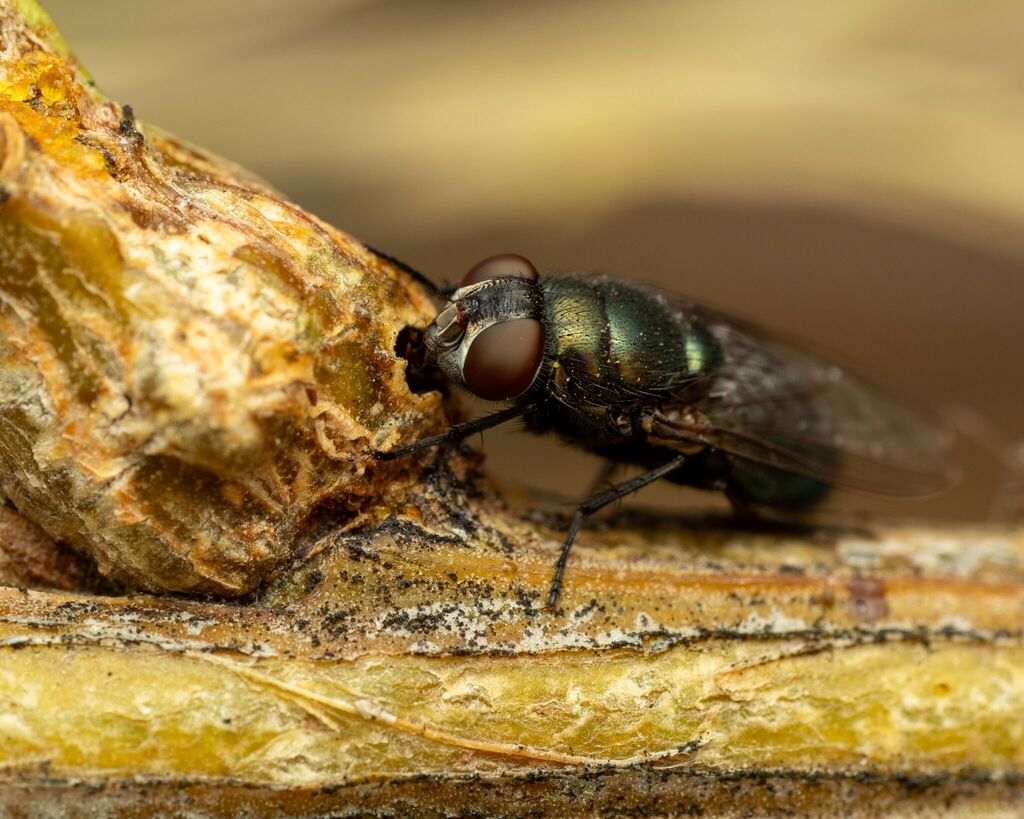
(c) Zachary Dankowicz, some rights reserved (CC BY) · licence
Family: Calliphoridae · Class: Insecta · Order: Diptera
Phormia regina (Black Blow Fly) is a California animal in the Calliphoridae family.
Phormia regina is a medium-sized blow fly measuring 6 to 14 mm (0.24 to 0.55 inches) in length. Adults display a distinctive metallic dark blue to olive-green coloration with a characteristic orange anterior spiracle on the thorax, which serves as a key identifying feature. The body has a robust build typical of calliphorid flies, with prominent setae covering the thorax and a metallic sheen that distinguishes it from similar species within the family. This species has an extensive geographic distribution across North America, Eurasia, and Hawaii (BugGuide). In North America, P. regina occurs throughout the continental United States and Canada, making it one of the more widely distributed blow fly species. The species shows significant adaptability to various climatic conditions, from temperate to subarctic regions, contributing to its broad distributional range. Phormia regina inhabits diverse environments but is primarily attracted to decaying organic matter, including carrion and dung (BugGuide). The species is commonly found in both urban and rural settings, frequently occurring around livestock operations, garbage disposal sites, and areas where animal carcasses are present. Adults are active during daylight hours and are strong fliers capable of dispersing considerable distances to locate suitable breeding substrates. As a necrophagous species, P. regina plays an important ecological role in decomposition processes. Adult flies feed on nectar and other liquid food sources, while females seek out carrion and fecal matter for oviposition. After mating, females deposit eggs directly onto decomposing organic material, where larvae develop through three instars before pupating in nearby soil. The complete life cycle from egg to adult typically requires 2 to 4 weeks under optimal temperature conditions (Byrd & Castner 2010), though this varies considerably with environmental factors. Larvae are efficient decomposers, helping to break down organic matter and return nutrients to the ecosystem. The species has gained forensic significance due to its predictable colonization patterns on decomposing remains, making it valuable in medicolegal investigations for estimating post-mortem intervals (Amendt et al. 2007). Laboratory colonies of P. regina are maintained for forensic research purposes, and the species' well-documented development rates at various temperatures have contributed substantially to forensic entomology protocols (Higley & Haskell 2010). The species shows optimal development at temperatures between 20-25°C (68-77°F), with development slowing significantly below 10°C (50°F). Phormia regina holds no special conservation status and is not considered threatened or endangered. The species appears to be stable throughout its range and may have actually benefited from human activities that create suitable breeding habitats. Its synanthropic nature and ability to exploit human-associated resources suggest that populations remain robust. Climate change impacts on the species remain unstudied, though its broad environmental tolerance suggests resilience to moderate temperature fluctuations. The species continues to serve important ecological functions as a decomposer and as part of food webs supporting insectivorous vertebrates.
Classification
Class: Insecta · Order: Diptera · Family: Calliphoridae
Frequently asked questions
How is Phormia regina classified?
Phormia regina belongs to class Insecta, order Diptera, family Calliphoridae.
What family does Phormia regina belong to?
Phormia regina is in the Calliphoridae family.
What is Phormia regina?
Phormia regina is a medium-sized blow fly measuring 6 to 14 mm (0.24 to 0.55 inches) in length.
Is Phormia regina found in California?
Yes. Phormia regina is recorded in California in The California Species Project's catalogue.
Related species
Other California species in the same genus, family, or bioregion.
Data from The California Species Project — 14,000+ California species with verified data from CNPS, CDFW, USFWS, and more.