Phrynosoma blainvillii
Coast Horned Lizard
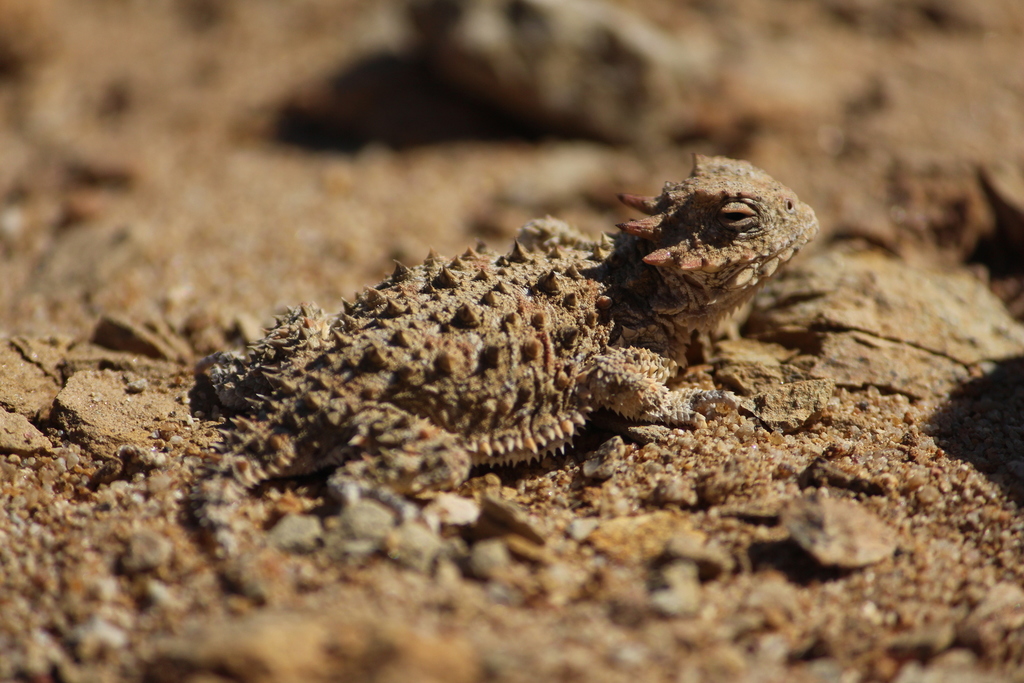
no rights reserved · CC0
Family: Phrynosomatidae · Class: Reptilia · Order: Squamata
Conservation status: G4 S4
Phrynosoma blainvillii (Coast Horned Lizard) is a California animal in the Phrynosomatidae family.
The coast horned lizard is a medium-sized reptile with a flattened, oval body and distinctive crown of pointed scales projecting from the back of the head. Adults typically measure 76 to 127 mm (3.0 to 5.0 inches) in snout-to-vent length, with females generally larger than males. The body is covered in spiny scales, with two rows of enlarged spines along each side. Dorsal coloration varies from gray to brown or reddish-brown, often matching local soil colors, with darker blotches and spots providing effective camouflage. The underside is cream to pale yellow with dark spots. Historically, coast horned lizards ranged throughout much of California's Central Valley, Coast Ranges, and southern coastal regions, extending into Baja California, Mexico. The current range has contracted significantly and is now fragmented, with populations persisting primarily in the San Joaquin Valley, parts of the Central Coast, and scattered locations in southern California. The species has been extirpated from much of the Los Angeles Basin and San Francisco Bay Area. Coast horned lizards inhabit open areas with sandy or gravelly soils, including grasslands, chaparral, oak woodlands, and desert scrub. They prefer areas with sparse vegetation that allows for thermoregulation and easy movement. Elevation ranges from sea level to approximately 2,440 meters (8,000 feet). The species requires loose soil for burrowing and areas with abundant ant populations. They are often found along washes, road edges, and other disturbed areas with appropriate substrate. This species is primarily insectivorous, with harvester ants comprising up to 90% of their diet. They are sit-and-wait predators, remaining motionless near ant trails and capturing prey with their sticky tongues. When threatened, coast horned lizards employ several defensive strategies including freezing, inflating their bodies, and projecting blood from their eyes at potential predators. Mating occurs in late spring, with females laying 6 to 20 eggs in sandy soil during summer. Eggs incubate for 6 to 8 weeks, with hatchlings emerging in late summer or early fall. The species exhibits temperature-dependent sex determination. The coast horned lizard currently has a Global rank of G4 (apparently secure) and California State rank of S4 (apparently secure), though populations have declined substantially from historical levels. The species is not federally listed but is considered a species of special concern by some wildlife agencies. Primary threats include habitat loss and fragmentation from urban development and agriculture, decline of native ant species due to invasive Argentine ants, vehicle mortality, collection for the pet trade, and pesticide use. Climate change may exacerbate these threats by altering ant community composition and availability. Conservation efforts focus on habitat protection, restoration of native plant communities that support native ant species, and reducing pesticide applications in occupied areas.
Classification
Class: Reptilia · Order: Squamata · Family: Phrynosomatidae
Conservation status
G4 S4
Frequently asked questions
How is Phrynosoma blainvillii classified?
Phrynosoma blainvillii belongs to class Reptilia, order Squamata, family Phrynosomatidae.
What family does Phrynosoma blainvillii belong to?
Phrynosoma blainvillii is in the Phrynosomatidae family.
Is Phrynosoma blainvillii protected or of conservation concern?
Phrynosoma blainvillii carries the following status: G4 S4.
What is Phrynosoma blainvillii?
The coast horned lizard is a medium-sized reptile with a flattened, oval body and distinctive crown of pointed scales projecting from the back of the head.
Is Phrynosoma blainvillii found in California?
Yes. Phrynosoma blainvillii is recorded in California in The California Species Project's catalogue.
Related species
Other California species in the same genus, family, or bioregion.
Data from The California Species Project — 14,000+ California species with verified data from CNPS, CDFW, USFWS, and more.