Phrynosoma douglasii
Pygmy Short-Horned Lizard
no rights reserved · CC0
Family: Phrynosomatidae · Class: Reptilia · Order: Squamata
Phrynosoma douglasii (Pygmy Short-Horned Lizard) is a California animal in the Phrynosomatidae family.
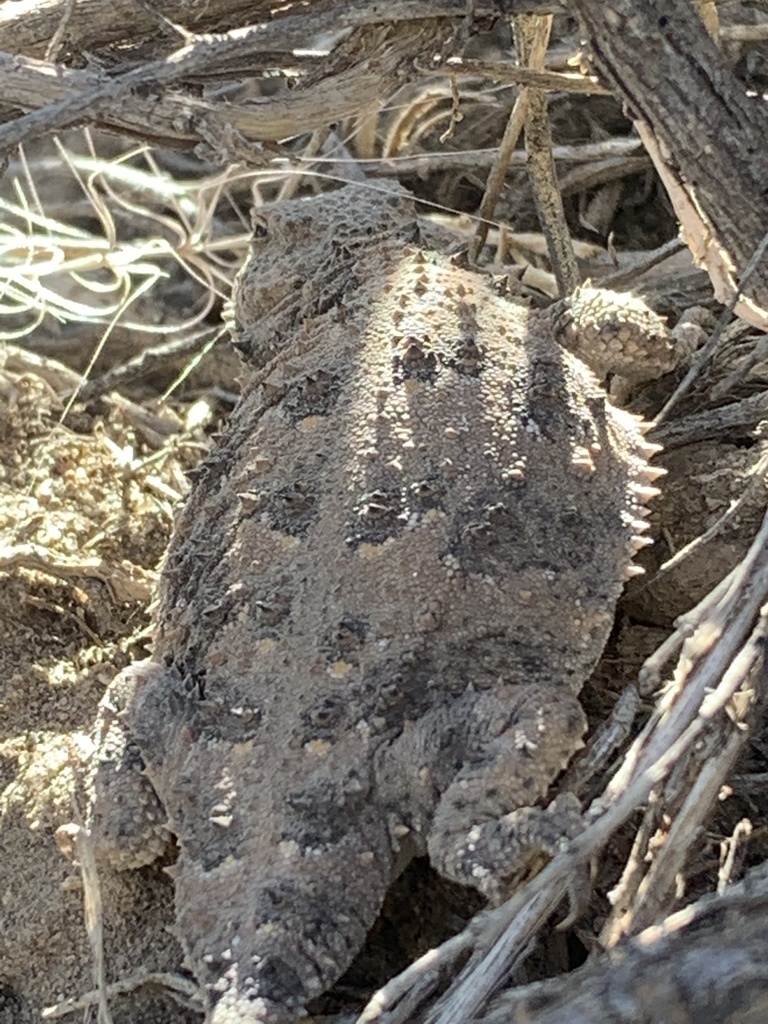
The Pygmy Short-horned Lizard is a small, flattened reptile measuring 45 to 63 mm (1.8 to 2.5 inches) in snout-to-vent length. The species displays a broad, dorsoventrally compressed body with a short tail typically less than half the body length. Coloration varies from gray to brown with darker blotches and bands that provide effective camouflage against rocky substrates. The head features prominent horn-like scales above the eyes, though these are less pronounced than in other horned lizard species. Small, pointed scales cover the dorsal surface, with enlarged scales forming a fringe along the body margins. The ventral surface is lighter, typically cream or pale yellow with scattered dark spots. Historically, Phrynosoma douglasii occurred across much of the western United States, including portions of California. In California, the species was documented from the northeastern regions, including areas of Modoc, Lassen, and Shasta counties. Current distribution in the state appears restricted compared to historical range, with populations potentially limited to scattered localities in the Cascade Range and Modoc Plateau regions. The species reaches elevations from approximately 1,200 to 2,400 meters (4,000 to 8,000 feet). Pygmy Short-horned Lizards inhabit arid and semi-arid environments characterized by sandy or gravelly soils, sagebrush scrub, juniper woodlands, and open pine forests. The species shows preference for areas with sparse vegetation that allows for thermoregulation and provides suitable ant foraging habitat. Rocky outcrops and areas with decomposed granite or volcanic soils are particularly favored. Microhabitat selection often includes locations near ant colonies, which serve as primary food sources. The species exhibits specialized feeding behavior, with ants comprising 90 to 95 percent of the diet. Harvester ants are preferred prey, though other ant species are consumed when available. Foraging typically occurs during morning and late afternoon hours when temperatures are suitable for activity. Pygmy Short-horned Lizards are ovoviviparous, giving birth to live young rather than laying eggs. Mating occurs in spring following emergence from winter dormancy. Gestation lasts approximately three months, with females producing 5 to 12 offspring in late summer. Young measure 18 to 22 mm at birth and reach sexual maturity in their second year. The species demonstrates several anti-predator adaptations, including the ability to inflate the body when threatened and specialized scales that make swallowing difficult for predators. When disturbed, individuals often remain motionless, relying on cryptic coloration for concealment. Some populations can eject blood from the orbital sinuses as a deterrent mechanism, though this behavior varies among individuals and populations. Conservation status information for Pygmy Short-horned Lizards in California remains limited. The species faces potential threats from habitat modification, livestock grazing impacts on ant populations, and climate change effects on suitable habitat zones. Agricultural conversion and urban development may have contributed to range reductions in some areas. Population monitoring and habitat assessment would benefit conservation planning for this specialized insectivore.
Classification
Class: Reptilia · Order: Squamata · Family: Phrynosomatidae
Frequently asked questions
How is Phrynosoma douglasii classified?
Phrynosoma douglasii belongs to class Reptilia, order Squamata, family Phrynosomatidae.
What family does Phrynosoma douglasii belong to?
Phrynosoma douglasii is in the Phrynosomatidae family.
What is Phrynosoma douglasii?
The Pygmy Short-horned Lizard is a small, flattened reptile measuring 45 to 63 mm (1.8 to 2.5 inches) in snout-to-vent length.
Is Phrynosoma douglasii found in California?
Yes. Phrynosoma douglasii is recorded in California in The California Species Project's catalogue.
Related species
Other California species in the same genus, family, or bioregion.
Data from The California Species Project — 14,000+ California species with verified data from CNPS, CDFW, USFWS, and more.