Phyciodes orseis
California Crescent
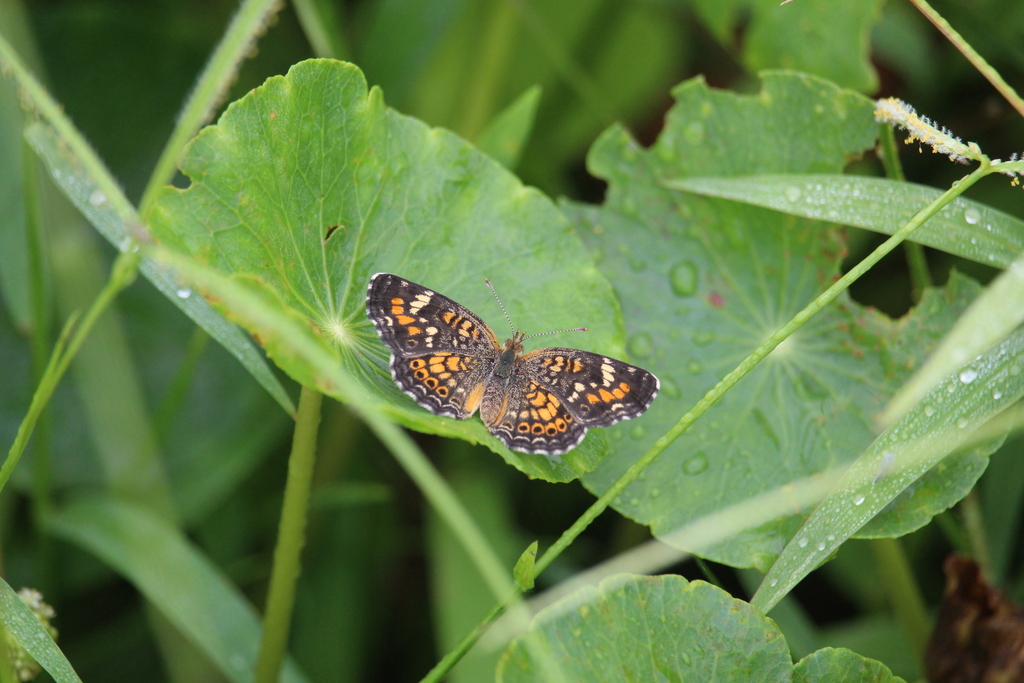
(c) Ricard Busquets Reverte, some rights reserved (CC BY) · licence
Family: Nymphalidae · Class: Insecta · Order: Lepidoptera
Phyciodes orseis (California Crescent) is a California animal in the Nymphalidae family.
The California Crescent (Phyciodes orseis) is a small to medium-sized butterfly in the family Nymphalidae, characterized by its distinctive orange and black checkered wing pattern. Adults have a wingspan ranging from 32 to 44 mm (1.3 to 1.7 inches). The dorsal wing surfaces display a bright orange background with black borders and distinctive black markings forming a reticulated pattern. The hindwings feature a row of black-bordered orange crescents along the outer margin, from which the species derives its common name. The ventral wing surfaces are paler orange with white and black markings, and the hindwings show a characteristic white crescent-shaped band. Males are typically smaller and more brightly colored than females, with more pronounced orange coloration. The California Crescent occurs from southern Oregon south along the Pacific coast to San Francisco, extending through the northern and central Sierra Nevada, and into western Nevada. Within California, the species is documented from the Coast Ranges, Central Valley foothills, and Sierra Nevada at elevations ranging from near sea level to approximately 2,400 meters (7,900 feet). Populations are generally discontinuous throughout this range, with local distributions often closely tied to the availability of suitable host plants. This species inhabits open areas including grasslands, chaparral, oak woodlands, montane meadows, and disturbed habitats such as roadsides and fields. The California Crescent shows a preference for areas with scattered stands of native thistles, particularly in sunny locations with adequate soil moisture. Adults are commonly observed nectaring on various wildflowers including coyote mint, asters, and their host plants. The species tolerates a range of habitat conditions from coastal scrub environments to higher elevation mountain meadows. California Crescents are exclusively dependent on thistles (Cirsium species) in the sunflower family as larval host plants. Females deposit eggs singly on young thistle leaves, typically selecting plants in early growth stages. Larvae feed on thistle foliage, creating distinctive feeding shelters by webbing leaves together. The species produces multiple broods per year in most locations, with flight periods extending from March through October, depending on elevation and local climate conditions. Peak flight activity typically occurs during late spring and summer months. Adults exhibit territorial behavior, with males perching on prominent vegetation to await passing females. The California Crescent is not currently listed under federal or state endangered species acts. Population trends vary regionally, with some areas experiencing declines due to habitat loss and alteration. Primary threats include urban development, agricultural conversion, invasive plant species that displace native thistles, and habitat fragmentation. Fire suppression may negatively impact populations by reducing the disturbed habitats that favor thistle establishment. Climate change poses additional concerns through altered precipitation patterns that affect host plant availability and distribution. Conservation efforts focus on maintaining diverse native plant communities and managing disturbance regimes that support thistle populations in natural and semi-natural habitats.
Classification
Class: Insecta · Order: Lepidoptera · Family: Nymphalidae
Frequently asked questions
How is Phyciodes orseis classified?
Phyciodes orseis belongs to class Insecta, order Lepidoptera, family Nymphalidae.
What family does Phyciodes orseis belong to?
Phyciodes orseis is in the Nymphalidae family.
What is Phyciodes orseis?
The California Crescent (Phyciodes orseis) is a small to medium-sized butterfly in the family Nymphalidae, characterized by its distinctive orange and black checkered wing pattern.
Is Phyciodes orseis found in California?
Yes. Phyciodes orseis is recorded in California in The California Species Project's catalogue.
Related species
Other California species in the same genus, family, or bioregion.
Data from The California Species Project — 14,000+ California species with verified data from CNPS, CDFW, USFWS, and more.