Phyciodes phaon
Phaon Crescent
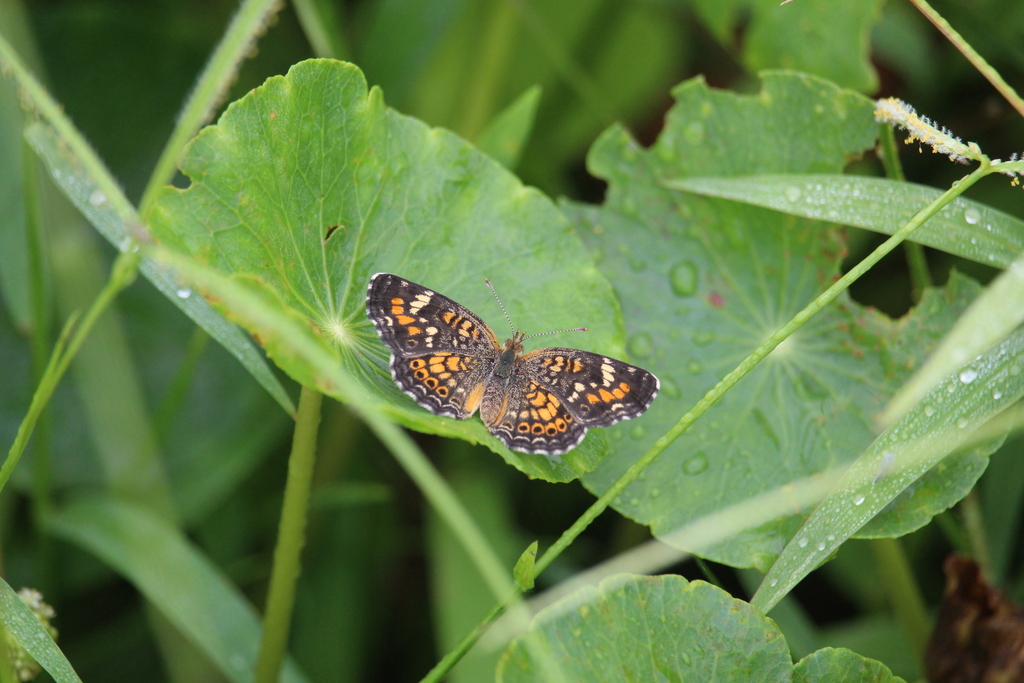
(c) Ricard Busquets Reverte, some rights reserved (CC BY) · licence
Family: Nymphalidae · Class: Insecta · Order: Lepidoptera
Phyciodes phaon (Phaon Crescent) is a California animal in the Nymphalidae family.
The Phaon Crescent is a small butterfly with a wingspan measuring 32 to 44 millimeters (1.3 to 1.7 inches). The dorsal wing surfaces are orange-brown with black markings that form intricate patterns across both forewings and hindwings. Males display brighter orange coloration with more defined black borders along wing margins, while females exhibit duller orange-brown tones with broader black markings. The ventral hindwing surface shows a distinctive cream-colored crescent-shaped mark surrounded by dark scaling, which distinguishes this species from similar crescents. The antennae are black with orange clubs, and the body is dark brown with orange scaling on the thorax. Phyciodes phaon ranges from Guatemala north through Cuba and Mexico to southern California, extending east through South Texas and Florida to coastal South Carolina. The species occasionally strays to eastern Colorado, Nebraska, Kansas, and Missouri. In California, populations are concentrated in the southern regions, particularly in areas where suitable host plants occur. The species maintains year-round breeding populations in frost-free areas of its range, while northern populations may experience seasonal fluctuations. Phaon Crescents inhabit open areas including fields, roadsides, vacant lots, gardens, and disturbed sites where host plants thrive. The species occurs from sea level to approximately 1,500 meters (4,900 feet) in elevation. Adults prefer sunny locations with abundant nectar sources and show particular affinity for areas with low-growing vegetation and exposed soil. Urban and suburban environments often provide suitable habitat, especially in regions with minimal pesticide use. This species is multivoltine, producing multiple generations per year in warmer climates. In California, breeding occurs throughout much of the year, with peak activity during spring and fall months. Females deposit eggs singly on the upper surfaces of host plant leaves, primarily fogfruit (Lippia lanceolata) and mat grass (Lippia nodiflora) in the verbena family. Larvae feed on host plant foliage and undergo five instars before pupating. The chrysalis is typically attached to host plant stems or nearby vegetation. Adults feed on nectar from various flowers including asters, lantana, and other small-flowered plants. Males exhibit territorial behavior, perching on low vegetation and pursuing potential mates or intruders. Phaon Crescent populations are not federally or state-listed for protection, and the species appears stable throughout most of its range. However, local populations may face threats from habitat loss due to urban development and agricultural intensification. The conversion of native plant communities to non-native landscaping can reduce availability of host plants and nectar sources. Pesticide applications in agricultural and urban areas pose additional risks to both larvae and adults. Climate change may affect the species' distribution patterns, potentially expanding northern range limits while impacting southern populations through increased temperatures and altered precipitation patterns.
Classification
Class: Insecta · Order: Lepidoptera · Family: Nymphalidae
Frequently asked questions
How is Phyciodes phaon classified?
Phyciodes phaon belongs to class Insecta, order Lepidoptera, family Nymphalidae.
What family does Phyciodes phaon belong to?
Phyciodes phaon is in the Nymphalidae family.
What is Phyciodes phaon?
The Phaon Crescent is a small butterfly with a wingspan measuring 32 to 44 millimeters (1.3 to 1.7 inches).
Is Phyciodes phaon found in California?
Yes. Phyciodes phaon is recorded in California in The California Species Project's catalogue.
Related species
Other California species in the same genus, family, or bioregion.
Data from The California Species Project — 14,000+ California species with verified data from CNPS, CDFW, USFWS, and more.