Phyciodes tharos
Pearl Crescent
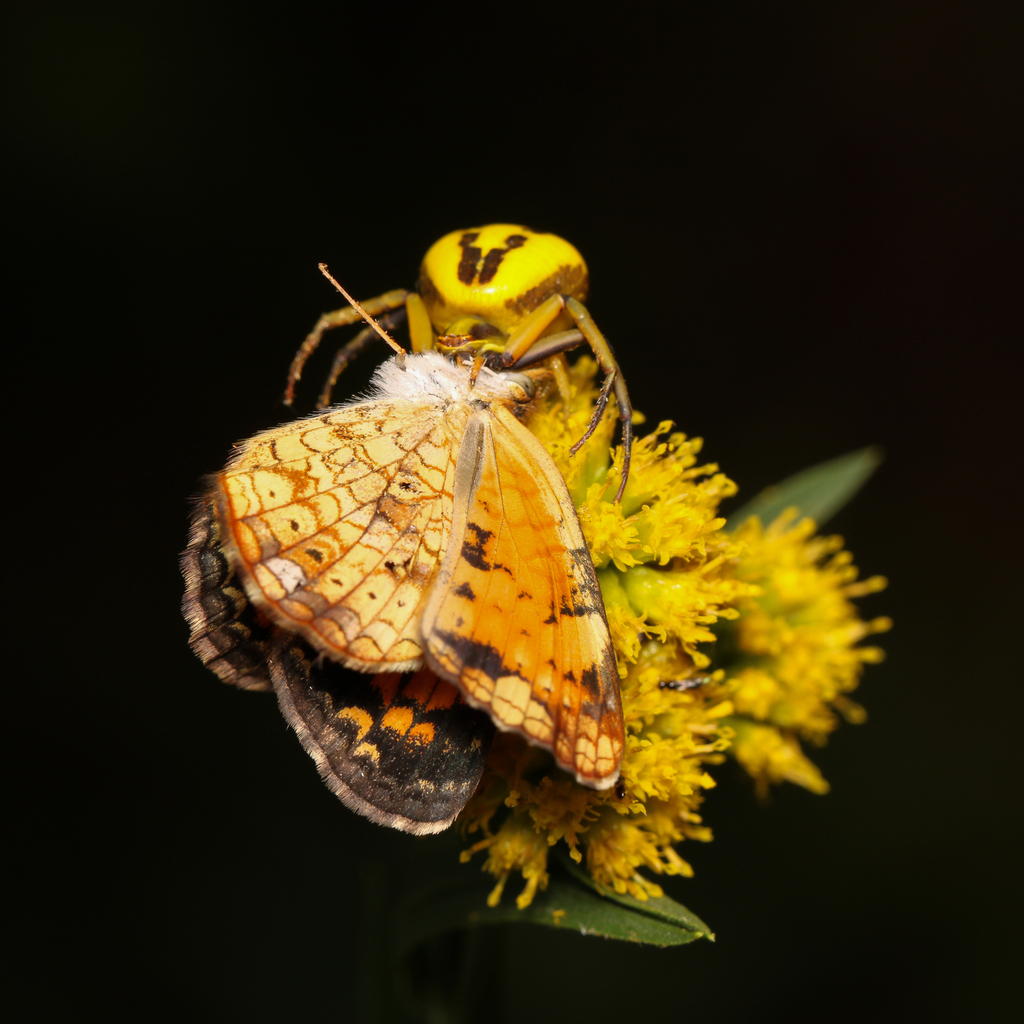
(c) Adrienne van den Beemt, some rights reserved (CC BY) · licence
Family: Nymphalidae · Class: Insecta · Order: Lepidoptera
Phyciodes tharos (Pearl Crescent) is a California animal in the Nymphalidae family.
The Pearl Crescent is a small butterfly with a wingspan ranging from 32 to 44 mm (1.3 to 1.7 inches). Males display bright orange dorsal wing surfaces with black borders and distinctive black markings, including a black patch along the forewing leading edge. The hindwings feature a row of black crescents near the outer margin. Females are similar but typically larger and more heavily marked with black. The underside of the hindwings is pale orange to yellow with a distinctive white crescent-shaped marking that gives the species its common name. This white pearl-like crescent is bordered by dark lines and serves as the most reliable field identification feature. The Pearl Crescent has an extensive range across North America, occurring from southeastern Alberta south through Montana, Wyoming, Colorado, New Mexico, Arizona, and southeastern California to Mexico, and east to southern Ontario throughout all eastern United States. In California, populations are primarily restricted to the southeastern desert regions, representing the western edge of the species' continental distribution. This species inhabits open areas including meadows, fields, roadsides, desert washes, and disturbed habitats where host plants are present. Pearl Crescents prefer sunny locations with low vegetation and are commonly found in areas with patchy sunlight and shelter. The species occurs from sea level to elevations exceeding 2,400 meters (8,000 feet) in mountainous regions. Adults are frequently observed basking on bare ground, rocks, or low vegetation during warm periods. Pearl Crescents are multivoltine, producing two to three broods annually depending on latitude and local climate conditions. In warmer regions, breeding may continue from spring through fall. Males are territorial and engage in patrolling behavior, flying low over open areas to locate females. Mating typically occurs during midday hours when temperatures are optimal. Females deposit eggs singly on the upper surface of host plant leaves. The species utilizes several species of smooth-leaved true asters including Aster pilosus, A. texanus, and A. laevis as larval host plants. Larvae are dark-colored with branched spines and feed primarily on young aster leaves. Adults feed on nectar from various flowers including dogbane, milkweeds, and white clover. The Pearl Crescent is not federally or state listed and appears to maintain stable populations across most of its range. The species benefits from human-modified landscapes that create open habitats suitable for both the butterfly and its aster host plants. However, populations may be locally affected by habitat loss, pesticide use, and changes in land management practices that eliminate host plants or reduce suitable habitat. Climate change may potentially shift the species' range northward and to higher elevations over time.
Classification
Class: Insecta · Order: Lepidoptera · Family: Nymphalidae
Frequently asked questions
How is Phyciodes tharos classified?
Phyciodes tharos belongs to class Insecta, order Lepidoptera, family Nymphalidae.
What family does Phyciodes tharos belong to?
Phyciodes tharos is in the Nymphalidae family.
What is Phyciodes tharos?
The Pearl Crescent is a small butterfly with a wingspan ranging from 32 to 44 mm (1.3 to 1.7 inches).
Is Phyciodes tharos found in California?
Yes. Phyciodes tharos is recorded in California in The California Species Project's catalogue.
Related species
Other California species in the same genus, family, or bioregion.
Data from The California Species Project — 14,000+ California species with verified data from CNPS, CDFW, USFWS, and more.