Phyllocnistis citrella
Citrus Leafminer
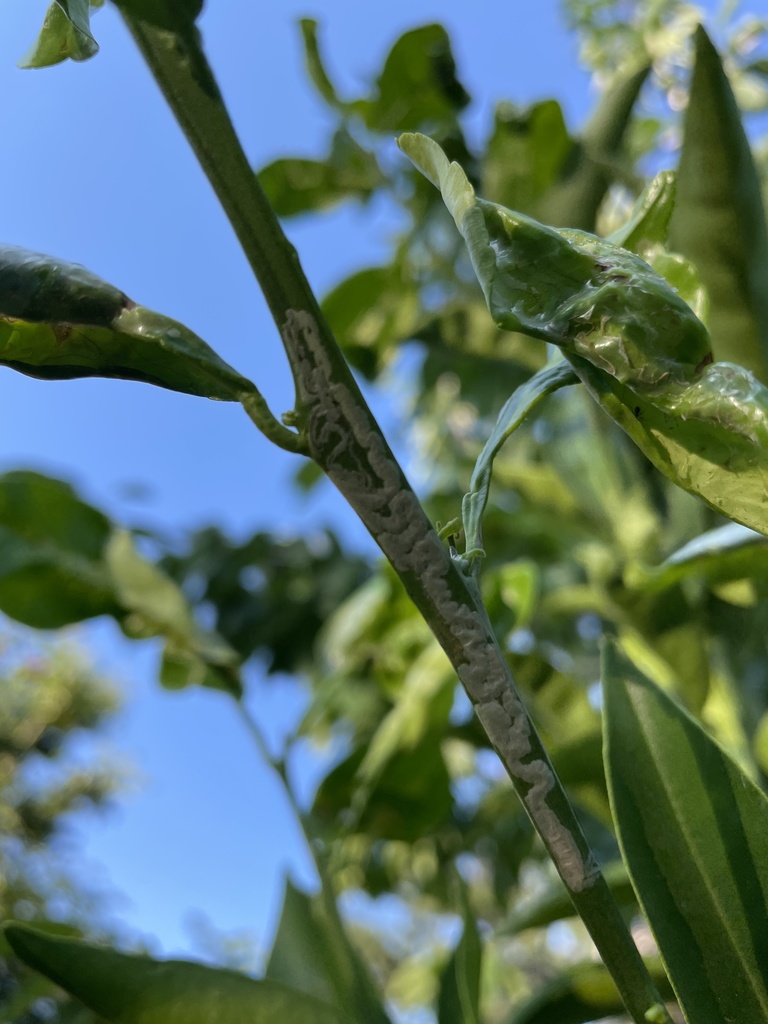
no rights reserved · CC0
Family: Gracillariidae · Class: Insecta · Order: Lepidoptera
Phyllocnistis citrella (Citrus Leafminer) is a California animal in the Gracillariidae family.
The citrus leafminer (Phyllocnistis citrella) is a small moth in the family Gracillariidae with forewings measuring approximately 4 mm in length. Adults display silvery-white forewings marked with distinctive golden-yellow and dark brown scaling patterns. The hindwings are narrow and fringed, typical of microlepidoptera. At rest, the moth assumes a characteristic head-down posture with its body held at an angle to the substrate. This species is native to Asia, Oceania, and Africa, but has become established in Florida and other warm regions globally (Moth Photographers Group). In North America, verified populations occur primarily in Florida, where the species was first detected in the 1990s. The moth's distribution closely follows the cultivation of citrus crops and ornamental plants in subtropical and tropical zones. Citrus leafminer inhabits areas with suitable host plants from multiple plant families. According to the Moth Photographers Group, documented host families include Rutaceae (citrus family), Oleaceae (olive family), Lauraceae (laurel family), Fabaceae (legume family), and Santalaceae. Primary host genera include Citrus, Fortunella, Murraya, Jasminum, Cinnamomum, and Dalbergia. The species shows particular affinity for citrus cultivation areas, nurseries, and landscapes containing ornamental plants from these families. Larvae are leaf miners, creating distinctive serpentine tunnels within leaf tissue as they feed (Klem & Zaspel 2019). The mining activity typically begins near the leaf margin and creates winding galleries that increase in width as the larva grows. Pupation occurs within the leaf mine or in a small pupal chamber at the mine's terminus. Adults are active year-round in suitable climates, with multiple overlapping generations occurring annually. Flight activity peaks during warm months, with adults attracted to artificial lights at night. The species exhibits rapid reproductive potential, with females depositing eggs singly on young, tender leaves of host plants. Development from egg to adult requires approximately 2-4 weeks depending on temperature, enabling multiple generations per year in favorable conditions. Adults are weak fliers but can disperse locally between suitable host plants. Citrus leafminer is not listed under federal or state endangered species legislation, as it is considered an introduced agricultural pest rather than a conservation concern. The species' establishment in North America represents a successful biological invasion facilitated by global trade and suitable climate conditions. In citrus-producing regions, the moth is managed as an economic pest due to its potential impact on fruit quality and tree health, particularly affecting young trees and nursery stock. Integrated pest management programs in affected areas focus on monitoring adult populations and implementing targeted control measures during peak activity periods.
Classification
Class: Insecta · Order: Lepidoptera · Family: Gracillariidae
Frequently asked questions
How is Phyllocnistis citrella classified?
Phyllocnistis citrella belongs to class Insecta, order Lepidoptera, family Gracillariidae.
What family does Phyllocnistis citrella belong to?
Phyllocnistis citrella is in the Gracillariidae family.
What is Phyllocnistis citrella?
The citrus leafminer (Phyllocnistis citrella) is a small moth in the family Gracillariidae with forewings measuring approximately 4 mm in length.
Is Phyllocnistis citrella found in California?
Yes. Phyllocnistis citrella is recorded in California in The California Species Project's catalogue.
Related species
Other California species in the same genus, family, or bioregion.
Data from The California Species Project — 14,000+ California species with verified data from CNPS, CDFW, USFWS, and more.