Phyllodesma americana
American Lappet Moth
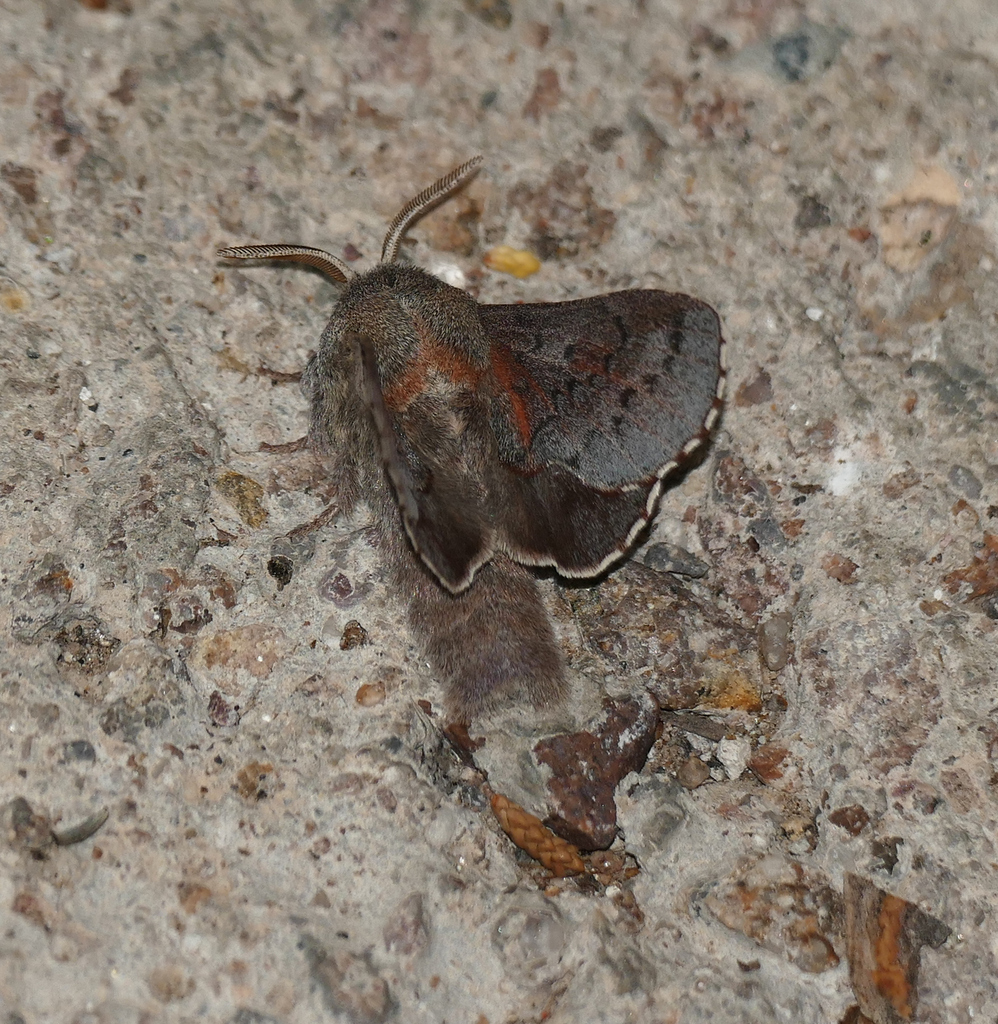
(c) Wendy McCrady, some rights reserved (CC BY) · licence
Family: Lasiocampidae · Class: Insecta · Order: Lepidoptera
Phyllodesma americana (American Lappet Moth) is a California animal in the Lasiocampidae family.
The American Lappet Moth is a medium-sized moth belonging to the family Lasiocampidae. Adults typically measure 25 to 40 mm (1.0 to 1.6 inches) in wingspan. The forewings are brown to grayish-brown with irregular darker markings and a characteristic deep notch at the anal angle. When resting on dead leaves, the moth's coloration provides effective camouflage (BugGuide). The hindwings are lighter brown with subtle banding patterns. Phyllodesma americana has an extensive range across North America, occurring from Nova Scotia to Georgia, extending west through Texas to California, and north to British Columbia and Yukon (BugGuide). This transcontinental distribution makes it one of the most widely distributed lappet moths in North America. The species occurs throughout California, from coastal regions to mountainous areas. The species inhabits diverse woodland and forest environments where its host plants are present. Adults are associated with areas containing alder (Alnus), birch (Betula), oak (Quercus), poplar (Populus), and willow (Salix) trees. In western regions, caterpillars also feed on snowbrush (Ceanothus velutinus) and chinquapin (Chrysolepis chrysophylla) (BugGuide). The moth adapts to various elevations and can be found in both deciduous and mixed forests. The American Lappet Moth exhibits regional variation in its life cycle timing. Flight season extends from March to September in southern populations with two broods annually, while northern populations typically have one brood with adults active from April to August in Ohio and May to July in eastern Ontario (BugGuide). Larvae are present from June to August across most of the range. The caterpillars are distinctively hairy with prominent lateral lobes called "lappets" that give the species its common name. The larval body displays blue, black, gray, white, and orange coloration on the dorsal surface. A diagnostic feature is the unpaired hump on the eighth abdominal segment. When disturbed or stretched, larvae expose a bright orange warning band across the second and third thoracic segments (BugGuide). Caterpillars feed on the leaves of their host trees, typically consuming foliage from multiple plant families. The larvae construct loose cocoons among leaf litter or in bark crevices for pupation. Adults are nocturnal and are attracted to artificial lights during their active season. The American Lappet Moth is not federally or state listed and appears to maintain stable populations across its range as of December 2025. The species' broad host plant range and extensive distribution suggest resilience to environmental changes. However, like many forest-dependent species, populations may be locally affected by habitat loss, deforestation, and forest management practices. The moth's ability to utilize multiple host plant families across diverse ecosystems contributes to its conservation stability. No specific conservation measures are currently implemented for this species, though general forest conservation efforts benefit its populations.
Classification
Class: Insecta · Order: Lepidoptera · Family: Lasiocampidae
Frequently asked questions
How is Phyllodesma americana classified?
Phyllodesma americana belongs to class Insecta, order Lepidoptera, family Lasiocampidae.
What family does Phyllodesma americana belong to?
Phyllodesma americana is in the Lasiocampidae family.
What is Phyllodesma americana?
The American Lappet Moth is a medium-sized moth belonging to the family Lasiocampidae.
Is Phyllodesma americana found in California?
Yes. Phyllodesma americana is recorded in California in The California Species Project's catalogue.
Related species
Other California species in the same genus, family, or bioregion.
Data from The California Species Project — 14,000+ California species with verified data from CNPS, CDFW, USFWS, and more.