Phylloscopus borealis
Arctic Warbler
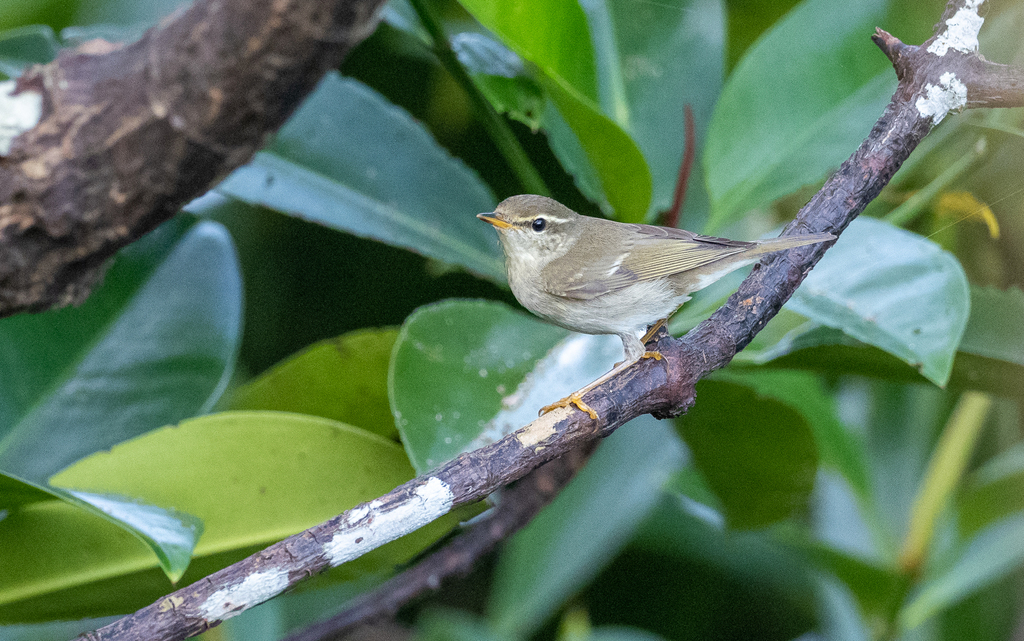
(c) Forest Botial-Jarvis, some rights reserved (CC BY) · licence
Family: Phylloscopidae · Class: Aves · Order: Passeriformes
Phylloscopus borealis (Arctic Warbler) is a California animal in the Phylloscopidae family.
The Arctic Warbler is a small, olive-toned songbird that occurs as a rare vagrant in California. Adults measure 11 to 13 cm (4.3 to 5.1 inches) in length with a wingspan of 19 to 21 cm (7.5 to 8.3 inches) and weigh 8 to 13 grams. The species displays olive-green to olive-brown upperparts with a distinctive pale yellowish or whitish supercilium extending from the bill to behind the eye. Underparts are whitish to pale yellow, often with a faint olive wash on the breast and flanks. The bill is dark with an orange-yellow base to the lower mandible, and the legs are pale brown to orange-brown. A single pale wing bar is visible on the median coverts, distinguishing it from similar Phylloscopus warblers. The Arctic Warbler breeds across the boreal forests of northern Eurasia, from Scandinavia east to Alaska and the Russian Far East. In North America, breeding populations are restricted to western and northern Alaska, primarily in willow and birch thickets along rivers and in mountain valleys. The species winters in Southeast Asia, from southern China and Myanmar south to Indonesia and the Philippines. California records represent vagrant individuals that have strayed from their normal migration route, typically occurring along the coast during fall migration from late August through October. Breeding habitat consists of dense deciduous and mixed forests, particularly areas dominated by birch, willow, and alder. The species favors forest edges, clearings, and riparian zones with thick understory vegetation. During migration and winter, Arctic Warblers utilize a broader range of wooded habitats, including parks, gardens, and scrublands. Vagrant birds in California are most often detected in coastal migrant traps, including islands and headlands with dense vegetation. Arctic Warblers are highly active foragers, gleaning insects and spiders from foliage and occasionally catching prey in short aerial sallies. Their diet consists primarily of small arthropods, including aphids, caterpillars, flies, and beetles, supplemented by small berries during migration and winter. Breeding occurs from late May through July, with females constructing dome-shaped nests on or near the ground in dense vegetation. Clutches typically contain 5 to 7 white eggs with fine reddish-brown spots. The species is strongly migratory, with North American populations traveling approximately 8,000 km to reach wintering grounds. The Arctic Warbler is not federally listed in the United States and has no special conservation status in California, where it occurs only as a vagrant. The global population is considered stable, though some regional declines have been documented in parts of the breeding range. In Alaska, the species remains locally common in suitable habitat. Climate change may affect northern breeding habitats and could potentially alter migration patterns, though the species' broad global range provides some resilience to environmental changes.
Classification
Class: Aves · Order: Passeriformes · Family: Phylloscopidae
Frequently asked questions
How is Phylloscopus borealis classified?
Phylloscopus borealis belongs to class Aves, order Passeriformes, family Phylloscopidae.
What family does Phylloscopus borealis belong to?
Phylloscopus borealis is in the Phylloscopidae family.
What is Phylloscopus borealis?
The Arctic Warbler is a small, olive-toned songbird that occurs as a rare vagrant in California.
Is Phylloscopus borealis found in California?
Yes. Phylloscopus borealis is recorded in California in The California Species Project's catalogue.
Related species
Other California species in the same genus, family, or bioregion.
Data from The California Species Project — 14,000+ California species with verified data from CNPS, CDFW, USFWS, and more.