Physalia utriculus
Indo-Pacific Man-O-War
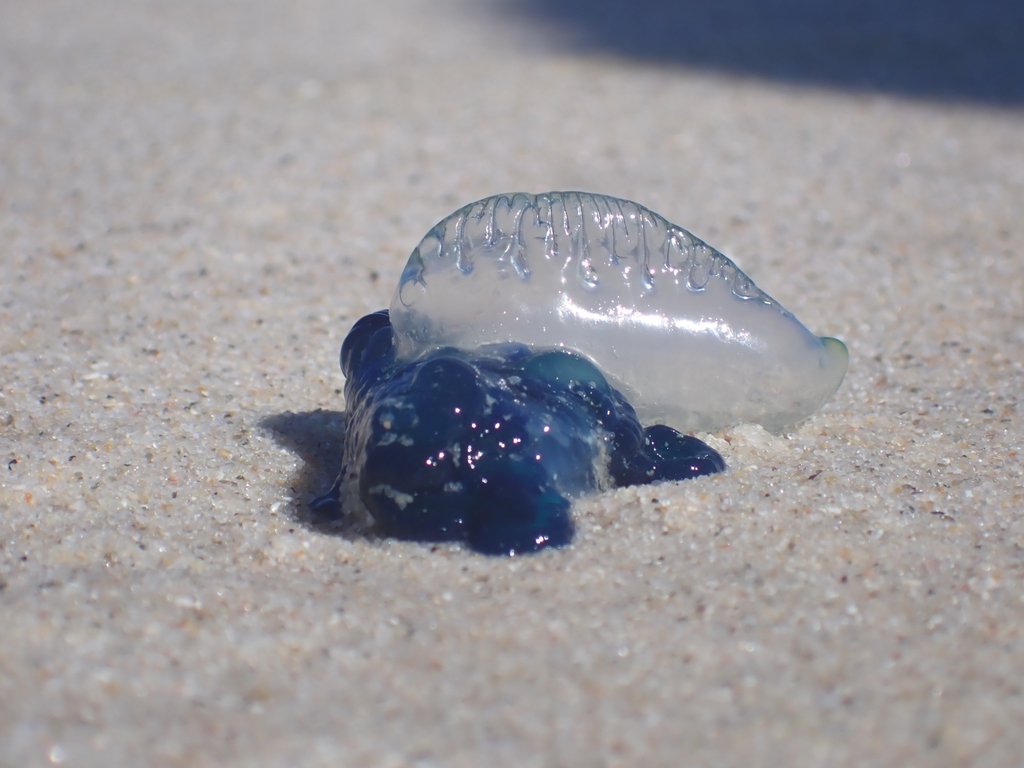
(c) Muhammad Uzair Davids, some rights reserved (CC BY) · licence
Family: Physaliidae · Class: Hydrozoa · Order: Siphonophorae
Physalia utriculus (Indo-Pacific Man-O-War) is a California animal in the Physaliidae family.
Physalia utriculus, commonly known as the Indo-Pacific Man-O-War or bluebottle, is a colonial siphonophore belonging to the order Siphonophora within the class Hydrozoa. Despite its jellyfish-like appearance, this organism is actually a complex colony of specialized polyps called zooids that function as a single unit. The most distinctive feature is the gas-filled bladder or pneumatophore, which appears as a translucent blue to purple balloon-like float measuring 3-15 cm in length. This bladder sits above the water surface and acts as a sail, allowing the organism to drift with ocean currents and winds. The Indo-Pacific Man-O-War is distributed throughout tropical and subtropical waters of the Indo-Pacific region, including the Indian Ocean and western Pacific Ocean (NatureMapr). The species has been documented in Australian waters, particularly along the eastern coastline including Tasmania, where it appears as a regular visitor especially to the east coast (Derwent Estuary Program). Unlike its Atlantic relative Physalia physalis, P. utriculus has a more restricted geographic range primarily within Indo-Pacific waters. This pelagic species inhabits open ocean waters and is commonly found in warmer coastal areas. The bluebottle is a passive drifter, unable to swim against currents, and relies entirely on wind and surface currents for movement. During certain weather conditions and seasonal patterns, large numbers may wash ashore on beaches, particularly following onshore winds. The species prefers surface waters where the pneumatophore can remain exposed to air while the colony's feeding and reproductive structures trail below in the water column. The Indo-Pacific Man-O-War is a carnivorous predator that captures prey using long, trailing tentacles armed with specialized stinging cells called nematocysts. These tentacles, which can extend several meters below the float, paralyze small fish, crustaceans, and other marine organisms. The colony is composed of four main types of zooids: the pneumatophore for flotation, gastrozooids for digestion, gonozooids for reproduction, and dactylozooids for defense and prey capture. Reproduction occurs through the release of gametes into the water column, where fertilization takes place externally. The conservation status of Physalia utriculus has not been formally evaluated by the International Union for Conservation of Nature (IUCN), and no federal or state listing status exists (Ocean Education & Conservation). As a widely distributed pelagic species with high reproductive potential, the Indo-Pacific Man-O-War does not currently face significant conservation threats. However, like many marine organisms, it may be affected by ocean acidification, pollution, and climate change impacts on ocean currents and temperature patterns. The species serves an important ecological role as both predator and prey in marine food webs, and its presence often indicates healthy pelagic ecosystems.
Classification
Class: Hydrozoa · Order: Siphonophorae · Family: Physaliidae
Frequently asked questions
How is Physalia utriculus classified?
Physalia utriculus belongs to class Hydrozoa, order Siphonophorae, family Physaliidae.
What family does Physalia utriculus belong to?
Physalia utriculus is in the Physaliidae family.
What is Physalia utriculus?
Physalia utriculus, commonly known as the Indo-Pacific Man-O-War or bluebottle, is a colonial siphonophore belonging to the order Siphonophora within the class Hydrozoa.
Is Physalia utriculus found in California?
Yes. Physalia utriculus is recorded in California in The California Species Project's catalogue.
More California species
This species has no close relatives in our California data — here are other species to explore.
Data from The California Species Project — 14,000+ California species with verified data from CNPS, CDFW, USFWS, and more.