Physeter macrocephalus
Sperm whale
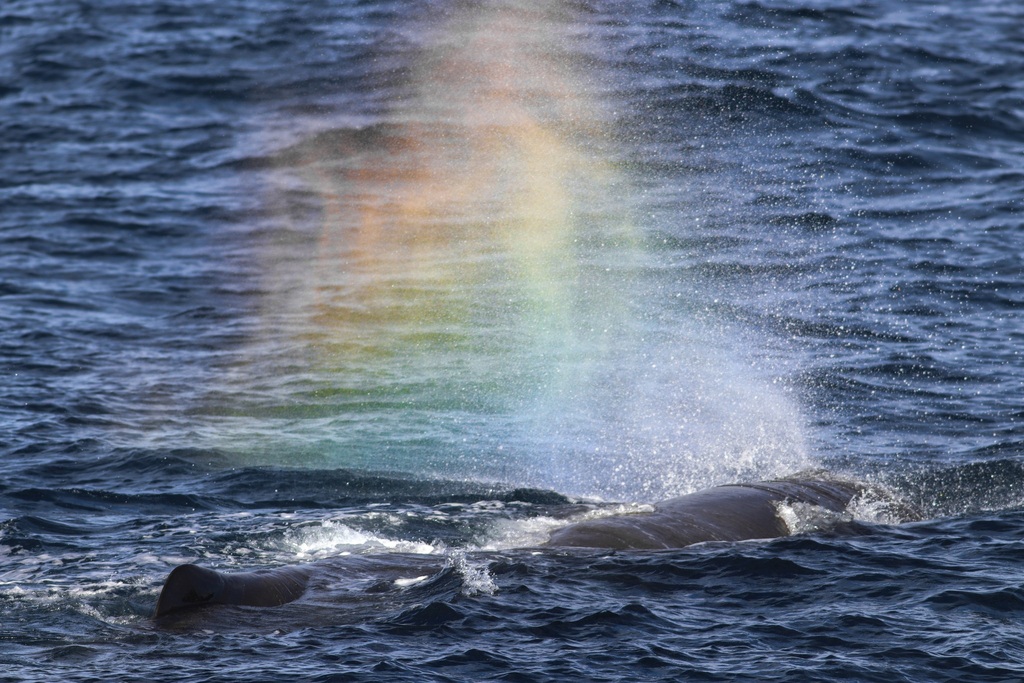
(c) Vsevolod Rudyi, some rights reserved (CC BY) · licence
Family: Physeteridae · Class: Mammalia · Order: Cetacea
Conservation status: Endangered
Physeter macrocephalus (Sperm whale) is a California animal in the Physeteridae family.
The sperm whale is the largest toothed whale species and the largest toothed predator on Earth. Adult males reach lengths of 15 to 18 meters (49 to 59 feet) and weights of 35 to 45 metric tons, while females are smaller, measuring 11 to 13 meters (36 to 43 feet) and weighing 15 to 20 metric tons. The species is distinguished by its massive, square-shaped head that comprises up to one-third of its total body length, housing the largest brain of any animal. The blowhole is positioned on the left front of the head, creating a distinctive forward-angled spout. The body is dark gray to brownish, with lighter coloration on the lower jaw and belly. Males possess 18 to 26 large, conical teeth in each side of the lower jaw that fit into sockets in the upper jaw. Sperm whales have a cosmopolitan distribution, occurring in all oceans from the equator to the edges of polar ice. In California waters, they are found year-round along the continental shelf and slope, particularly in deep waters beyond the 200-meter depth contour. The species ranges from Baja California to Alaska along the Pacific Coast, with concentrations off Point Reyes, Monterey Bay, and the Channel Islands. Historical whaling records indicate sperm whales were once abundant throughout California waters before commercial exploitation. The species inhabits deep oceanic waters, typically at depths exceeding 200 meters where they can access their primary prey. Sperm whales are capable of diving to extreme depths, regularly reaching 400 to 1,000 meters and capable of descending beyond 2,000 meters. These dives can last 30 to 90 minutes, with the deepest recorded dive reaching 2,250 meters. They prefer areas with steep underwater topography and upwelling zones that support high concentrations of cephalopods. Sperm whales are specialized predators that feed primarily on deep-sea squid, including giant and colossal squid species. Their diet also includes deep-sea fish, octopi, and occasionally bottom-dwelling rays. Females and juveniles live in social groups of 15 to 20 individuals, while mature males are largely solitary except during breeding. Gestation lasts 14 to 16 months, with females giving birth to a single calf every three to six years. Calves nurse for two to three years and remain with their mothers for several more years. The sperm whale is listed as endangered under the Endangered Species Act, originally listed in 1970. According to the National Marine Fisheries Service, the global population is estimated at approximately 200,000 to 300,000 individuals as of 2024. Primary threats include vessel strikes, entanglement in fishing gear, ocean noise pollution, and chemical contaminants. Climate change affects prey distribution and ocean chemistry. The species was heavily exploited during commercial whaling operations from the 1700s through the 1980s, with populations reduced to a fraction of historical levels. Recovery efforts focus on reducing anthropogenic threats and monitoring population trends through acoustic surveys.
Classification
Class: Mammalia · Order: Cetacea · Family: Physeteridae
Conservation status
Endangered
Frequently asked questions
How is Physeter macrocephalus classified?
Physeter macrocephalus belongs to class Mammalia, order Cetacea, family Physeteridae.
What family does Physeter macrocephalus belong to?
Physeter macrocephalus is in the Physeteridae family.
Is Physeter macrocephalus protected or of conservation concern?
Physeter macrocephalus carries the following status: Endangered.
What is Physeter macrocephalus?
The sperm whale is the largest toothed whale species and the largest toothed predator on Earth.
Is Physeter macrocephalus found in California?
Yes. Physeter macrocephalus is recorded in California in The California Species Project's catalogue.
More California species
This species has no close relatives in our California data — here are other species to explore.
Data from The California Species Project — 14,000+ California species with verified data from CNPS, CDFW, USFWS, and more.