Pica hudsonia
Black-billed Magpie
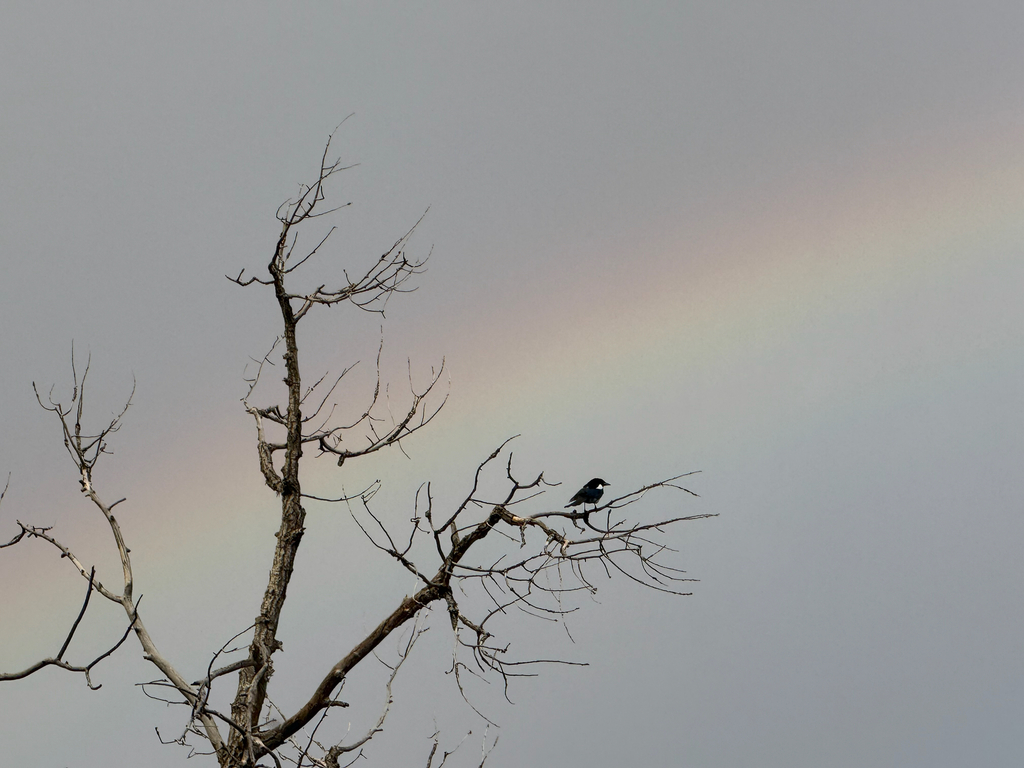
(c) Jared Lincenberg, some rights reserved (CC BY) · licence
Family: Corvidae · Class: Aves · Order: Passeriformes
Pica hudsonia (Black-billed Magpie) is a California animal in the Corvidae family.
The Black-billed Magpie is a large, distinctive corvid measuring 45 to 60 cm (18 to 24 inches) in length, with an exceptionally long, graduated tail comprising roughly half of the bird's total length. Adults weigh between 145 to 210 grams (5.1 to 7.4 ounces). The species exhibits striking black and white plumage with iridescent blue-green sheens on the wings, tail, and back that become visible in direct sunlight. The head, breast, back, and tail are black, while the belly, flanks, and primary wing feathers are white. A distinctive white shoulder patch is visible during flight. The bill is straight, pointed, and entirely black, distinguishing it from the Yellow-billed Magpie found elsewhere in California. In California, Black-billed Magpies occur primarily in the northeastern counties, including portions of Modoc, Lassen, and Siskiyou counties. Their range extends from sea level to elevations of approximately 2,500 meters (8,200 feet) in mountainous areas. The species has a broader North American distribution, ranging from Alaska and western Canada south through the western United States to New Mexico and east to the Great Plains. Black-billed Magpies inhabit open woodlands, riparian areas, rangelands, and agricultural landscapes. They prefer areas with scattered trees or tall shrubs for nesting, combined with open ground for foraging. The species commonly occupies sagebrush steppe, aspen groves, cottonwood bottomlands, and areas near human habitation including farmlands and suburban edges. They avoid dense forests and completely treeless areas. These corvids are omnivorous opportunists with a varied diet including insects, small mammals, bird eggs and nestlings, carrion, fruits, and seeds. They are known to follow large mammals to feed on insects disturbed by grazing and will scavenge at carcasses. Black-billed Magpies are highly social, often forming flocks of 6 to 12 individuals outside the breeding season. Breeding occurs from March through July, with pairs constructing large, dome-shaped nests in trees or tall shrubs. Nests are built with sticks and mud, lined with fine materials, and feature a side entrance. Females lay 6 to 7 greenish eggs with brown markings, which are incubated for 16 to 21 days. Young fledge after 25 to 29 days but may remain with parents for several weeks. The Black-billed Magpie is not federally listed and maintains stable populations across most of its range. However, the species has experienced some regional declines due to habitat loss from agricultural intensification and urban development. In California, populations appear stable but localized. The species demonstrates adaptability to human-modified landscapes, though it remains sensitive to complete habitat conversion. Climate change may affect future distribution patterns, particularly at higher elevations where suitable habitat could shift upward.
Classification
Class: Aves · Order: Passeriformes · Family: Corvidae
Frequently asked questions
How is Pica hudsonia classified?
Pica hudsonia belongs to class Aves, order Passeriformes, family Corvidae.
What family does Pica hudsonia belong to?
Pica hudsonia is in the Corvidae family.
What is Pica hudsonia?
The Black-billed Magpie is a large, distinctive corvid measuring 45 to 60 cm (18 to 24 inches) in length, with an exceptionally long, graduated tail comprising roughly half of the bird's total length.
Is Pica hudsonia found in California?
Yes. Pica hudsonia is recorded in California in The California Species Project's catalogue.
Related species
Other California species in the same genus, family, or bioregion.
Data from The California Species Project — 14,000+ California species with verified data from CNPS, CDFW, USFWS, and more.