Pica nuttalli
Yellow-billed Magpie
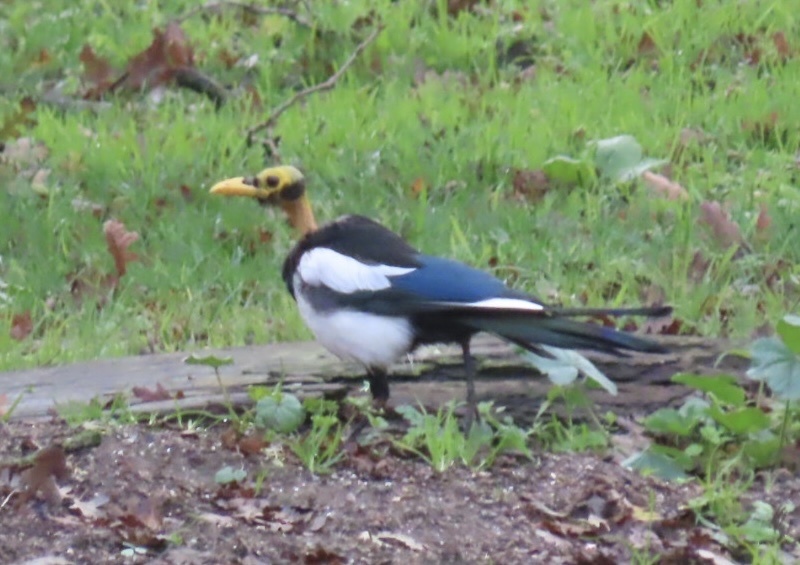
(c) tlaloc27, some rights reserved (CC BY) · licence
Family: Corvidae · Class: Aves · Order: Passeriformes
Conservation status: G3G4 S3S4
Pica nuttalli (Yellow-billed Magpie) is a California animal in the Corvidae family.
The Yellow-billed Magpie is a medium-sized corvid endemic to California's Central Valley and surrounding foothills. Adults measure 406 to 457 mm (16 to 18 inches) in length with a wingspan of approximately 610 mm (24 inches). The species weighs between 140 to 210 grams (4.9 to 7.4 ounces). Distinguished from the Black-billed Magpie by its bright yellow bill and bare yellow skin patch behind the eye, the Yellow-billed Magpie displays iridescent black plumage on the head, breast, back, and wings, with white shoulders, belly, and flanks. The long, graduated tail shows a green-blue iridescence and comprises nearly half the bird's total length. The Yellow-billed Magpie occurs exclusively in California's Great Central Valley and adjacent oak woodlands of the Coast Ranges and Sierra Nevada foothills. The range extends from Shasta County south to Kern County, with the core population concentrated in the Sacramento and San Joaquin valleys. Historically, the species ranged more extensively throughout suitable habitat but has experienced significant range contraction due to habitat loss and fragmentation. Yellow-billed Magpies inhabit oak savannas, riparian woodlands, agricultural areas with scattered trees, and open parklands from sea level to approximately 610 meters (2,000 feet) elevation. The species requires a combination of open foraging areas and suitable nesting trees, particularly preferring valley oak (Quercus lobata) and blue oak (Q. douglasii) woodlands. They avoid dense forests and treeless areas, showing strong preference for landscapes with 10 to 50 percent tree cover. These highly social corvids live in year-round flocks of 6 to 30 individuals, with larger congregations forming during winter months. Yellow-billed Magpies are omnivorous, foraging on the ground for insects, small vertebrates, carrion, fruits, and seeds. They cache food items for later consumption and demonstrate tool use when extracting insects from bark crevices. Breeding occurs from March through July, with pairs constructing large, domed stick nests lined with mud and fine materials. Females lay 3 to 9 eggs, which are incubated for 16 to 18 days. Young fledge after 25 to 30 days but remain dependent on parents for several weeks. The Yellow-billed Magpie is not federally listed but carries a G3G4 S3S4 conservation ranking, indicating the species is vulnerable to extirpation. According to the North American Bird Conservation Initiative, populations declined by approximately 60 percent between 1966 and 2019. The 2020 Christmas Bird Count documented the species' lowest numbers since monitoring began. Primary threats include habitat conversion for agriculture and urban development, West Nile Virus mortality events, and climate change impacts on oak woodland ecosystems. The 2018 West Nile Virus outbreak caused significant population declines in several core areas. Conservation efforts focus on protecting and restoring oak woodland habitat through partnerships with private landowners and land trusts.
Classification
Class: Aves · Order: Passeriformes · Family: Corvidae
Conservation status
G3G4 S3S4
Frequently asked questions
How is Pica nuttalli classified?
Pica nuttalli belongs to class Aves, order Passeriformes, family Corvidae.
What family does Pica nuttalli belong to?
Pica nuttalli is in the Corvidae family.
Is Pica nuttalli protected or of conservation concern?
Pica nuttalli carries the following status: G3G4 S3S4.
What is Pica nuttalli?
The Yellow-billed Magpie is a medium-sized corvid endemic to California's Central Valley and surrounding foothills.
Is Pica nuttalli found in California?
Yes. Pica nuttalli is recorded in California in The California Species Project's catalogue.
Related species
Other California species in the same genus, family, or bioregion.
Data from The California Species Project — 14,000+ California species with verified data from CNPS, CDFW, USFWS, and more.